📖 Estimated Reading Time Calculator
Enter word count and reading speed to instantly calculate how long it will take to read any text.
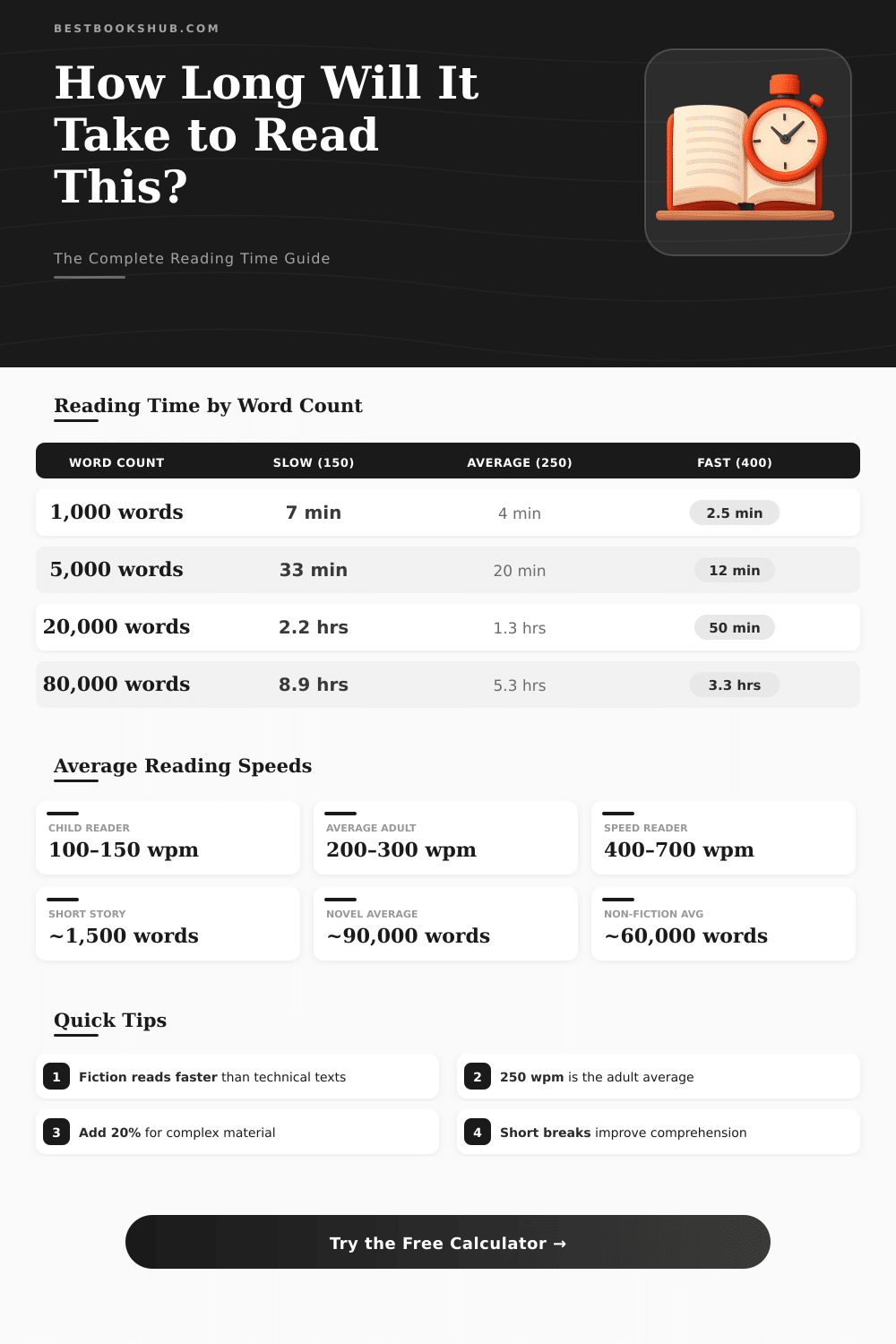
| Word Count | Slow (150 wpm) | Average (250 wpm) | Fast (400 wpm) | Speed (600 wpm) |
|---|---|---|---|---|
| 500 words | 3 min 20 sec | 2 min | 1 min 15 sec | 50 sec |
| 1,000 words | 6 min 40 sec | 4 min | 2 min 30 sec | 1 min 40 sec |
| 5,000 words | 33 min 20 sec | 20 min | 12 min 30 sec | 8 min 20 sec |
| 10,000 words | 1 hr 6 min | 40 min | 25 min | 16 min 40 sec |
| 40,000 words | 4 hr 26 min | 2 hr 40 min | 1 hr 40 min | 1 hr 6 min |
| 80,000 words | 8 hr 53 min | 5 hr 20 min | 3 hr 20 min | 2 hr 13 min |
| 100,000 words | 11 hr 6 min | 6 hr 40 min | 4 hr 10 min | 2 hr 46 min |
| Text Type | Typical Word Count | Est. Pages | Avg Read Time (250 wpm) |
|---|---|---|---|
| Tweet / Social Post | 20–280 words | — | Under 1 min |
| Blog Post | 500–2,000 words | 2–8 | 2–8 min |
| Short Story | 1,000–7,500 words | 4–30 | 4–30 min |
| Novelette | 7,500–20,000 words | 30–80 | 30 min–1.3 hr |
| Novella | 20,000–50,000 words | 80–200 | 1.3–3.3 hrs |
| Novel | 70,000–100,000 words | 280–400 | 4.7–6.7 hrs |
| Epic Novel | 100,000–300,000 words | 400–1,200 | 6.7–20 hrs |
| Non-fiction Book | 50,000–80,000 words | 200–320 | 3.3–5.3 hrs |
| Academic Paper | 3,000–12,000 words | 12–48 | 12–48 min |
| Thesis | 60,000–100,000 words | 240–400 | 4–6.7 hrs |
| Content Type | Speed Multiplier | Typical WPM Range | Notes |
|---|---|---|---|
| Fiction / Narrative | 1.0× (baseline) | 220–300 wpm | Engaging, flows naturally |
| Non-fiction / General | 0.9× | 200–270 wpm | Slightly denser information |
| News / Journalism | 1.1× | 250–350 wpm | Short sentences, clear prose |
| Academic / Research | 0.6–0.7× | 150–200 wpm | Dense, requires re-reading |
| Technical / Scientific | 0.5–0.6× | 100–175 wpm | Jargon, formulas, diagrams |
| Poetry / Verse | 0.4–0.6× | 100–150 wpm | Slow, reflective reading |
| Page Count | Single-spaced (~500 wpp) | Double-spaced (~250 wpp) | Est. Read Time (250 wpm) |
|---|---|---|---|
| 1 page | ~500 words | ~250 words | 1–2 min |
| 5 pages | ~2,500 words | ~1,250 words | 5–10 min |
| 10 pages | ~5,000 words | ~2,500 words | 10–20 min |
| 50 pages | ~25,000 words | ~12,500 words | 50 min–1.7 hr |
| 100 pages | ~50,000 words | ~25,000 words | 1.7–3.3 hrs |
| 200 pages | ~100,000 words | ~50,000 words | 3.3–6.7 hrs |
| 300 pages | ~150,000 words | ~75,000 words | 5–10 hrs |
A standard published novel page has roughly 250–300 words. If you have a page count but no word count, multiply pages by 275 for a solid estimate.
For technical or academic content, apply the “Moderate” pause setting (20%) to account for re-reading and note-taking, which significantly extends total time.
Do not genuinely care about finding the ideal moment so that everything magically works, it matters to decide that reading quite a lot matters and act on that. That desire must be real. When it happens, you raise the eye and suddenly notice that you were lost in a book for hours without even noticing that.
DISCLOSURE: This post may contain affiliate links, meaning when you click the links and make a purchase, I receive a commission. As an Amazon Associate I earn from qualifying purchases.
Start small. Choose something simply easy for instance one page daily. That lasts easily without feeling it as a duty.
Easy Ways to Read More
While you keep going, you naturally move to books that genuinely please you, and your interest expands. Here is a good reason to check: look at the statistics of your phone about time. Most folks wonder at so much time that dies in apps and social media.
If you redirect part of that spare energy to books, everything works.
Ways to work are perfect for reading. Twenty minutes in a train? They add up soon.
E-books are useful a lot, because you carry your whole collection in the pocket. Ways by train, waiting for someone, siting in the waiting room of a doctor, those moments become real Reading Time, when you replace the mindless scrolling habit, that honest can eat a whole hour, if you do not mind.
Morning hours work well for many. Thirty minutes before work or reading during breakfast and lunch at the buffet adds pages without big effort. Afternoon time works also, but evenings and late nights commonly are calmer and allow you to fully sink into the story, as if you watch it unfold.
Then the attention is strongest.
One reading session usually reaches its best moment between twenty minutes and one hour, before your mind starts getting restless. Even so sometimes a book grabs you like this, that ten hours in one day simply pass. On workdays it is possible two hours, during weekend time easily extends too five or more.
Now, a thousand page novel, that will require around fifteen to twenty hours fully, any way you share it through the days.
The reading pace affects the cause. If you go too slowly, your thoughts drift, you reread sentences, and daydreaming takes over. But if you aim around four hundred to six hundred words per minute?
That pushes your focus without losing the insight. Websites with reading calculators can estimate the time for some text based on word count and your pace. Depending on the density or difficulty of the text, they give separate times for silent reading against oral reading, that works for something like speeches.
Do not forget: reading aloud to children certainly counts. Also, most libraries, whether university or local, allow you to take e-books and audiobooks free through their apps, so almostno fence exists for starting.