📖 Book Trim Size Calculator
Calculate spine width, page area, bleed dimensions & book weight for any format
| Page Count | Cream 50lb | White 55lb | White 60lb | Glossy 80lb |
|---|---|---|---|---|
| 100 pages | 0.25" | 0.23" | 0.25" | 0.31" |
| 200 pages | 0.50" | 0.45" | 0.49" | 0.62" |
| 300 pages | 0.75" | 0.68" | 0.74" | 0.94" |
| 400 pages | 1.00" | 0.90" | 0.98" | 1.25" |
| 500 pages | 1.25" | 1.13" | 1.23" | 1.56" |
| 600 pages | 1.50" | 1.35" | 1.48" | 1.87" |
| Format | Trim Size | Avg Pages | Approx Weight |
|---|---|---|---|
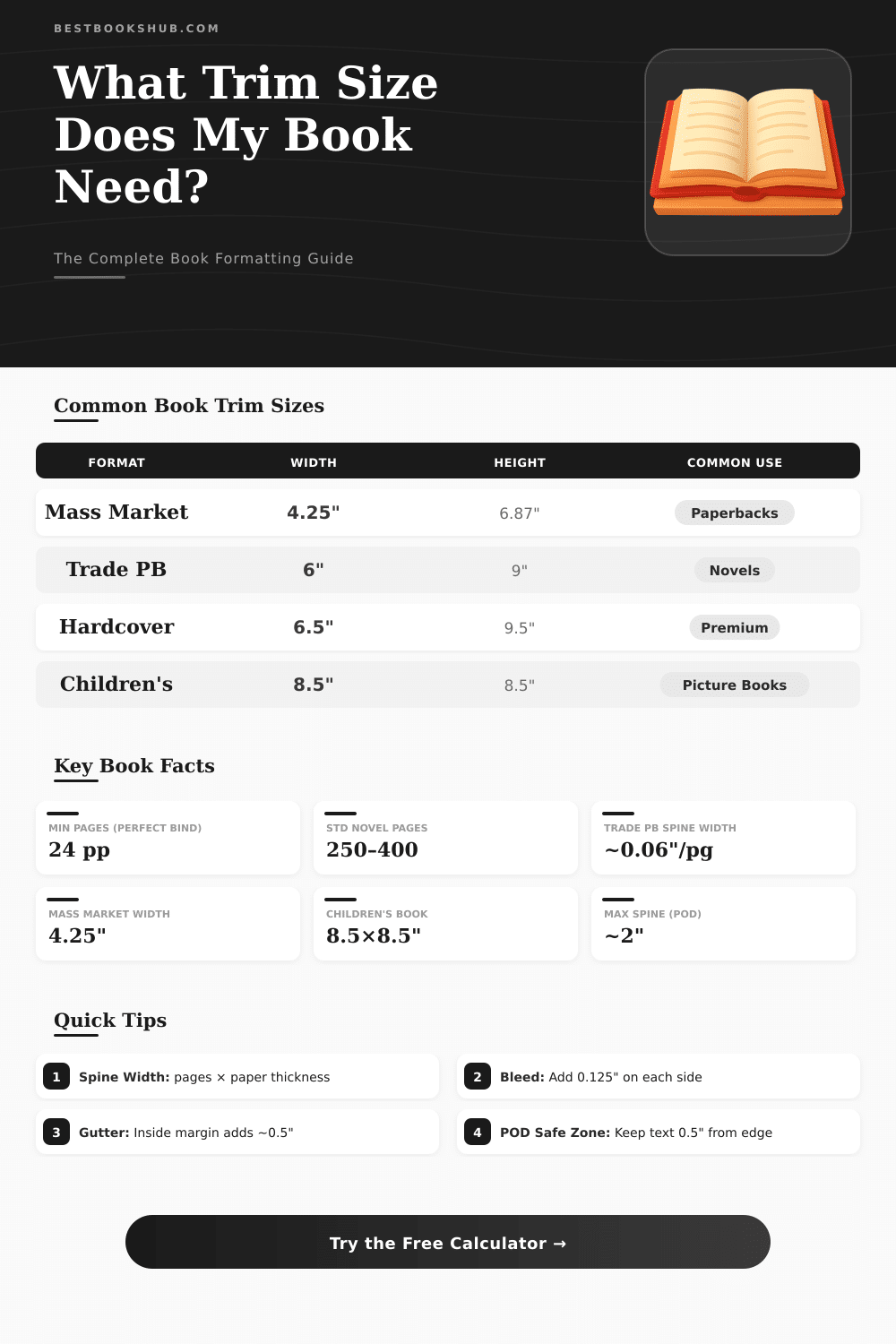
| Mass Market PB | 4.25 x 6.87" | 300 | 7–9 oz (200–255g) |
| Trade Paperback | 6 x 9" | 300 | 12–16 oz (340–453g) |
| Hardcover Novel | 6.5 x 9.5" | 350 | 1.1–1.5 lb (500–680g) |
| Children's PB | 8.5 x 8.5" | 32 | 4–6 oz (113–170g) |
| Textbook | 8.5 x 11" | 500 | 3–5 lb (1.36–2.27kg) |
| Coffee Table | 11 x 8.5" | 200 | 3–6 lb (1.36–2.72kg) |
| Pocket Book | 4 x 6" | 200 | 4–6 oz (113–170g) |
| Large Print | 8 x 10" | 300 | 1.2–1.8 lb (544–816g) |
| Trim Size | Trim Area | +0.125" Bleed Area | Metric (cm) |
|---|---|---|---|
| 4 x 6" | 24 sq in | 4.25 x 6.25" | 10.16 x 15.24cm |
| 4.25 x 6.87" | 29.2 sq in | 4.5 x 7.12" | 10.8 x 17.5cm |
| 5.5 x 8.5" | 46.75 sq in | 5.75 x 8.75" | 13.97 x 21.59cm |
| 6 x 9" | 54 sq in | 6.25 x 9.25" | 15.24 x 22.86cm |
| 6.5 x 9.5" | 61.75 sq in | 6.75 x 9.75" | 16.51 x 24.13cm |
| 8.5 x 8.5" | 72.25 sq in | 8.75 x 8.75" | 21.59 x 21.59cm |
| 8.5 x 11" | 93.5 sq in | 8.75 x 11.25" | 21.59 x 27.94cm |
| 11 x 8.5" | 93.5 sq in | 11.25 x 8.75" | 27.94 x 21.59cm |
The Book Trim Size affects the final shape of its pages, after they will be cut to that size. One commonly writes it as width by height, measured in inches in United States or in millimeters in other countries. Deciding about that size soon is important, it ranks between the basic choices that determines how the content of your book truly will appear on the pages.
DISCLOSURE: This post may contain affiliate links, meaning when you click the links and make a purchase, I receive a commission. As an Amazon Associate I earn from qualifying purchases.
When a book goes to printing, the pages receive neat form by shaving of rough edges, around one inch from the top, bottom and outer edge. When you have images or drawings that must cover the whole page until the edge, they must go past the neat line by the same amount. This is called bleed and it matters, that everything looks flat in the finished book, without any sad white spaces.
How to Choose a Book Size
For fiction books, two main Book Trim Size options lead the market. There is the Digest format at 5.5 by 8.5 inches, and then the American Trade, that measures 6 by 9 inches. Many folks suggest the 6-by-9-format as the main choice for paperback books.
Why is it so popular? The cost of printing matters a lot. A novel with 70,000 words at that size stays fairly cheap to produce, so you can keep the store-price nice for readers.
In United Kingdom, the B-format, around 5 by 7.8 inches, appears on most shelves of paperback books, and it simply is the usual standard their.
Then there is the mass-market paperback book, those little volumes that you grab at the airport or at the checkout of a grocery store. They are around 4.25 by 6.87 inches. Still not every printer offers that pocket-sized choice.
The trade paperback books that sit in real bookshops land somewhere between 5 by 8 inches for the smaller and 8 by 10 inches for the bigger. The 5-by-8-size gives that old pulp novel feeling, especially good for vintage-fantasy or science fiction. It goes well with 6 by 9, if you want something that reads modern.
The number of words matters more than one thinks while you choose the Book Trim Size. Press 100,000 words into a book of 5 by 8 inches, and you receive a brick volume that costs too much to print and is truly hard to hold during reading.
Technical or reference books commonly use the 7-by-10-format. Textbooks and workbooks with images or with side by side plans require even bigger, imagine 8 by 10 or 8.5 by 11 inches. Landscape sizes, like 11 by 8.5 or 12 by 9, create strong visual impact and work well for art books, photo collections and coffee-table volumes thatintend to be shown.
It is helpful to wait until your writing and layout will end fully, before you will decide about the final Book Trim Size. Still, keeping same shape through a whole series ensures that they look neat arranged on the shelf. E-books do not have a real Book Trim Size…
They adapt to any screen size that your readers use, and that belongs to their flexibility.