📚 Book Dimension Calculator
Calculate shelf space, book volumes, and storage capacity for any collection size
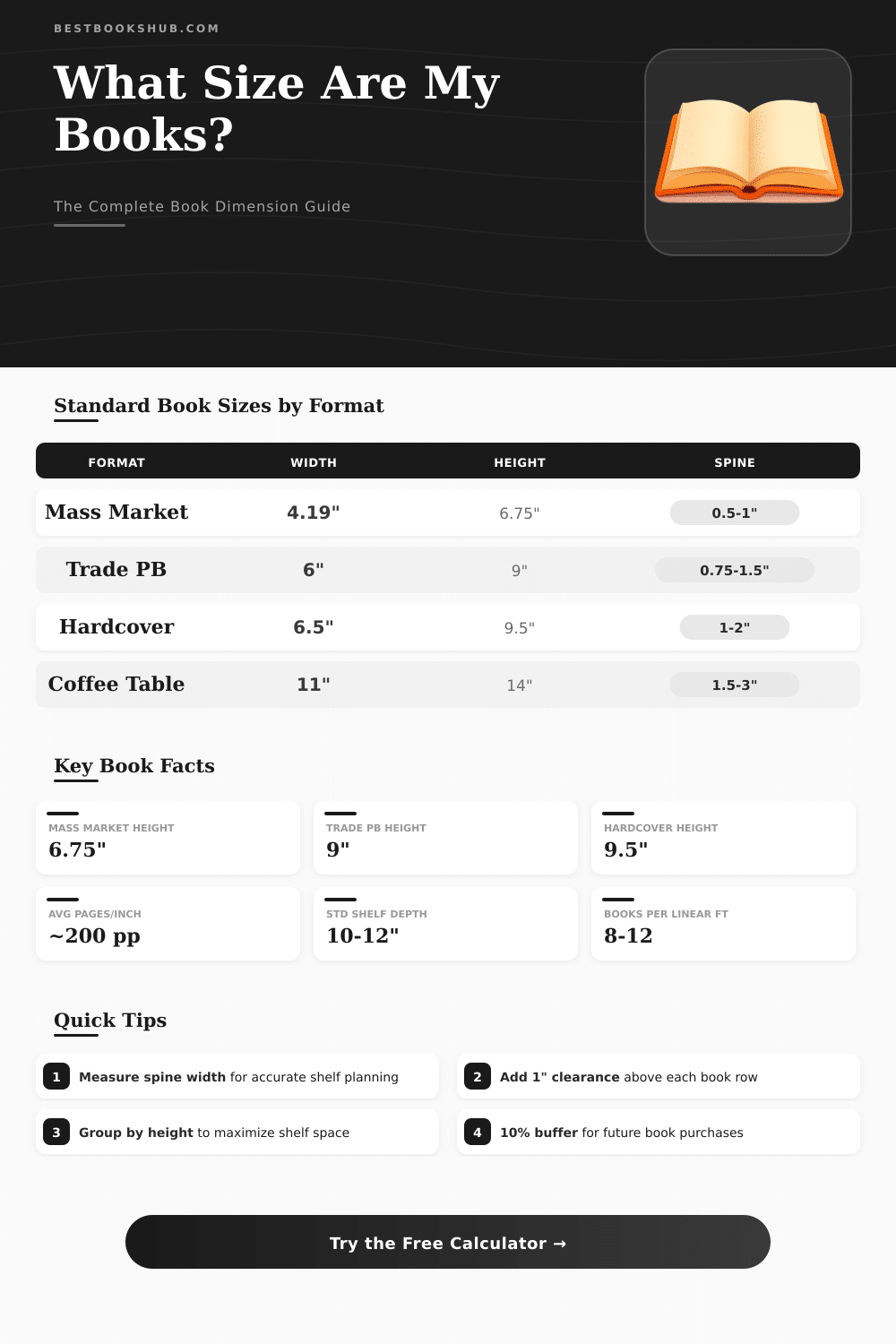
| Format | Width | Height | Width (cm) | Height (cm) | Avg Spine | Books/Linear Ft |
|---|---|---|---|---|---|---|
| Mass Market Paperback | 4.19" | 6.75" | 10.6 cm | 17.1 cm | 0.5-1" | 12-24 |
| Digest / Pocket | 4.25" | 7.0" | 10.8 cm | 17.8 cm | 0.4-0.8" | 15-30 |
| Trade Paperback (Small) | 5.5" | 8.5" | 14.0 cm | 21.6 cm | 0.6-1.2" | 10-20 |
| Trade Paperback (Std) | 6.0" | 9.0" | 15.2 cm | 22.9 cm | 0.75-1.5" | 8-16 |
| Standard Hardcover | 6.5" | 9.5" | 16.5 cm | 24.1 cm | 1.0-2.0" | 6-12 |
| Manga / Comic | 5.0" | 7.5" | 12.7 cm | 19.1 cm | 0.5-0.75" | 16-24 |
| Children's Picture Book | 8.5" | 11.0" | 21.6 cm | 27.9 cm | 0.25-0.5" | 24-48 |
| Textbook (Standard) | 8.5" | 11.0" | 21.6 cm | 27.9 cm | 1.0-2.5" | 5-12 |
| Coffee Table Book | 9.0-12.0" | 11.0-14.0" | 22.9-30.5 cm | 27.9-35.6 cm | 1.5-3.0" | 4-8 |
| Format | Thin (0.5" spine) | Avg (0.75" spine) | Thick (1.5" spine) | Per Meter |
|---|---|---|---|---|
| Mass Market PB | 24 books | 16 books | 8 books | 52 / 21 / 10 |
| Trade Paperback | 24 books | 16 books | 8 books | 52 / 21 / 10 |
| Hardcover | 12 books | 8 books | 6 books | 31 / 21 / 8 |
| Manga / Comic | 24 books | 19 books | — | 63 / 49 / — |
| Textbook | 12 books | 8 books | 5 books | 31 / 21 / 13 |
| Coffee Table | — | 6 books | 4 books | — / 16 / 10 |
| Bookshelf Model | Dimensions (W x H) | Shelf Length | Shelf Count | Capacity (avg books) |
|---|---|---|---|---|
| IKEA KALLAX 2x2 | 30.3" x 30.3" | 13" | 4 cubbies | ~20-30 books |
| IKEA KALLAX 4x4 | 57.1" x 57.1" | 13" | 16 cubbies | ~80-120 books |
| IKEA BILLY (narrow) | 15.7" x 79.5" | 15.7" | 5 shelves | ~60-80 books |
| IKEA BILLY (standard) | 31.5" x 79.5" | 31.5" | 5 shelves | ~120-160 books |
| Standard 3-Shelf Unit | 36" x 48" | 36" | 3 shelves | ~90-120 books |
| Standard 5-Shelf Unit | 36" x 72" | 36" | 5 shelves | ~150-200 books |
| Tall Bookcase | 36" x 84" | 36" | 6 shelves | ~180-240 books |
| Wall-to-Wall Built-In | 120" x 96" | 120" | 8 shelves | ~800-1200 books |
Book sizes affect more than folks think. Whether you notice that exact measure printed on the cover of a book? That is what designers call the “Book Dimension“, the width and height after everything is cut and squared up.
DISCLOSURE: This post may contain affiliate links, meaning when you click the links and make a purchase, I receive a commission. As an Amazon Associate I earn from qualifying purchases.
For commercial publications the most used form is 6 by 9 inches, and it works because they look good on shelves and do not bother in the hands. There is also the digest format at 5.5 by 8.5 inches… Smaller more practical and clean looking.
What Book Sizes Mean
Printers usually accept both without problems.
Even so there are enough ways to try beyond those two standards. One can use little square forms around 7.5 by 7.5 inches, or go to bigger square at 8.5 by 8.5. Detailed novels commonly land in their own niche at 6.625 by 10.25 inches, taller and wide, which gives writers the needed space for breathing.
Also there is the rectangular size at 8.5 by 11 inches. Really the best choice depends on the tpye of book that you prepare.
That whole system did not come from nothing. Before, printers and bookbinders worked with big pages of paper and found creativity in the folds. One fold made a folio, tall and wide format, that looked impressive.
If one folds it again, one gets a quartet, that drops the height a lot, but keeps good width. Those folding principles stayed and formed all Book Dimension options that we use know.
Publishers benefit from that. When a book is very long. Which commonly happens in the middle of vast series, one can choose smaller pages to stop the physical size growing.
Like this the back does not beat the whole weight that presses down.
For groups of printing on demand, every platform has its own setup. You enter the Book Dimension, page count and paper in their system, and it makes a template. Load that in your design program, and you start building the cover art and back charts on it.
Most services include special calculators, so that you can set exact measures before starting something. Everything shows as width by height, clearly and simply.
Now, following those details online can quickly become hard. Websites like LibraryThing do not always have reliable data about sizes. Books from Amazon sometimes show fake numbers, for instance 20 by 20 by 20, which clearly is garbage.
Library records can be missing info also. Here is what those measures really mean: height runs from top to bottom of the back, length from back to front edge, and thickness is how wide it sits on the shelf. Most platforms let you switch visibility for dimensions, pagecount and weight fields, but fixing all mistakes requires going through them one by one.