📖 Coleman-Liau Index Calculator
Measure the readability grade level of any text using the Coleman-Liau formula
Enter raw text statistics for the Coleman-Liau formula. All values are per 100 words of text.
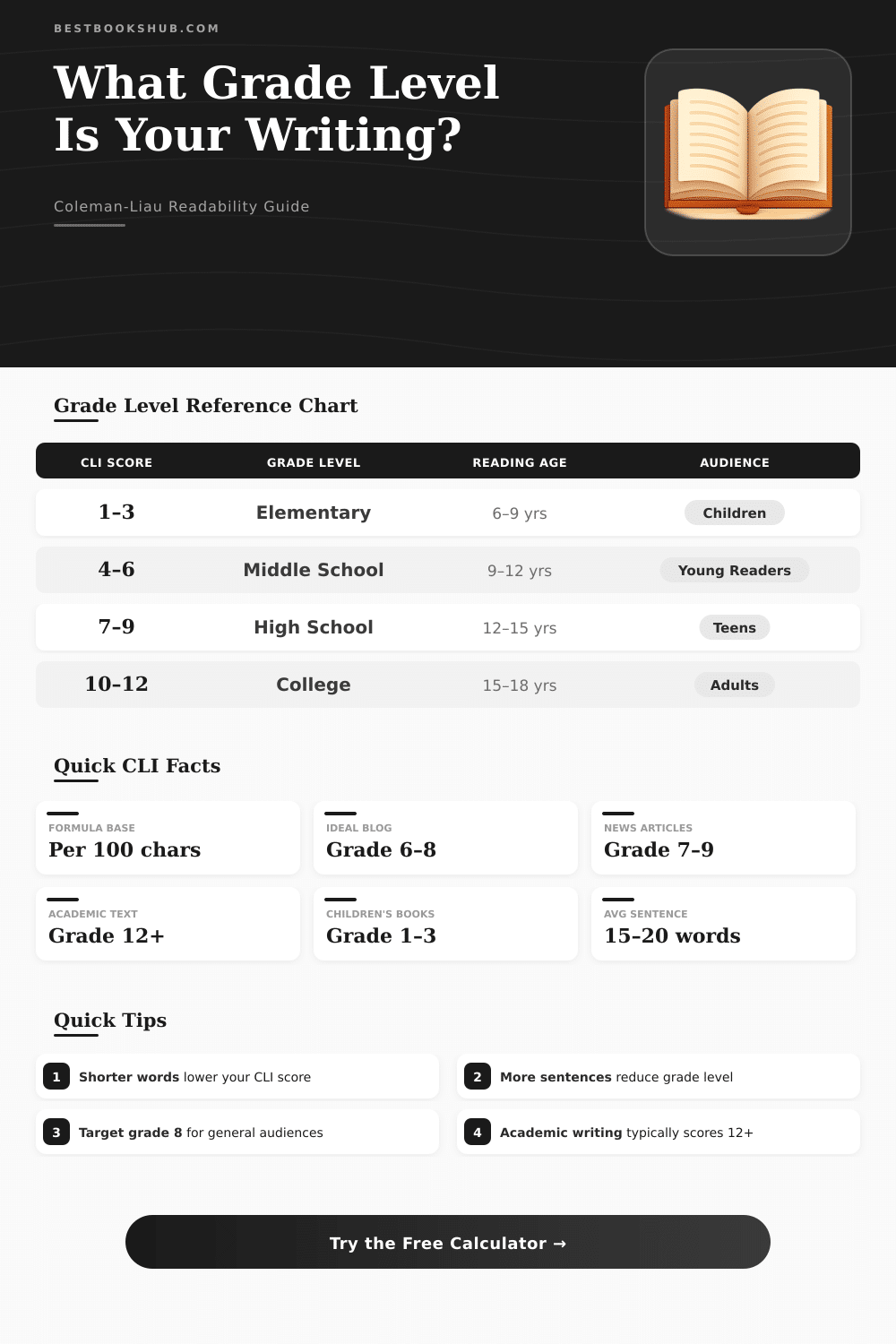
| CLI Score | Grade Level | Approx. Age | Typical Audience | Example Text Type |
|---|---|---|---|---|
| 1 – 2 | Grade 1–2 | 6–8 years | Early readers | Beginner picture books |
| 3 – 4 | Grade 3–4 | 8–10 years | Young children | Chapter books |
| 5 – 6 | Grade 5–6 | 10–12 years | Upper elementary | Middle grade fiction |
| 7 – 8 | Grade 7–8 | 12–14 years | Middle school | YA novels, blogs |
| 9 – 10 | Grade 9–10 | 14–16 years | High school | News articles, essays |
| 11 – 12 | Grade 11–12 | 16–18 years | Advanced HS | Literary fiction |
| 13 – 15 | College Undergrad | 18–22 years | College students | Textbooks, research |
| 16+ | Graduate / Expert | 22+ years | Specialists | Academic journals |
Where L = average number of letters per 100 words, and S = average number of sentences per 100 words.
| Text Type | Avg CLI Score | Target Grade | Avg Letters/100 Words | Avg Sentences/100 Words |
|---|---|---|---|---|
| Children’s Books | 2 – 4 | Grade 2–4 | 350–380 | 12–18 |
| Young Adult Fiction | 5 – 7 | Grade 5–7 | 390–420 | 7–10 |
| Blog / Web Content | 6 – 9 | Grade 6–9 | 400–440 | 6–9 |
| News Articles | 8 – 10 | Grade 8–10 | 420–460 | 5–7 |
| Literary Fiction | 9 – 12 | Grade 9–12 | 440–480 | 4–7 |
| Business Writing | 10 – 13 | Grade 10–13 | 450–490 | 4–6 |
| Academic Papers | 12 – 16 | College+ | 470–530 | 3–5 |
| Legal Documents | 14 – 18 | Graduate+ | 490–560 | 2–4 |
| Technical Manuals | 13 – 17 | College+ | 480–540 | 3–5 |
| Metric | Simple Text | Average Text | Complex Text |
|---|---|---|---|
| Avg Word Length (chars) | 3.5 – 4.2 | 4.3 – 5.0 | 5.1 – 6.5+ |
| Letters per 100 Words | 350 – 400 | 401 – 460 | 461 – 560+ |
| Avg Sentence Length (words) | 8 – 12 | 13 – 18 | 19 – 30+ |
| Sentences per 100 Words | 8 – 12 | 5 – 8 | 3 – 5 |
| CLI Index Range | 1 – 5 | 6 – 10 | 11 – 18+ |
DISCLOSURE: This post may contain affiliate links, meaning when you click the links and make a purchase, I receive a commission. As an Amazon Associate I earn from qualifying purchases.
The readability index shows simply how hard one reads a text. That rating comes from the analysis of its complexity. One considers this by means of length of words, size of phrases and number of syllables, that all help to estimate the difficulty.
It seems easy but there stands long history behind it.
Readability tests and scores
Already in 1847, specialists tried to estimate how hard one reads text. Through the time, one created around two hundreds of different indexes about readability. For instance, they go from Flesch until Fry, from Gunning Fog until SMOG and from Spache until LIX.
Like this there exist many different ways to reach the same main ideas.
Between the most used tests find the Flesch test about easy reading, the Flesch-Kincaid for grade level, the Gunning Fog index, the Coleman Liau Index, the SMOG index, the Automated index about readability and the Dale-Chall test about readability. Tools for checking readability usually apply some of those methods at once, to quickly esitmate how easily one understands the content.
The Flesch index estimates the ease of reading of text. If the score is high, the text is easily understood. The magazine Reader’s Digest has typical index around 65.
Time magazine marks about 52 points. Normal essay of student in the sixth until seventh class reaches 60 until 70, what matches to reading level of sixth until seventh grade. The Harvard Law Review keeps average in the low 30s. Like this, with lower score, the text is more rough.
The Coleman Liau Index works differently. Here high score shows that one requires high reading level to seize the ideas. The usual range goes from 1 until 16, and 12 points match too 12th grade level for reading.
Many indexes count long phrases together with hard words, to mark high level of difficulty. For instance, the Automated index about readability takes long words and big sentences to set its value. Such methods help a lot in teaching and publishing, to estimate the readability of texts.
If one writes for the whole public, they should aim for score between 8 and 10. That makes the content open for the majority of readers. Sometimes reaching high grade level simply requires more words or bigger ones in phrases, what is notalways most useful.
LibraryThing allows members to sort their books according to reading levels by means of Lexile measures. There are pages for every range of Lexile, since 200L for books like Clifford and The Gruffalo until 1580L for texts of graduate study. Teachers and librarians of schools care about that feature, since one created LibraryThing.