📖 Word Count Per Minute Calculator
Calculate your WPM for reading, typing, or speaking — instantly measure and benchmark your speed
| Document Type | Word Count | At 150 WPM (Slow) | At 250 WPM (Avg) | At 400 WPM (Fast) |
|---|---|---|---|---|
| Tweet / Short Post | 25 | 10 sec | 6 sec | 4 sec |
| Email (short) | 200 | 1 min 20 sec | 48 sec | 30 sec |
| Blog Article | 1,500 | 10 min | 6 min | 3 min 45 sec |
| Long-form Article | 5,000 | 33 min | 20 min | 12 min 30 sec |
| Short Story | 10,000 | 1 hr 7 min | 40 min | 25 min |
| Novella | 40,000 | 4 hr 27 min | 2 hr 40 min | 1 hr 40 min |
| Average Novel | 90,000 | 10 hr | 6 hr | 3 hr 45 min |
| Epic Novel | 200,000 | 22 hr 13 min | 13 hr 20 min | 8 hr 20 min |
| Speed Level | WPM Range | 1,000 Words Takes | 5,000 Words Takes | Typical Profile |
|---|---|---|---|---|
| Hunt & Peck | 10–20 | 50–100 min | 4–8 hrs | Two-finger typing |
| Beginner | 20–35 | 29–50 min | 2.4–4 hrs | New touch typist |
| Average | 40–65 | 15–25 min | 1.3–2 hrs | Most office workers |
| Proficient | 65–80 | 12–15 min | 62–77 min | Regular computer users |
| Fast | 80–100 | 10–12 min | 50–62 min | Skilled typists |
| Expert | 100–120 | 8–10 min | 42–50 min | Transcriptionists |
| Speed Typist | 120+ | Under 8 min | Under 42 min | Competitive typists |
| Presentation Length | At 100 WPM | At 130 WPM (Avg) | At 160 WPM | Notes |
|---|---|---|---|---|
| 2-minute talk | 200 words | 260 words | 320 words | Elevator pitch |
| 5-minute talk | 500 words | 650 words | 800 words | Short presentation |
| 10-minute talk | 1,000 words | 1,300 words | 1,600 words | TED Talk format |
| 20-minute speech | 2,000 words | 2,600 words | 3,200 words | Conference talk |
| 45-minute lecture | 4,500 words | 5,850 words | 7,200 words | University lecture |
| 60-minute keynote | 6,000 words | 7,800 words | 9,600 words | Keynote speech |
| Project Type | Typical Word Count | Read at 250 WPM | Type at 55 WPM |
|---|---|---|---|
| Social Media Post | 50–280 | ~1 min | ~5 min |
| Email (professional) | 150–300 | ~1 min | ~4 min |
| Blog Post (short) | 500–800 | ~3 min | ~12 min |
| Blog Post (standard) | 1,000–1,500 | ~5 min | ~22 min |
| Academic Essay | 1,500–3,000 | ~10 min | ~45 min |
| White Paper | 5,000–10,000 | ~30 min | ~2.5 hrs |
| Short Story | 1,000–10,000 | ~30 min | ~3 hrs |
| Novella | 20,000–50,000 | ~2.7 hrs | ~12 hrs |
| Novel | 70,000–100,000 | ~6 hrs | ~28 hrs |
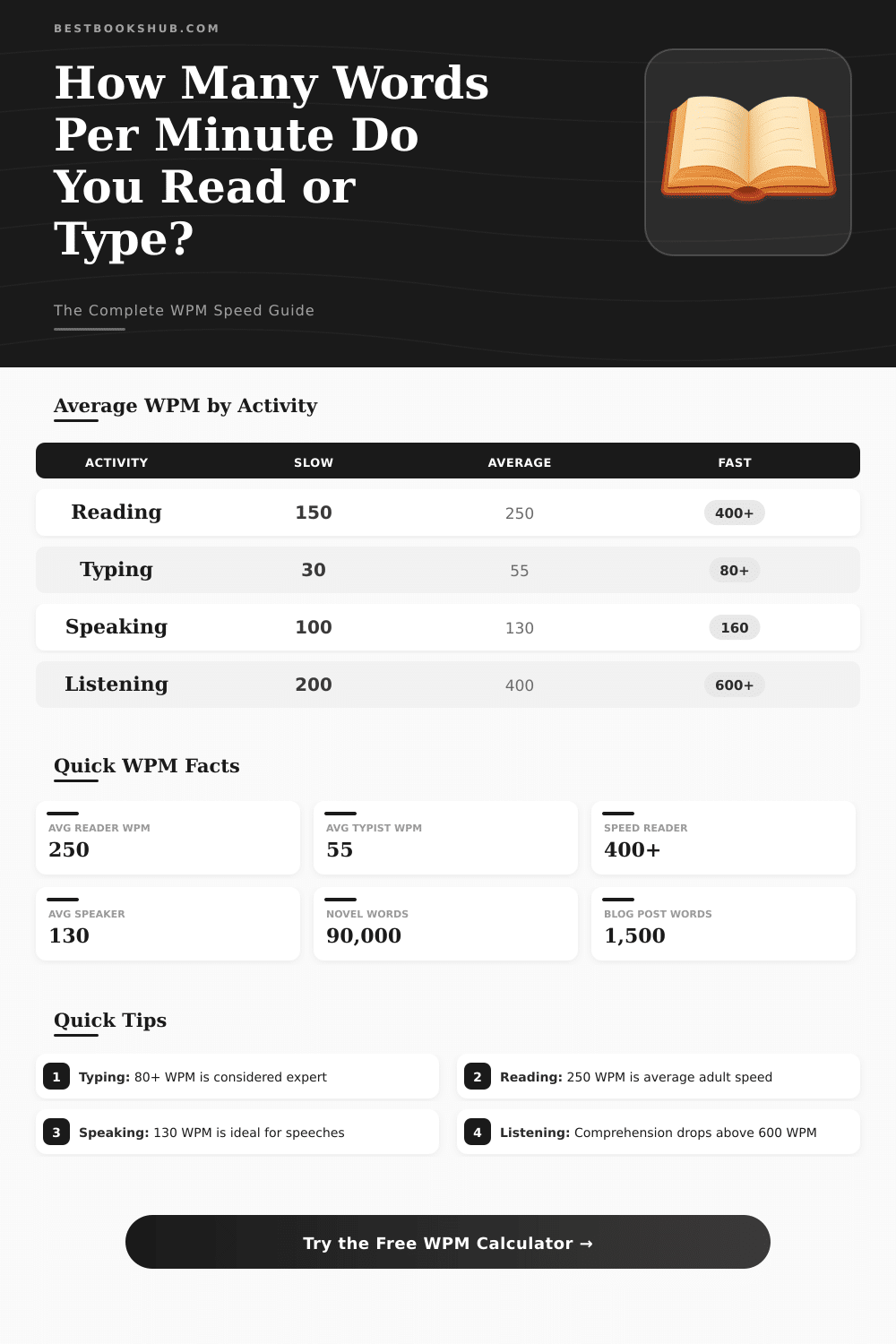
When one mentions the speed of reading, one usually thinks about Word Count Per Minute, or WPM. That simply shows how quickly someone can read text. A lot of tests are available that estimate your WPM and right away give a score about understanding, with results that you can follow to see your progress over time.
DISCLOSURE: This post may contain affiliate links, meaning when you click the links and make a purchase, I receive a commission. As an Amazon Associate I earn from qualifying purchases.
The most many of them allow you to choose between shorter 200-word text or longer 400-word according to your mood.
How Fast People Read in Words Per Minute
For adults that read silent English, the typical speed hovers around 238 WPM. One commonly hears references about 300 WPM, although the exact numbers range according to how the tests estimate the causes, what counts as a word and what one indeed reads. When dealing with nonfiction texts, folks on average reach about 238 WPM.
About fiction? It goes a bit more quickly, near 260 WPM. In 1998, scientists found that students, reading naturally at any speed, averaged around 308 WPM.
If one considers the whole situation, most folks fall between 200 and 300 WPM.
The education level matters a lot for the reading speed of anyone. Children in the third grade usually advance at 150 WPM. Jump to the eighth grade, and you find something near to 250 WPM.
In high school, average students raech around 450 WPM. Interestingly, many folks naturally estimate between 400 and 500 WPM without any special teaching, they simply read a lot and learnt useful ways along the way.
The truly brilliant readers, those who surpass 1000 WPM while keeping around 85% of understanding (form only 1% of all readers). Participants in speed reading contests boast about reach of 1000 to 4000 WPM, according to the kind of material. But hear the problem: if you rip through a fiction book at 800 WPM, you probably miss the details that the author enclosed, like the rhythm, the flow and the music of the language.
Anything above 500 WPM? Then understanding starts to fail. A wiser method is skip titles and jump to main ideas, later slow when the text becomes dense and difficult.
What you read matters just as much as the speed in which you read it. Open a scientific textbook, and your speed could sink to around 250 WPM. Take an easy beach book, and you could end it quickly.
Tiredness is another element. The more tired you become, the less quickly you will read naturally.
To estimate your WPM at home, simply count the words on a page, divide the seconds that it took to read them, and later multiply by 60. Assume you read 925 words in 270 seconds… That gives around 205 WPM.
Another way is to mark where you start, read during exactly one minute at your usual speed, and later multiply the lines that you covered by the average number of words in a line.
One team of researchers found that the ideal for both reading and hearing sits around 270 WPM. That nearly doubles the usual speed of audiobooks, that stays at 150 WPM. Calculators for reading can also guess how much time you will need to end a book according to your personal speed.
At 350 WPM, a thicknovel could take you around four hours and fifteen minutes.