📚 Lexile & Guided Reading Level Converter
Convert Lexile scores to Guided Reading Levels, DRA, Fountas & Pinnell, and Grade Level equivalents
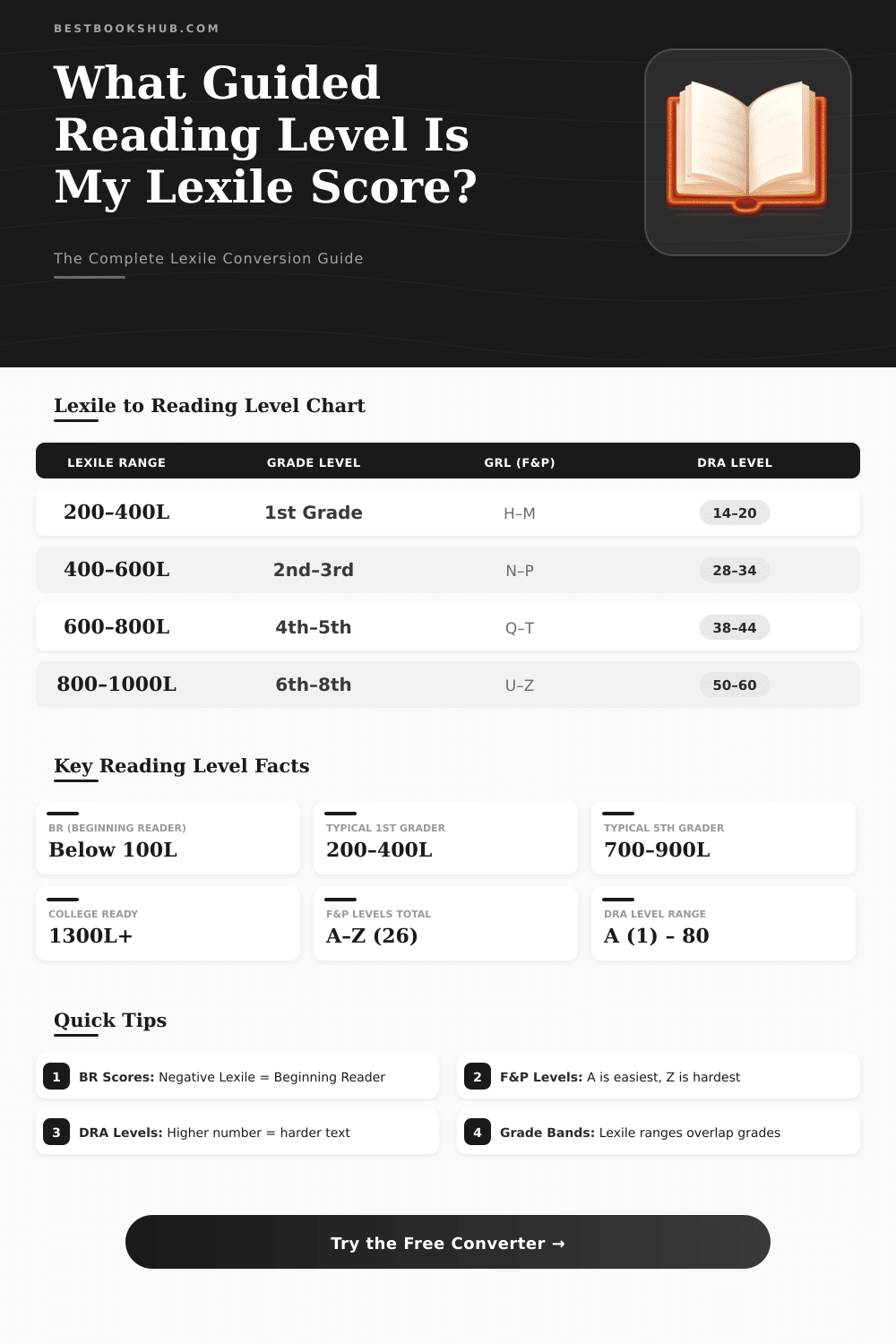
| Lexile Range | Grade Level Band | Fountas & Pinnell | DRA Level | Reading Recovery | AR Level (approx) |
|---|---|---|---|---|---|
| BR–100L | Kindergarten | A–C | A–3 | 1–4 | 0.1–1.0 |
| 100–200L | Kindergarten–Grade 1 | D–F | 4–10 | 5–10 | 1.0–1.5 |
| 200–300L | Grade 1 | G–I | 12–16 | 11–16 | 1.5–2.0 |
| 300–400L | Grade 1–2 | J–M | 18–24 | 17–20 | 2.0–2.5 |
| 400–500L | Grade 2–3 | N–O | 28–30 | — | 2.5–3.0 |
| 500–600L | Grade 3 | P–Q | 34–38 | — | 3.0–3.5 |
| 600–700L | Grade 4 | R–S | 40–44 | — | 3.5–4.0 |
| 700–800L | Grade 4–5 | T–U | 44–50 | — | 4.0–4.5 |
| 800–900L | Grade 5–6 | V–W | 50–60 | — | 4.5–5.0 |
| 900–1000L | Grade 6–8 | X–Y | 60–70 | — | 5.0–6.0 |
| 1000–1100L | Grade 8–9 | Z | 70–80 | — | 6.0–7.0 |
| 1100–1200L | Grade 9–10 | Z+ | 80+ | — | 7.0–8.0 |
| 1200–1300L | Grade 11–12 | Z+ | 80+ | — | 8.0–9.0 |
| 1300L+ | College / Adult | Z+ | 80+ | — | 9.0+ |
| F&P Level | Typical Grade | Approx Lexile | DRA Equiv. | Word Count Range |
|---|---|---|---|---|
| A | Kindergarten | BR–80L | A | 10–60 |
| B | Kindergarten | 80–120L | 1–2 | 30–80 |
| C | Kindergarten | 120–180L | 3–4 | 50–120 |
| D | Grade 1 | 180–220L | 6 | 80–160 |
| E | Grade 1 | 200–260L | 8 | 100–200 |
| F | Grade 1 | 230–300L | 10 | 130–250 |
| G | Grade 1 | 270–330L | 12 | 150–350 |
| H | Grade 1–2 | 300–380L | 14 | 200–500 |
| I | Grade 2 | 340–420L | 16 | 300–650 |
| J | Grade 2 | 370–450L | 18 | 400–1000 |
| K | Grade 2 | 400–490L | 20 | 500–1500 |
| L | Grade 3 | 430–530L | 24 | 600–2000 |
| M | Grade 3 | 470–570L | 28 | 800–3000 |
| N | Grade 3–4 | 520–620L | 30 | 1000–5000 |
| O | Grade 4 | 560–660L | 34 | 1500–8000 |
| P | Grade 4 | 600–700L | 38 | 2000–10000 |
| Q | Grade 4–5 | 640–740L | 40 | 5000–15000 |
| R | Grade 5 | 680–780L | 40 | 8000–20000 |
| S | Grade 5 | 720–820L | 44 | 10000–25000 |
| T | Grade 5–6 | 760–860L | 44 | 15000–30000 |
| U | Grade 6 | 800–900L | 50 | 20000–40000 |
| V | Grade 6–7 | 840–940L | 50 | 25000–50000 |
| W | Grade 7 | 880–980L | 60 | 30000–60000 |
| X | Grade 7–8 | 920–1020L | 60 | 40000+ |
| Y | Grade 8 | 960–1060L | 70 | 40000+ |
| Z | Grade 8–9 | 1000–1100L | 80 | 40000+ |
| Z+ | Grade 9–Adult | 1100L+ | 80+ | 40000+ |
| DRA Level | Typical Grade | Approx Lexile | F&P Equiv. | Reading Stage |
|---|---|---|---|---|
| A–1 | Kindergarten | BR–100L | A | Emergent |
| 2–3 | Kindergarten | 100–160L | B–C | Emergent |
| 4–6 | Grade 1 | 150–220L | D–E | Early |
| 8–10 | Grade 1 | 210–280L | F–G | Early |
| 12–14 | Grade 1–2 | 270–340L | H–I | Early Transitional |
| 16–18 | Grade 2 | 320–400L | J | Transitional |
| 20–24 | Grade 2–3 | 380–470L | K–L | Transitional |
| 28–30 | Grade 3 | 450–540L | M–N | Extending |
| 34–38 | Grade 3–4 | 520–620L | O–P | Extending |
| 40–44 | Grade 4–5 | 610–730L | Q–S | Independent |
| 50–60 | Grade 5–6 | 720–880L | T–V | Independent |
| 70–80 | Grade 7–9 | 870–1050L | W–Z | Advanced |
| 80+ | Grade 10+ | 1050L+ | Z+ | Advanced |
Read level converters are resources that helps to match books or texts to the right grade levels or reading levels. They serve teachers, parents and all that bother to find the right match between reader and text. The problem is that no one single standard exists; various systems exist, and trying to count how they relate without good guide can become quickly chaotic.
DISCLOSURE: This post may contain affiliate links, meaning when you click the links and make a purchase, I receive a commission. As an Amazon Associate I earn from qualifying purchases.
One way is use chart for convert reading levels. Such charts show how different reading programs link together. The best tie K until 12th grade levels, levels of IRLA, levels of AR, Lexile Levels and levels of Fountas and Pinnell, everything in one place.
Tools to Check and Match Reading Levels
For instance, Benchmark Education offers interactive chart that translates letter and number levels to Lexile points and grade matches. Booksource also has a good converter chart that shows the overlaps of mainstream systems, so that it is more easily to choose books fit to skills of every pupil.
So here comes the way of monitors for readability. They research a piece of text and say, at what grade level it genuinely sits. Some analyse the text by means of counting sentences, word counts, syllables and signs, later pass those patterns through eight different formulas of readability to see what comes out.
Other free websites for testing give quick information about grade levels and offer warnings about phrases that could confuse readers. One outside website for readability ranks among the most liked, because it offers tests like the reading ease of Flesch, Guided Reading Level of Flesch-Kincaid, Index of Gunning Fog and Index of HALE.
But here the issue however; various tools commonly give entirely diferent results. One page could name text material for 11th or 12th grade, while another lays it in 6th grade. Such changes genuinely confuse and upset.
AI-based levelers for texts now also entered the scene. They take existing text and redo it for the intended grade level or Lexile score, without losing the main message or basic form. They do that by means of change of vocabulary, adjustment of sentence order and change of grammar.
Diffit helps teachers repeat content and create custom materials, so that each student engage with work fit to his grade. Fast work operates as free extension for Chrome… Simply press the button in your toolbar to alter any web article or text to another reading level.
Rewordify simplifies English texts to low reading level, acting as a brilliant tool that dumps complexity.
Chatbots offer another viewpoint. Simply upload a chapter and ask it too repeat the content for a particular grade level, and you are ready. Moreover, Lexile Levels of MetaMetrics connect to library systems, helping librarians and readers search books fit to their readinglevels.
LibraryThing added data of Lexile Framework, so each member gathers his books sorted according to reading difficulty.