📚 Comic Book Reading Order Checker
Find how many issues, trades, and reading time your comic series needs — plan your collection read-through
| Format | Width x Height (in) | Width x Height (cm) | Typical Pages |
|---|---|---|---|
| Modern Standard | 6.625 x 10.25 | 16.8 x 26.0 | 22–24 |
| Golden Age (pre-1956) | 7.75 x 10.5 | 19.7 x 26.7 | 64–68 |
| Silver Age (1956–1970) | 7.0 x 10.375 | 17.8 x 26.4 | 32–36 |
| Prestige Format | 6.625 x 10.25 | 16.8 x 26.0 | 48–64 |
| Digest | 5.5 x 8.5 | 14.0 x 21.6 | 96–120 |
| Treasury / Oversized | 10.0 x 13.5 | 25.4 x 34.3 | 100+ |
| Trade Paperback | 6.625 x 10.25 | 16.8 x 26.0 | 128–160 |
| Hardcover Collection | 7.0 x 10.875 | 17.8 x 27.6 | 160–300 |
| Issue Count | Total Pages (22pp) | Time @ 3pp/min | Weeks @ 30min/day |
|---|---|---|---|
| 6 Issues (Mini) | 132 pages | 44 min | ~0.2 weeks |
| 12 Issues (Limited) | 264 pages | 88 min | ~0.4 weeks |
| 25 Issues (Short Run) | 550 pages | 3 hrs 3 min | ~0.9 weeks |
| 50 Issues | 1,100 pages | 6 hrs 7 min | ~1.7 weeks |
| 100 Issues | 2,200 pages | 12 hrs 13 min | ~3.5 weeks |
| 200 Issues | 4,400 pages | 24 hrs 27 min | ~7 weeks |
| 500 Issues | 11,000 pages | 61 hrs | ~17 weeks |
| Format | Issues Collected | Spine Width (in) | Shelf Space / Volume |
|---|---|---|---|
| Single Issue | 1 | 0.1 in / 0.25 cm | 0.1 in per issue |
| Trade Paperback | 4–8 | 0.5–0.75 in | 1 slot per TPB |
| Hardcover (slim) | 6–12 | 0.75–1.0 in | 1 slot per HC |
| Hardcover (thick) | 12–20 | 1.0–1.5 in | 1 slot per HC |
| Omnibus | 20–30 | 2.0–3.0 in | 1 slot per Omnibus |
| Absolute Edition | 8–15 | 1.5–2.0 in | Oversized shelf |
| Series | Total Issues | Est. TPBs Needed | Shelf Space (in) |
|---|---|---|---|
| Watchmen | 12 | 1 TPB | 0.5 in |
| The Walking Dead | 193 | 16 TPBs | 10 in |
| Saga (current) | 66+ | 9+ TPBs | 5.5 in |
| Sandman | 75 | 10 TPBs | 6 in |
| Batman (main, post-2000) | 180+ | 25+ TPBs | 15 in |
| X-Men (all titles, 1963+) | 6,000+ | 600+ TPBs | 350+ in |
| Hellboy | 60 | 12 TPBs | 7 in |
| Preacher | 66 | 9 TPBs | 5.5 in |
Comic books, where one could start with comics, commonly twist genuinely embarrassing cause. Comic books appeared already in the 1930s, and they do not form one single continuous history. Every volume presents its own story, and sometimes many heroes involve in short series.
DISCLOSURE: This post may contain affiliate links, meaning when you click the links and make a purchase, I receive a commission. As an Amazon Associate I earn from qualifying purchases.
Such separate parts already complicate everything for beginners. Simply it occasionally seems entirely unreachable.
How to Read Comic Books in Order
For Marvel and DC there are more than 350 different Comic Book Reading Order lists for comics. They cover all main patterns and events. Similar results also count for publications of Image, Dark Horse or other companies.
Our goal is to find the most precise Comic Book Reading Order and tips for every world and event.
Famous aid is Funny Book Signal, that offers a full guide for reading Marvel. It focuses mainly on the modern period of comics since the 1990s. Besides that, an excellent option is the Complete Marvel Comic Book Reading Order, known as CMRO. The basic idea is to read the comics according to their publishing order.
One clearly cares about teh right arrangement of everything, so that references appear before one notices them. CMRO prepares also order for DC, even though that plan stays in its early phases and requires a lot of time to reach current days. There also exists website comicbookreadingorders.com, that gives orders according to players, according to events and main reading plans.
Funny events commonly raise the confusion. Those main events normally include main short series, wear the main plot unrolls. For instance, King in Black from edition one until five.
Even so, they also store tied episodes, namely stories in separate comics that show what other characters do during the main cause.
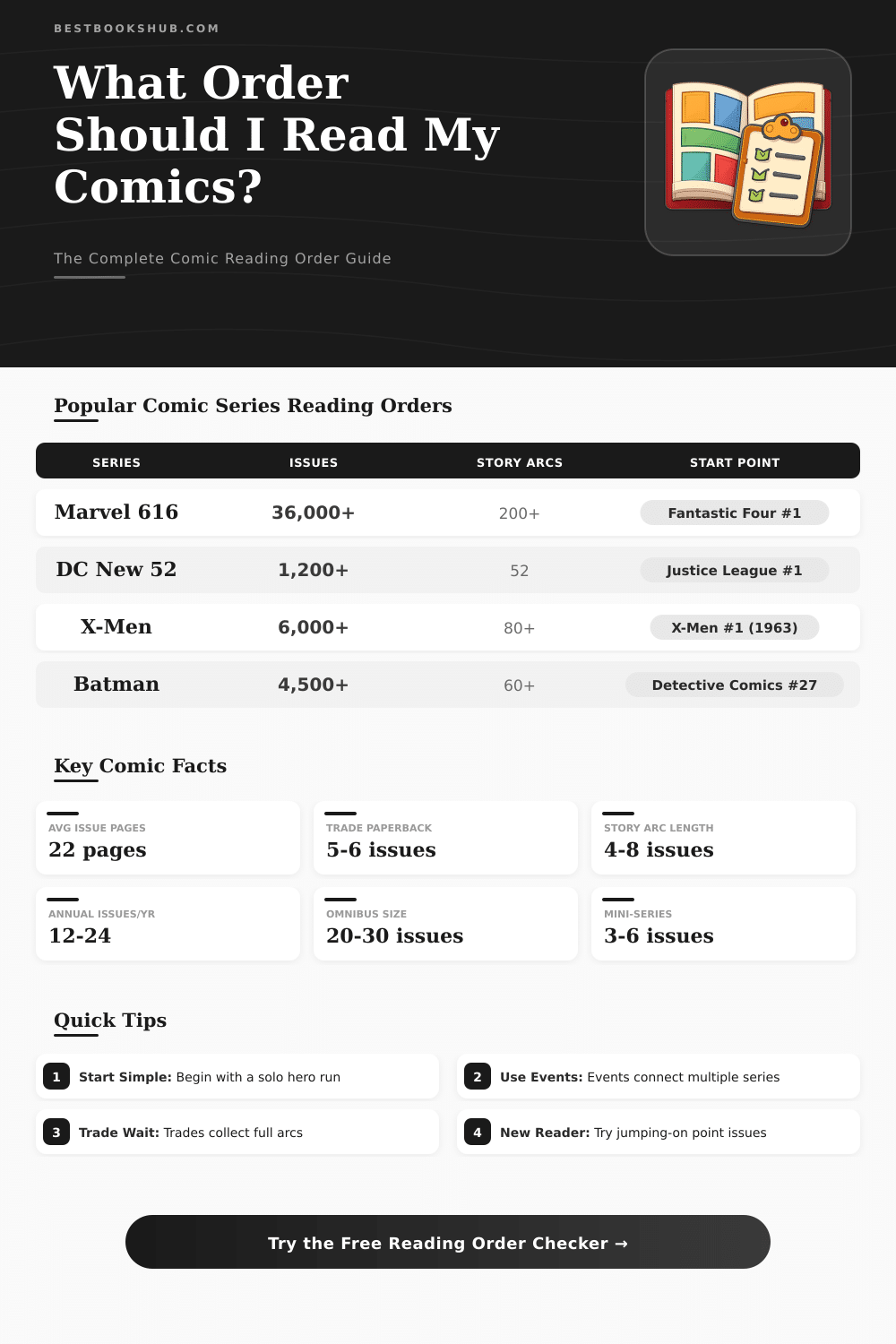
Practical draft for Marvel Comic Book Reading Order lists all main timeline comics, starting from Fantastic Four edition one. It aims to create reliable reading order without time jumps or plot mix. Although it still grows, it already works for usage.
The tips split according to various periods, what eases the search of separate spots in the history of Marvel comics. Every section mentions the main continuous series, limited series and single publications from that time, arranged according to logical continuity.
Efficient mode is to start according to publishing order, later add chronological access when it explains the ties. Old comics genuinely require much more time to read than the current. Before, one finds more descriptions each page and plenty of talk.
What today spans itself over three until five editions, thatwould fill only a few pages.