📄 Paper Thickness Calculator
Calculate stack height, sheet count, or single-sheet thickness in mm, inches & microns
| Sheets | Stack (mm) | Stack (cm) | Stack (inches) |
|---|---|---|---|
| 10 | 1.0 mm | 0.10 cm | 0.039" |
| 50 | 5.0 mm | 0.50 cm | 0.197" |
| 100 | 10.0 mm | 1.00 cm | 0.394" |
| 250 | 25.0 mm | 2.50 cm | 0.984" |
| 500 | 50.0 mm | 5.00 cm | 1.969" |
| 1000 | 100.0 mm | 10.00 cm | 3.937" |
| Millimeters (mm) | Micrometers (µm) | Inches | Thousandths (thou) |
|---|---|---|---|
| 0.05 mm | 50 µm | 0.00197" | 1.97 thou |
| 0.07 mm | 70 µm | 0.00276" | 2.76 thou |
| 0.10 mm | 100 µm | 0.00394" | 3.94 thou |
| 0.21 mm | 210 µm | 0.00827" | 8.27 thou |
| 0.26 mm | 260 µm | 0.01024" | 10.24 thou |
| 0.27 mm | 270 µm | 0.01063" | 10.63 thou |
| Pages (total) | Sheets (leaves) | Spine (mm) | Spine (inches) |
|---|---|---|---|
| 100 pages | 50 sheets | 3.5 mm | 0.14" |
| 200 pages | 100 sheets | 7.0 mm | 0.28" |
| 300 pages | 150 sheets | 10.5 mm | 0.41" |
| 400 pages | 200 sheets | 14.0 mm | 0.55" |
| 600 pages | 300 sheets | 21.0 mm | 0.83" |
| 1000 pages | 500 sheets | 35.0 mm | 1.38" |
| Package | Sheets | Stack (mm) at 0.10mm | Stack (inches) |
|---|---|---|---|
| Mini Ream | 250 | 25.0 mm | 0.98" |
| Standard Ream | 500 | 50.0 mm | 1.97" |
| Double Ream | 1000 | 100.0 mm | 3.94" |
| Carton (5 reams) | 2500 | 250.0 mm | 9.84" |
| Bulk Carton (10 reams) | 5000 | 500.0 mm | 19.69" |
The paper thickness matters much more than many folks believe. It affects the feel of the paper, its quality and its use in various tasks. Weight of paper helps to estimate its paper thickness.
DISCLOSURE: This post may contain affiliate links, meaning when you click the links and make a purchase, I receive a commission. As an Amazon Associate I earn from qualifying purchases.
But the thickness ranges according to the materials for its production and the grade of pressure during the process called calendering.
What Paper Thickness and GSM Mean
Thick paper usually weighs more. Hence many printer stores use only one measure to estimate the density of paper. One best notices the difference between different types of paper, that one calls paper materials.
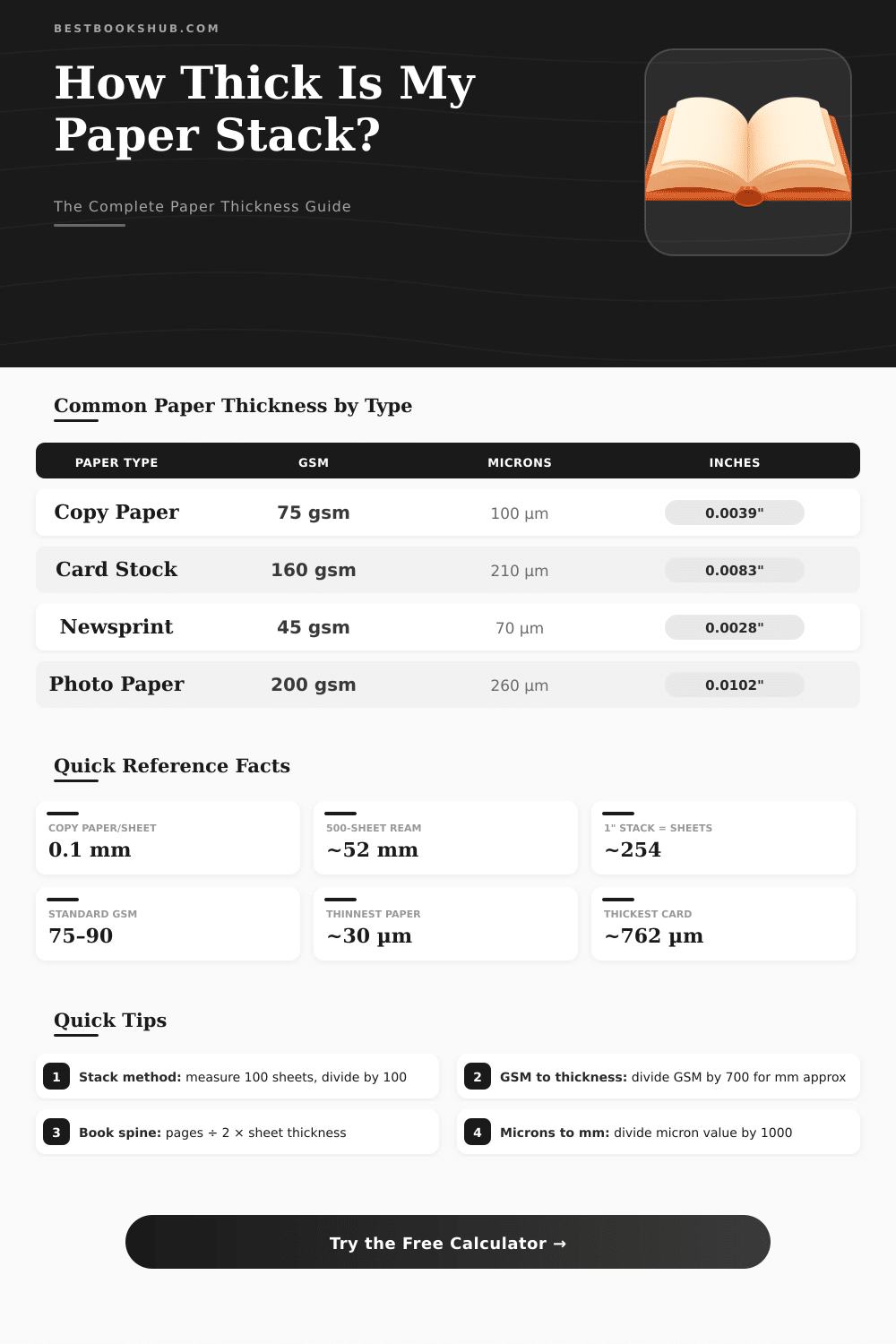
Average A4-sheet of 80 GSM paper has exactly 0.1 mm thickness. GSM stands for grams each square metre. Almost all office paper has 80 GSM.
The bigger the GSM, the thicker is the paper or cardboard. Sheet of 100 GSM weighs 100 grams, if it measures one square metre. That standard means printers compare paper from various lands, regardless of the sheet shape.
Exclusive paper reaches around 100 GSM. At 120 GSM the paper noticeably hradens compared to usual paper.
One can estimate paper thickness also by means of “thou”, what matches to one thousandth of inch. Because four inches estimate 101.6 mm, easily convert: around four thou for 100 microns. Exclusive sheet for inkjet printer can have 0.0055 inches of thickness, or 5.5 thousandths of inch.
Caliper delivers other mode to estimate the real thickness of one sheet, by means of microns or thousandths. Micrometer ratings directly measure individual sheets by means of a micrometer.
PT forms another unit for rating. Paper of 10 PT is less thick and bends more, while 16 PT-paper has lot of thickness together with durability and hardness. Millimeters are used more outside of United States.
Spots give very exact rating, but one rarely uses them in commercial printing.
When paper surpasses 300 to 350 GSM, the difference becomes clearly visible. In the upper limit it becomes really massive. Protective paper, that one commonly calls cardboard, range of 60 to 120 pounds and stay thick and stiff.
Heavy cover materials between 110 and 130 pounds ensure maximum hardness four elegant pamphlets.
Volume of paper also affects. Many paper types have volume one. Magazine sheets most commonly fall below one, because them cover and press in bright dense deposit.
Paper in 1.5 or 2 volumes feels lot more thick. For books above 500 pages, 60-pound paper or alike special slim variants answer most. In books with 100 pages or less, 70- or 80-pound paper forms reliable option.
Use more helpful paper forbig books help readers easily bear them.