📡 Ladder Line Spacing Calculator
Calculate conductor spacing, characteristic impedance, and velocity factor for your open-wire transmission line
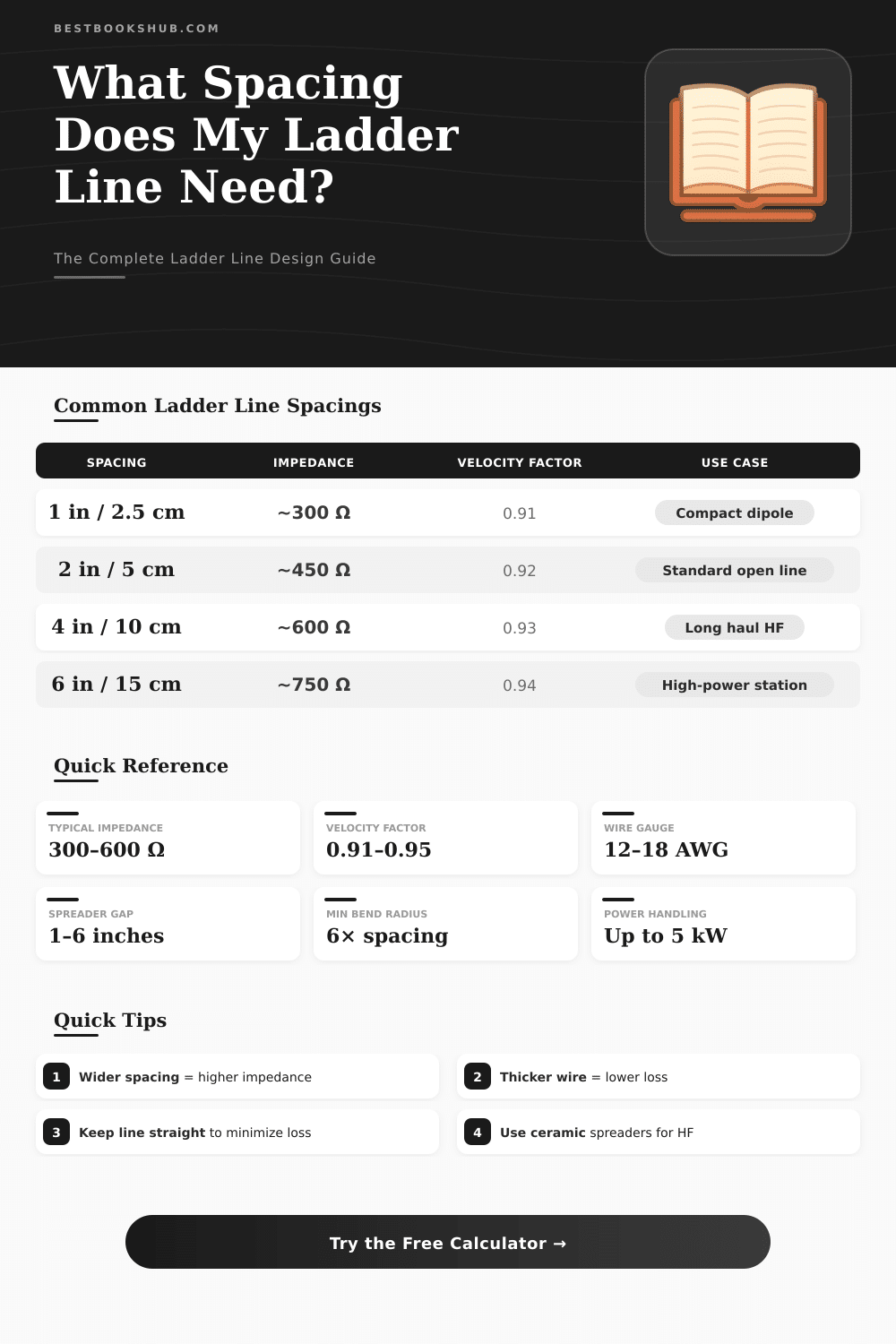
| Spacing (in) | Spacing (cm) | AWG 14 Wire Z₀ (Ω) | AWG 12 Wire Z₀ (Ω) | Velocity Factor | Common Use |
|---|---|---|---|---|---|
| 0.5 in | 1.27 cm | ~252 Ω | ~236 Ω | 0.91 | Compact / portable |
| 1 in | 2.54 cm | ~308 Ω | ~292 Ω | 0.92 | 450 Ω window line |
| 2 in | 5.08 cm | ~367 Ω | ~350 Ω | 0.93 | DIY open wire |
| 3 in | 7.62 cm | ~408 Ω | ~390 Ω | 0.94 | HF general purpose |
| 4 in | 10.16 cm | ~437 Ω | ~420 Ω | 0.95 | High power HF |
| 6 in | 15.24 cm | ~476 Ω | ~459 Ω | 0.95 | Long haul open wire |
| 12 in | 30.48 cm | ~536 Ω | ~519 Ω | 0.97 | Ultra-wideband HF |
| Line Length | Spreader Interval | Min Spreader Length | Notes |
|---|---|---|---|
| Up to 50 ft | Every 3–4 ft | = Conductor spacing | Wind loading minimal |
| 50–100 ft | Every 2–3 ft | 1.1× spacing | Add extra at midpoint |
| 100–200 ft | Every 2 ft | 1.1× spacing | Use rigid spreaders |
| 200 ft+ | Every 18–24 in | 1.2× spacing | Consider fiberglass rods |
| AWG | Diameter (mm) | Resistance (Ω/1000 ft) | Max Current (A) | Weight (lb/1000 ft) |
|---|---|---|---|---|
| 10 | 2.59 | 1.00 | 30 | 31.4 |
| 12 | 2.05 | 1.59 | 20 | 19.8 |
| 14 | 1.63 | 2.52 | 15 | 12.4 |
| 16 | 1.29 | 4.02 | 10 | 7.82 |
| 18 | 1.02 | 6.39 | 7 | 4.92 |
Ladder line is kind of parallel wires used for antennas that keeps distance between them. For a characteristic impedance of 450 Ohms with two parallel copper wires, the centers of the leads must be apart in about 1.725 inches. Commercial products commonly have spacing of 3.5 inches but you can easily create other distance if that is necessary
DISCLOSURE: This post may contain affiliate links, meaning when you click the links and make a purchase, I receive a commission. As an Amazon Associate I earn from qualifying purchases.
True ladder line is made up of two wires, usually without insulation, that keep insulators laid repeatedly. Those insulators are widely made from ceramic, glass, bakelite, phenolic or even fiberglass. If the line looks like broad double cable with holes punched out, it is not ladder line.
Ladder Line Basics and How to Build One
Such things serve for other targets.
Good initial dimensions are 4-inch line with 12-inch spacers. Some build it with 2.5 inches between the wires and spacers each 12 inches. For leads of 16 or 18 gauge, lay insulators every six inches work well.
The big advantage of open wire line is that it allows flow with almost silly SWR values without excessive tolls.
The distance between the wires should not pass 6 inches, otherwise the pattern will become weird. Even so, the precise spacing is not that critical. You can use any material for the spreaders, provided it does not lead electricity.
You can buy spacers online, although very few vendors now sell particular bits for ldaer line.
Many amateurs want to make parallel lines home. The process seems quite simple, because you only require wire and some insulators laid regularly to keep permanent distance. Even so, there usually exists a difference between the simple notion and the right result.
You can use the same wire from the dipole until the ladder line, so there will not be connections that could corrode. Some builder even used soft aluminum wire for electrical fence with four-inch spacers directly before the balun.
You can create 600 Ohm or 450 Ohm open line for dipole with 100% copper wire (16 gauge, 26 threads) with 3.5 inch spacing. Such lines are very lightweight and have low wind load. Moreover, there is no risk of failure because of splices, solder or crimping.
Parallel feeders can seize RF signal from the antenna and transport it as common-mode flow, which means that the two wires act as one in the same phase. To escape that, you must escape resonant lengths. The necessary length of the line depends on the length of the dipole and the intended frequencies.
Good balanced tuners will settle the problem if the dipole is at least half wavelength long at the used frequency. If you want to pass ladder line through a window, you can make a board with insulators that would suit in the opening.