📜 Public Domain Calculator
Determine if a creative work has entered the public domain under U.S. and international copyright law
📋 Copyright Status Results
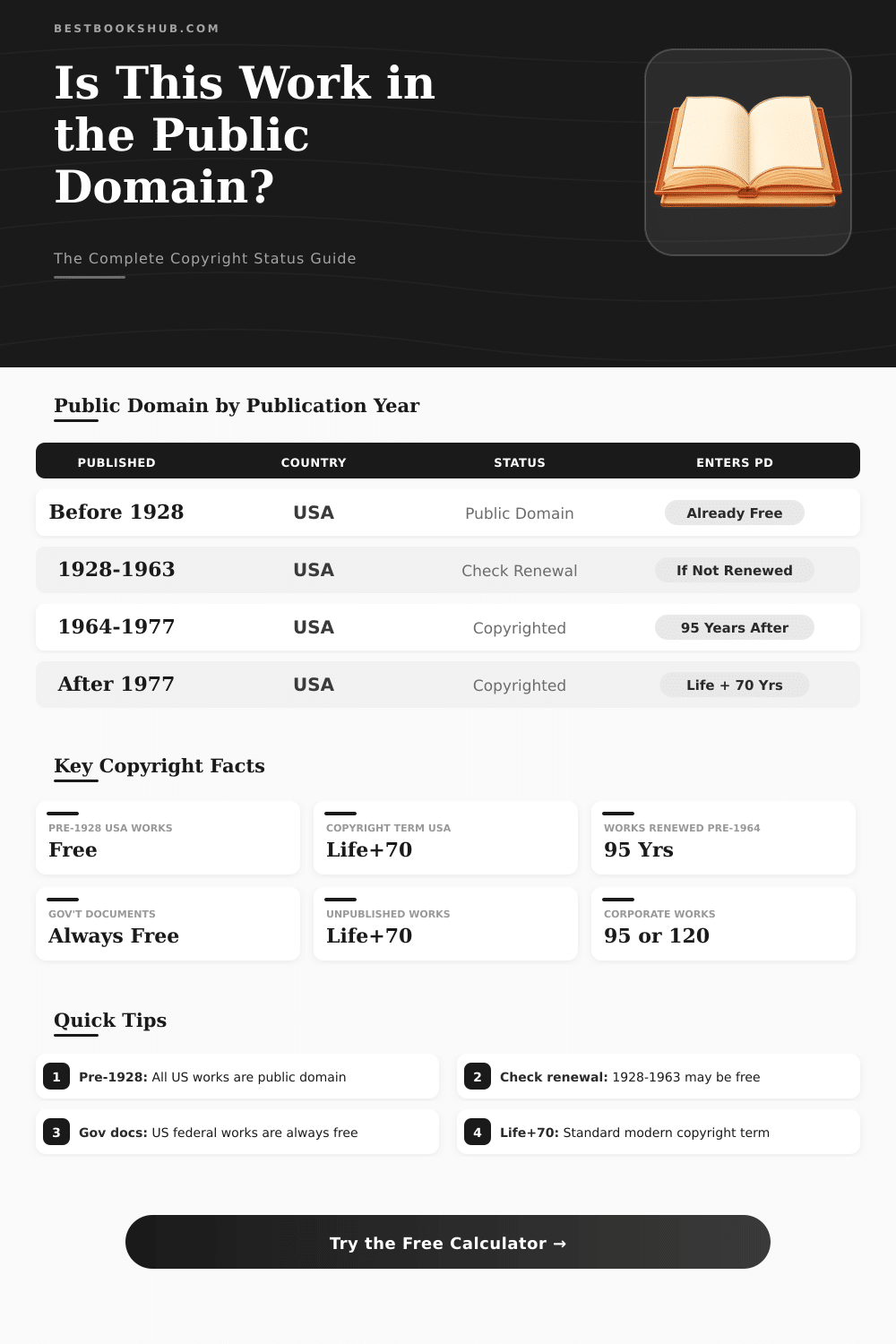
| Publication Period | Conditions | Copyright Term | Status (2025) |
|---|---|---|---|
| Before 1928 | Any published work | Expired | Public Domain |
| 1928 – 1963 | Published with notice, copyright renewed | 95 years from publication | Check Renewal |
| 1928 – 1963 | Copyright NOT renewed | 28 years (expired) | Public Domain |
| 1964 – 1977 | Published with notice | 95 years from publication | Protected |
| 1978 – 2002 | Created after Jan 1, 1978 | Life of author + 70 years | Protected |
| After 2002 | Any work | Life + 70 years | Protected |
| Any Year | U.S. Government work | No copyright | Public Domain |
| Any Year | Published without notice (pre-1989) | May be in public domain | Needs Review |
| Calendar Year | Works Published | Original Term | Notes |
|---|---|---|---|
| 2025 | Published in 1929 | 95 years | Renewed copyrights from 1929 |
| 2026 | Published in 1930 | 95 years | Renewed copyrights from 1930 |
| 2027 | Published in 1931 | 95 years | Renewed copyrights from 1931 |
| 2028 | Published in 1932 | 95 years | Renewed copyrights from 1932 |
| 2029 | Published in 1933 | 95 years | Renewed copyrights from 1933 |
| 2030 | Published in 1934 | 95 years | Renewed copyrights from 1934 |
| 2035 | Published in 1939 | 95 years | Includes The Wizard of Oz film |
| 2049 | Published in 1953 | 95 years | Last pre-1964 renewal year |
| Work Category | Copyright Term | Measured From | Example |
|---|---|---|---|
| Work for Hire (published) | 95 years | Date of publication | Corporate annual report |
| Work for Hire (unpublished) | 120 years | Date of creation | Unpublished corporate memo |
| Anonymous Work | 95 or 120 years | Publication or creation | Unsigned editorial |
| Pseudonymous Work | 95 or 120 years | Publication or creation | Pen name author |
| Joint Work | Life of last survivor + 70 | Death of last author | Co-authored textbook |
| Compilation / Database | Life + 70 years | Death of compiler | Curated anthology |
| Sound Recording (pre-1972) | Special state/federal rules | Varies by state | Old vinyl recordings |
| Architecture (post-1990) | Life + 70 years | Death of architect | Building design plans |
Public domain relates to creative works that do not have laws about intellectual property, such as copyright, trademark or patent. These works belong to the public, rather than to some author or artist. No single person owns the public domain as the name says, it is open for everyone.
DISCLOSURE: This post may contain affiliate links, meaning when you click the links and make a purchase, I receive a commission. As an Amazon Associate I earn from qualifying purchases.
Anyone can copy, distribute or modify those works without asking for permission or a license from some company
What Is the Public Domain?
Works can become part of the public domain by various ways. That happens when the period of copyright expires, if the author gives up his rights on purpose, or if you did not follow the rules of the past. Also works that government employees of United States created as part of official tasks are not protected.
Even so, works of state or local governments not always have that status and can be protected by copyright.
The public domain is a group of creative works; including books, music, art and films, that anyone can use, adapt and share without restrictions. When a work becomes public, the characters in it also become public domain, assuming that they were protected initially.
Being available on-line was absolutely not the same thing as being in the public domain. Currently, copyright happens automatically. If someone creates something, it is immediately protected.
Moreover, works can be protected in one land, but belong to the public domain in another.
In United States, almost all works (except sound recordings) issued before January 1st 1931 lost their protection after 95 years, which will happen in January 2026. That means, that works from 1930 will enter the public domain then. Musical compositions follow that same rule of 95 years.
Sound recordings however have other rules and will become public grade from 2021 until 2067. The status of works issued between 1925 and 1968 depends on whether you followed certain formalities. For instance, a work from 1928 without copyright notice did not meet the law and hence is already public.
For works created before 1870, you can safely assume that they are in the public domain globally. But when the dates are newer, the status varies because of different laws in various lands. Unfortunately, many institutions claim to have copyright over scanned images of public works, so check the information that they upload.
The Public Domain Mark operates as a label. It helps institutions and other people communicate with reliable knowledge, that a work is no longer restricted by copyright. Those marks help to identify public works clearly, ease their finding and reuse, and give sure info about the copyright status to the public.