📄 GSM Paper Weight Converter
Convert between GSM, lb Bond, lb Cover, lb Text, lb Index, and Points — instantly and accurately
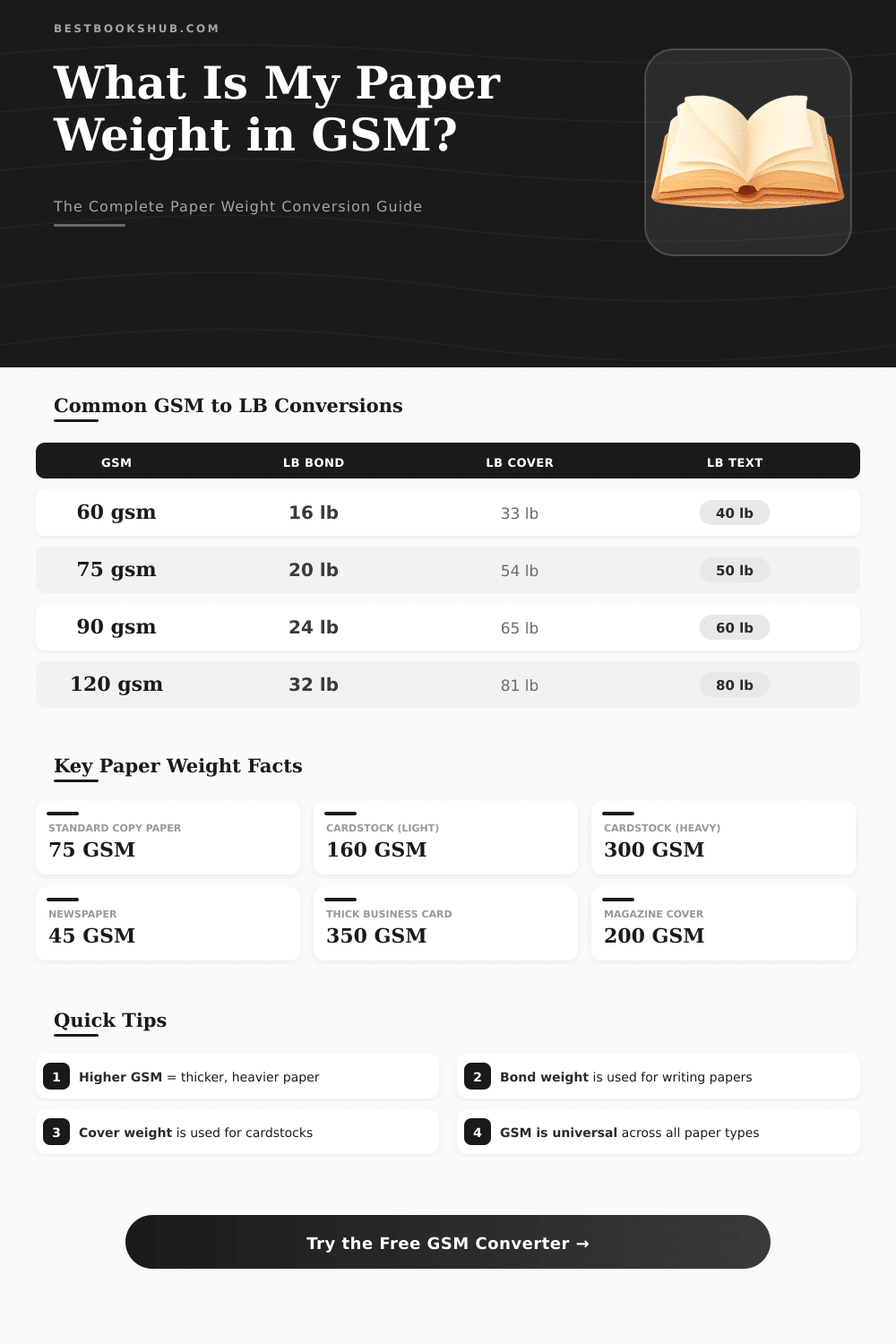
| GSM (g/m²) | LB Bond | LB Cover | LB Text | LB Index | Points (pt) |
|---|---|---|---|---|---|
| 45 gsm | 12 lb | 24 lb | 30 lb | 33 lb | 2.0 pt |
| 60 gsm | 16 lb | 33 lb | 40 lb | 44 lb | 2.7 pt |
| 75 gsm | 20 lb | 41 lb | 50 lb | 55 lb | 3.4 pt |
| 90 gsm | 24 lb | 49 lb | 60 lb | 66 lb | 4.0 pt |
| 105 gsm | 28 lb | 57 lb | 70 lb | 77 lb | 4.7 pt |
| 120 gsm | 32 lb | 65 lb | 80 lb | 88 lb | 5.4 pt |
| 148 gsm | 40 lb | 80 lb | 99 lb | 108 lb | 6.6 pt |
| 163 gsm | 44 lb | 88 lb | 109 lb | 120 lb | 7.3 pt |
| 200 gsm | 54 lb | 108 lb | 134 lb | 147 lb | 8.9 pt |
| 250 gsm | 67 lb | 135 lb | 168 lb | 184 lb | 11.2 pt |
| 300 gsm | 81 lb | 162 lb | 201 lb | 220 lb | 13.4 pt |
| 350 gsm | 94 lb | 189 lb | 235 lb | 257 lb | 15.6 pt |
| Paper Type | Basic Sheet Size | Sheets per Ream | GSM Factor (divide lb by) | Typical Use |
|---|---|---|---|---|
| Bond / Writing | 17" x 22" | 500 | 0.266 | Copy paper, letterhead |
| Cover | 20" x 26" | 500 | 0.137 | Cardstock, covers |
| Text / Book | 25" x 38" | 500 | 0.675 | Books, brochures |
| Index | 25.5" x 30.5" | 500 | 0.147 | Index cards, tabs |
| Bristol | 22.5" x 28.5" | 500 | 0.167 | Drawings, art |
| Tag | 24" x 36" | 500 | 0.552 | Tags, labels |
| GSM | Paper Type | Ream (500 sheets) Weight | Per Sheet Weight | Common Name |
|---|---|---|---|---|
| 75 gsm | Bond | ~8.8 lbs (4.0 kg) | ~4.0 g | Standard Copy |
| 80 gsm | Bond | ~9.4 lbs (4.3 kg) | ~4.3 g | Office Paper |
| 90 gsm | Bond | ~10.6 lbs (4.8 kg) | ~4.8 g | Premium Copy |
| 160 gsm | Cover | ~18.8 lbs (8.5 kg) | ~8.5 g | Light Cardstock |
| 200 gsm | Cover | ~23.5 lbs (10.7 kg) | ~10.7 g | Photo Paper |
| 300 gsm | Cover | ~35.3 lbs (16.0 kg) | ~16.0 g | Heavy Cardstock |
GSM means “grams per square metre” and it is for measuring the weight or density of paper. Simply put, it shows how much one square metre of the product weighs. This measure is also used for clothes.
DISCLOSURE: This post may contain affiliate links, meaning when you click the links and make a purchase, I receive a commission. As an Amazon Associate I earn from qualifying purchases.
Although the official symbol according to the metric standards is g/m² in everyday life you commonly write “gsm”.
What GSM Means for Paper
You call paper weight also “basis weight“. You can measure it in pounds (lbs) or in GSM. Because GSM measures the actual weight of a square metre, it is much more simple than the basis weight.
The lower the GSM number, the thinner and lighter is the paper. Higher GSM means thicker and heavy paper. Like this, high GSM gives more strong sheets that do not let the ink go across and allow sharper results.
In the United States, you measure paper weight in pounds, which depends on the category of the paper and the size of the sheet. If the package says that the paper is “24 lb“, that means a ream of 500 sheets would weigh 24 lbs. This imperial measure is based on the weight of 500 sheets, but it changes according to the size of the paper.
Makers use differnet standards, for instance 17″ x 22″ or 20″ x 26″. That can be confusing, because different categories have different rules. For instance, “60lb Text/Offset” is 90 gsm, but “65lb Cover” is 175 gsm.
The gram system is the most precise way to determine the weight of paper. GSM gives a universal and steady way to compare the thickness of various papers. The numbers always go from small to big regardless of the base of the paper.
To change pounds to GSM, you multiply every pound of cover paper by 2.708. Like this, 80lb text paper corresponds to approximately 118.4 gsm.
Even so, GSM is only a guide. Two different papers can have the same weight, but different thickness or density. For instance, thinner but denser paper can have higher GSM than thicker, but less dense paper.
So, GSM affects the thickness, but it is not entirely the same thing. A gloss sheet with the same thickness as a smooth, uncoated sheet will weigh more because of the coating.
Generally, paper of 75 GSM is considered lightweight. Standard office paper usually measures between 70 and 90 gsm, and 80 gsm is the most common weight. For prime invitation cards, the weight is much higher.
Paper between 250 and 350 GSM is widely seen as heavy card stock. When you reach 350 to 400 GSM, the paper is very thick and commonly used for special cards. European countries usually use GSM for measuring paper, while North America commonly use other standards.
Even so, GSM stays the standard measure used worldwide.