⚗️ AP Chemistry Score Calculator
Convert your raw MCQ & FRQ scores to a predicted AP score (1–5)
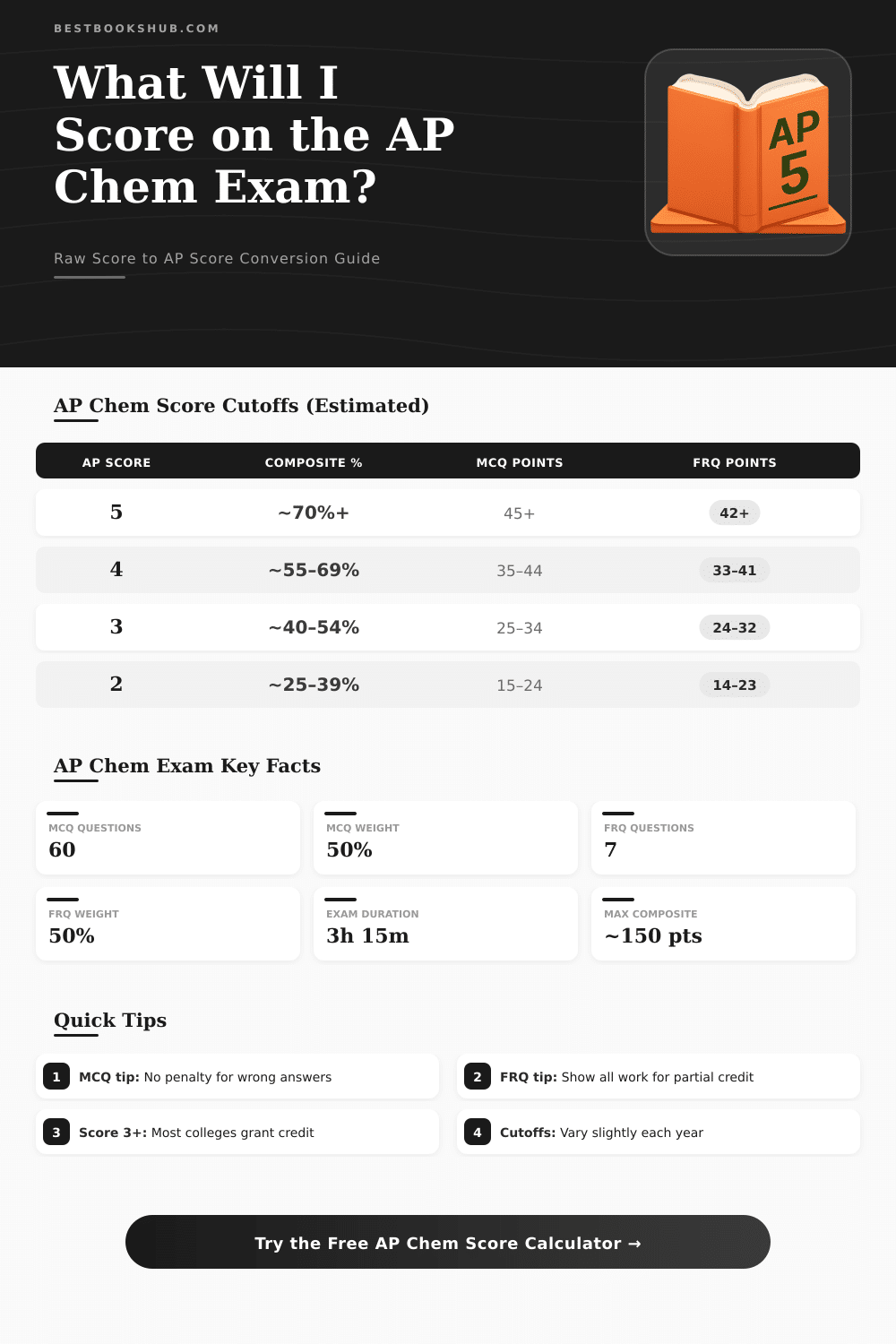
| AP Score | Composite % Range | Standard Year | Lenient Year | Strict Year | Meaning |
|---|---|---|---|---|---|
| 5 | ~68–75%+ | ~70% | ~65% | ~75% | Extremely Well Qualified |
| 4 | ~54–68% | ~56% | ~52% | ~60% | Well Qualified |
| 3 | ~40–54% | ~42% | ~38% | ~46% | Qualified |
| 2 | ~26–40% | ~28% | ~24% | ~32% | Possibly Qualified |
| 1 | 0–26% | <28% | <24% | <32% | No Recommendation |
| Question | Type | Max Points | Typical Topics | Difficulty |
|---|---|---|---|---|
| Q1 | Long FRQ | 10 pts | Equilibrium, Thermodynamics | High |
| Q2 | Long FRQ | 10 pts | Kinetics, Acids/Bases | High |
| Q3 | Long FRQ | 10 pts | Electrochemistry, Solutions | High |
| Q4 | Short FRQ | 4 pts | Atomic Structure, Bonding | Medium |
| Q5 | Short FRQ | 4 pts | IMFs, States of Matter | Medium |
| Q6 | Short FRQ | 4 pts | Stoichiometry, Reactions | Lower |
| Q7 | Short FRQ | 4 pts | Lab Analysis, Data | Medium |
| Unit | Topic | ~% of MCQ | ~Questions |
|---|---|---|---|
| 1–3 | Atomic Structure, Bonding, IMF | 15–18% | 9–11 |
| 4 | Reactions & Stoichiometry | 7–9% | 4–5 |
| 5 | Kinetics | 7–9% | 4–5 |
| 6 | Thermodynamics | 7–9% | 4–5 |
| 7 | Equilibrium | 7–9% | 4–5 |
| 8 | Acids, Bases & Buffers | 11–15% | 7–9 |
| 9 | Electrochemistry | 7–9% | 4–5 |
| Mixed | States of Matter, Solutions, Lab | 18–22% | 11–13 |
| Composite Score | % of Max (~150) | Predicted AP Score (Standard) | Predicted AP Score (Lenient) |
|---|---|---|---|
| 135–150 | 90–100% | 5 | 5 |
| 115–134 | 77–89% | 5 | 5 |
| 105–114 | 70–76% | 5 | 5 |
| 90–104 | 60–69% | 4 | 5 |
| 84–89 | 56–59% | 4 | 4 |
| 75–83 | 50–55% | 3 | 4 |
| 63–74 | 42–49% | 3 | 3 |
| 57–62 | 38–41% | 2 | 3 |
| 42–56 | 28–37% | 2 | 2 |
| 0–41 | 0–27% | 1 | 1 |
The AP Chemistry exam uses a scale of 1 to 5, where 5 is the highest achievement and shows that you are “extremely well qualified” in the subject. Various colleges interpret those scores differently; some give advance placement, others credit for courses. Usually, scores of 3 or more are considered passing.
DISCLOSURE: This post may contain affiliate links, meaning when you click the links and make a purchase, I receive a commission. As an Amazon Associate I earn from qualifying purchases.
Even so, if you want strong college credit, especially for pre-med or STEM, you will likely need 4 or 5. Remember that pre-med students must check whether their intended schools and medical schools accept AP Chemistry to meet the preconditions. Currently, 3 is the standard to qualify
What AP Chemistry Scores Mean
The average scores range from year to year. Last year the average was 3.31, while 2023 it was 3.26. Before that the figures were lower, in 2022 it was 2.73 and in 2021 were 2.66.
The year 2020 had a mean around 2.76. The College Board issues detailed lists that show how many students reached every score, together with the total number of test takers and mean results. You will notice that the majority of students locate in the center.
Very few reach the extremes, either fail or perfectly succeed, which create the known form of the bell curve.
Here is an important spot: only around 30% of the students receive 4 or 5. That maybe sounds scary, but do not worry too much. The cause is that the test is not compared with your classmates.
If each would receive 90 from 100, each would receive 5. The success of others does not steal points from you. If you reach the threshold, you genuinely deserve it.
The exam is made up of two parts, and each counts 50% of the final result. AP Chemistry covers nine major units through the whole curriculum. You will write your free response answers by hand in booklets, that you later send for grading.
A team of high school and college teachers grade those answers by means of a rubric that they make when the grading starts. During both parts of the exam (the multiple choice and the free answer), you get to use a sheet with common equations and constants.
If we look at the last years, reaching around 78 to 80% in the exams usually gives you 5. Some ratings say that the threshold could be a bit lower, around 77 to 79%, depending on the version of the exam. Even so, no one genuinely knows what the College Board will decide annually.
They do not even issue the guides for the free answers until they indeed start to read the exams.
do not panic if everything does not go perfectly. A score of 3 still is passing; and that already is a good achievement. While you prepare, practice tests help a lot.
If you track which questions you miss and which you succeed, you will know exactly what to study. If your results in practice tests are a bit low regarding your target, extra work usually helps calm thenerve.