📚 Cumulative GPA Calculator
Combine your previous GPA with new semester grades to find your updated cumulative GPA
| Course Name (Optional) | Credit Hours | Letter Grade |
|---|
| Step | What to Do | Example | Result |
|---|---|---|---|
| 1 | Multiply previous GPA × previous credits | 3.20 × 60 | 192 grade points |
| 2 | Multiply each course grade × course credits | 4.0 × 3 credits | 12 grade points |
| 3 | Sum all new semester grade points | 12 + 9 + 6 + 8 | 35 grade points |
| 4 | Add old + new grade points | 192 + 35 | 227 total points |
| 5 | Add old + new credit hours | 60 + 15 | 75 total credits |
| 6 | Divide total points by total credits | 227 ÷ 75 | 3.03 new cumulative GPA |
| Current GPA | Credits Done | Need 3.0: Sem GPA Required | Need 3.5: Sem GPA Required |
|---|---|---|---|
| 2.5 | 30 | 3.50 over 30 credits | 4.00+ (may not be possible) |
| 2.5 | 60 | 3.50 over 60 credits | 4.00+ (may not be possible) |
| 2.7 | 30 | 3.30 over 30 credits | 4.00 over 30 credits |
| 2.7 | 60 | 3.60 over 60 credits | 4.00+ (may not be possible) |
| 2.9 | 30 | 3.10 over 30 credits | 3.80 over 30 credits |
| 2.9 | 60 | 3.10 over 60 credits | 4.00 over 60 credits |
| 3.2 | 30 | Already above 3.0 | 3.80 over 30 credits |
| 3.2 | 60 | Already above 3.0 | 3.80 over 60 credits |
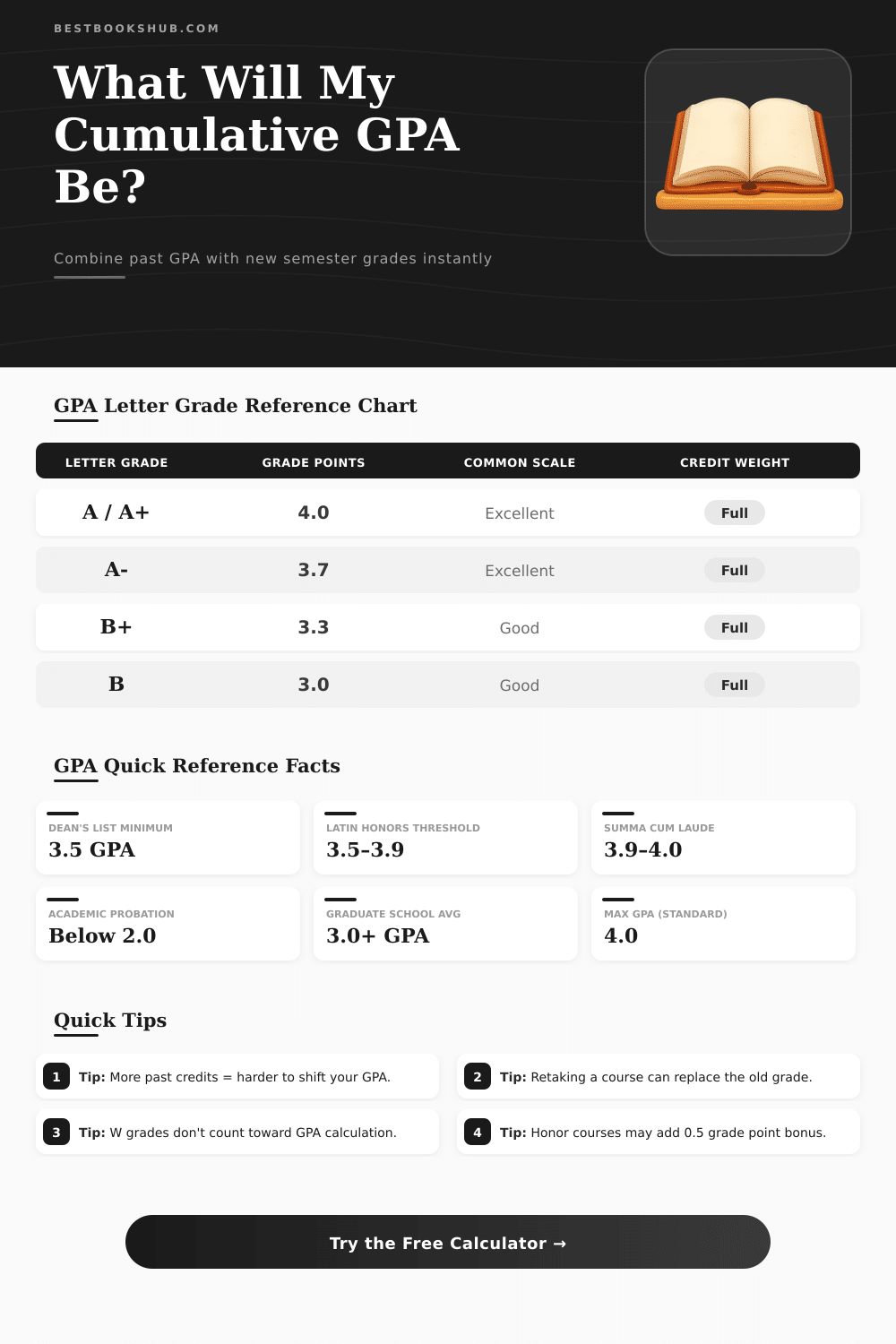
| Letter Grade | Grade Points | Academic Standing | Notes |
|---|---|---|---|
| A+ / A | 4.0 | Excellent | Highest achievable |
| A- | 3.7 | Excellent | Slightly below A |
| B+ | 3.3 | Good | Above average |
| B | 3.0 | Good | Standard graduate threshold |
| B- | 2.7 | Above Average | |
| C+ | 2.3 | Average | |
| C | 2.0 | Average | Minimum passing (many majors) |
| C- | 1.7 | Below Average | |
| D+ | 1.3 | Poor | |
| D | 1.0 | Poor | Lowest passing grade |
| F | 0.0 | Failing | No credit earned |
The cumulative GPA shows the average of all grades got during the whole secondary or university career rather to only one semester or quarter. It combines the GPAs of all periods in one total number. When some mention simply “your GPA” without more details, it usually means this cumulative, that outlines the whole academic way so far.
DISCLOSURE: This post may contain affiliate links, meaning when you click the links and make a purchase, I receive a commission. As an Amazon Associate I earn from qualifying purchases.
The term GPA considers only the classes of one particular semester. Rather, the cumulative GPA is the total amount of all classes done in the school. That is the main GPA, what explains the word “cumulative”, it adds values one after the another.
What Is Cumulative GPA?
Every course has a fixed number of credits, usually according to the hours that it involves wekly. To count the GPA, you divide the amount of grade points by the amount of credits. For cumulative GPA, you take the whole of spots and credits through all semesters.
For instance, 63.2 spots over 17 credits give a semester GPA of 3.72. The cumulative version mixes all semesters similarly.
Every course at full credit, with final grade of A to F, enter the calculation. You usually exclude remedial courses under 100-level and no-graded compulsory classes. Some, as sports or electives, also can lack from the GPA.
The cumulative GPA is the number used for university apps or jobs. In the Common App, it must match with the transcript. It can be unweighted or weighted.
Schools weight differently, but usually cumulative GPA means the unweighted. If a request mentions it, ask whether weighted or not.
Transfer credits make things tricky. At many schools, credits of another institution transfer, but not the GPA, only the credits self. The cumulative GPA of community college measures only classes done there.
For a new school, you use the cumulative of the main institution.
The major GPA limits to courses in a particular field of study. Some students point it in a CV, if it surpasses the cumulative. At Canadian universities, the last year commonly weighs more than the whole accumulation for new programs.
Schools like to see progress in grades, so a good finishhelps a lot.