📈 Readability index
Automated Readability Index Calculator
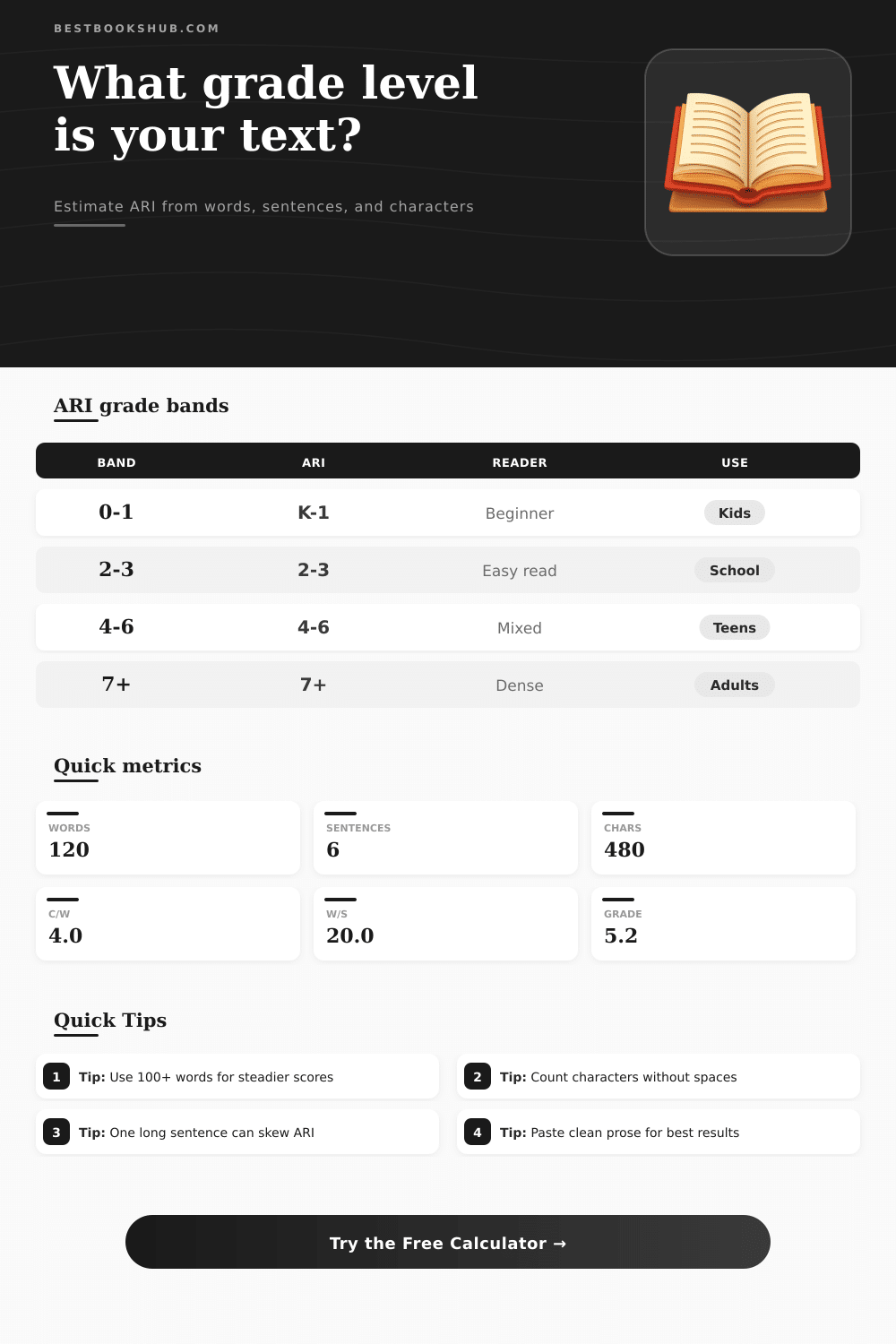
Estimate grade level from character, word, and sentence counts. Compare ARI bands, audience fit, and revision targets in one pass.
| Band | ARI | Reader | Action |
|---|---|---|---|
| Very easy | 0-1 | Primary | Use for beginners |
| Easy | 2-3 | Upper primary | Good for children |
| Moderate | 4-6 | Middle grades | Balanced for web |
| Hard | 7+ | Teens + adults | Trim long sentences |
| Sample size | Confidence | Best use | Why |
|---|---|---|---|
| 25-49 words | Low | Quick draft | Too small for stable ARI |
| 50-99 words | Fair | Short excerpt | Useful for early checks |
| 100-149 words | Good | Main scoring | Stable enough for review |
| 150+ words | High | Final pass | Best for comparisons |
DISCLOSURE: This post may contain affiliate links, meaning when you click the links and make a purchase, I receive a commission. As an Amazon Associate I earn from qualifying purchases.
A readability index is an estimate of how hard a text is to read. The estimate is made by measuring how complex the text is. Things like word length, sentence length, and syllable count give ways to measure how complex a piece of writing really is.
There are several well-known readability formulas. The Flesch-Kincaid Grade Level formula gives a score as a U.S. Grade level, making it easier for teachers, parents, librarians, and others to judge the readability level of books and texts. The Flesch Reading Ease score falls between 1 and 100.
Readability Tests and Scores
A score of 70 or higher means the text is very readable, roughly at an eighth grade level or easier. Scores between 50 and 70 match a high school reading level. A score between 70 and 80 is equal to grade 8 and works for most professional documents.
Anything for children should score 80 or above
The Coleman-Liau Index measures the difficulty of English text and estimates the grade level needed to understand it. It focuses on the average number of letters and sentences. Two linguists named T.L.
Liau and Meri Coleman created this readability index in 1975. They wanted to assess the readability of textbooks being used in public schools in the USA.
Less well-known than the Flesch-Kincaid or Dale-Chall indexes is the Gunning Fog Index. Gunning was an editor and American businessman who, after having his writing critiqued as too difficult, began to see the benefits of simplification. He developed a formula that combined the approaches of the Flesch-Kincaid and the Dale-Chall
The Automated Readability Index was developed by linguists E.A. Smith and R.J. Senter to improve the readability of technical manuals.
It assesses the U.S. Grade level required to read a piece of text and uses long words and long sentences to calculate a score.
All of these formulas are meant to assess continuous paragraphs with full sentences. The SMOG Index, for example, requires a minimum of 30 sentences: ten from the start, ten from the middle, and ten from the end
These readability tests are used a lot in education. Some big school book publishers in the US had mandatory requirements of certain readability scores for their books. A high readability score doesn’t always mean the content is actually more readable, though.
The algoritms can be tricked with gibberish text.
Software tools can quickly use algorithms like the Flesch Reading Ease or the Gunning Fog Index to spot hard-to-read passages. LibraryThing has partnered with MetaMetrics to bring Lexile measures to their platform, offering another way for members to view their books by reading level. These tools work as a complement to editorial expertise, not a replacement for it.Thesetools work as a complement to editorial expertise, not a replacement for it.