✍ Draft planning
Writing Schedule Calculator
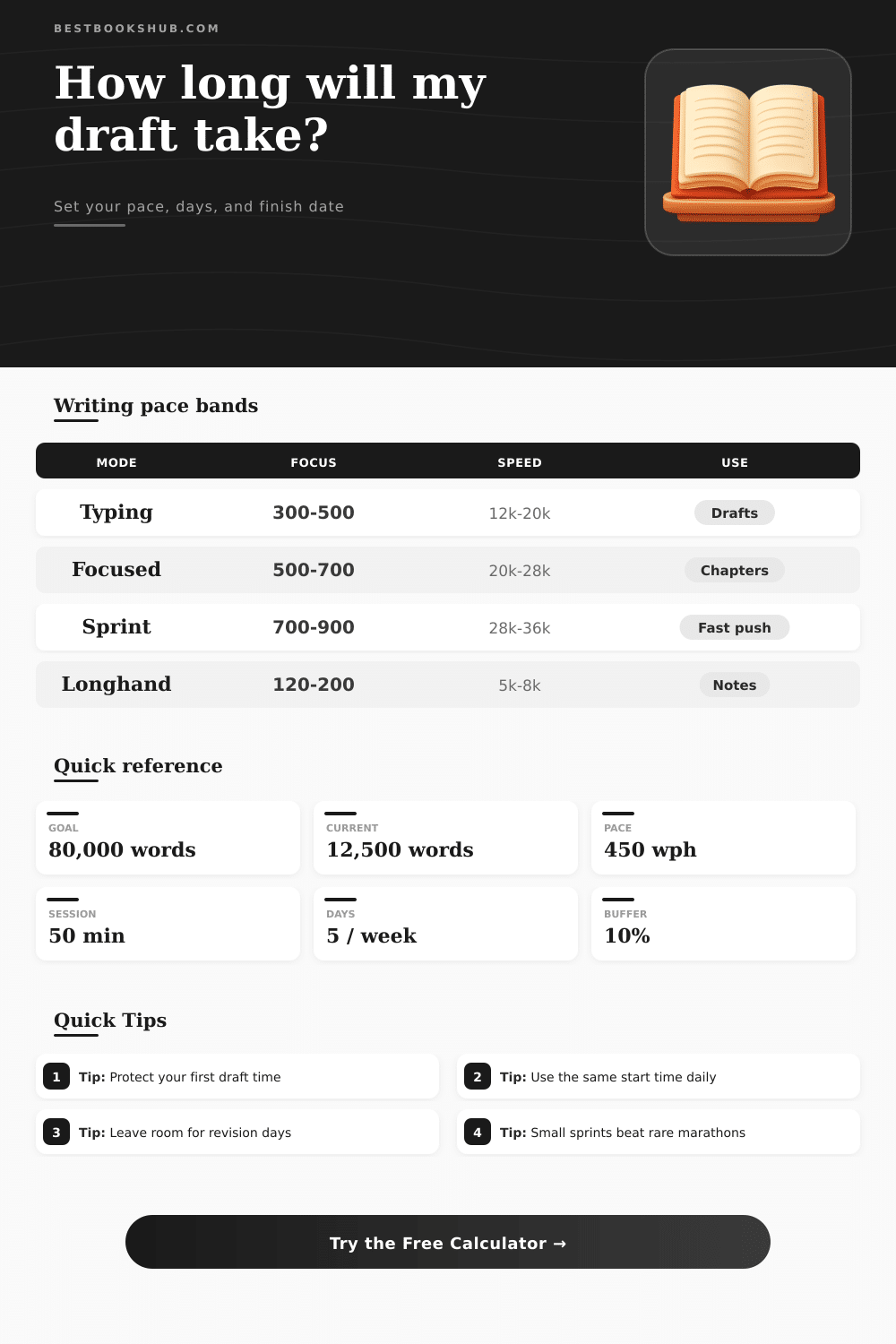
Estimate total writing time, convert it into a daily plan, and see the finish date based on your current pace and deadline.
The calculator blends word count, progress gap, writing mode, difficulty, buffer, and weekly availability to estimate a realistic plan.
| Mode | Pace | Retention | Best use |
|---|---|---|---|
| Skim | Fast | Low | Plotting and planning |
| Notes | Steady | Medium | Most first drafts |
| Recall | Slower | High | Edits and rewrites |
| Teach | Slowest | Very high | Proofing and final checks |
| Plan | Min/day | Days/wk | Best fit |
|---|---|---|---|
| Sprint | 90-120 | 6 | Deadline push |
| Balanced | 60-90 | 5 | Most study plans |
| Weekend | 120-180 | 2 | Busy weekdays |
| Steady | 45-60 | 6 | Long runway plans |
DISCLOSURE: This post may contain affiliate links, meaning when you click the links and make a purchase, I receive a commission. As an Amazon Associate I earn from qualifying purchases.
Writing schedule is more than just planning when to sit and work on book. It helps authors ensure that they really end their novels Creating writing schedule gives you time management tool for more productive routine. That also marks official state of writer.
As long as some write, they are writer.
How to Make a Writing Schedule
Be concrete. Something like “one hour each morning during weekdays” forms good base. Think how much time you devot daily to writing.
One author intends only 20 minutes of solid writing daily, while others want two hours. Key is safe plan that you successfully will follow during two to four weeks. After it roots, long sessions help to keep the rhythm.
Grow as writer require high stamina.
Simple method for writing schedule planning starts with word count, for instance 90 000 words. Later set everyday word count. Every writer is different, so everyday targets range according to days.
Number the working days between start date and intended end date. Share the whole word count by that number of working days. Like this you find the everyday word count to reach the target.
For instance, five writing days weekly during 13 weeks give 65 days for 80 000 words.
Not every author writes daily. Everyday writing can cost the pleasure for some. Four days weekly operate well as alternative.
No fast or slow mode, only that what answers to each. Main spot is prioritize and find time in the day, even if only some minutes.
Some authors write several hours daily without strict plan, commonly in the morning, but also in afternoon. Three intended hours produce around 4 000 new words or allow to review 10 000 words. Others wake up early, write one hour, do day job, later rest and write at least yet one hour.
That schedule gives 3 000 until 8 000 words a day.
While days off some authors write almost all day and reach 4 000 until 10 000 words, during working days they write 1 000 until 5 000 words in afternoon. Book can be finished in two weeks or so. Life stage matters.
Young writers that start career and family write when it is possible. Professional follows fixed schedule and write daily, because that is his work.
The best writing time is personal. Some authors write original text by hand and intend five until seven pages a day, ideally in the morning, for later engage in research or other causes. Others use evenings instead of reading or looking at television when time limits.
The good schedule is that that you genuinely follow.