📚 Citation integrity tracker
Self-Citation Calculator
Audit author-driven citations, compare them with field norms, and see how much of your citation footprint comes from outside the loop.
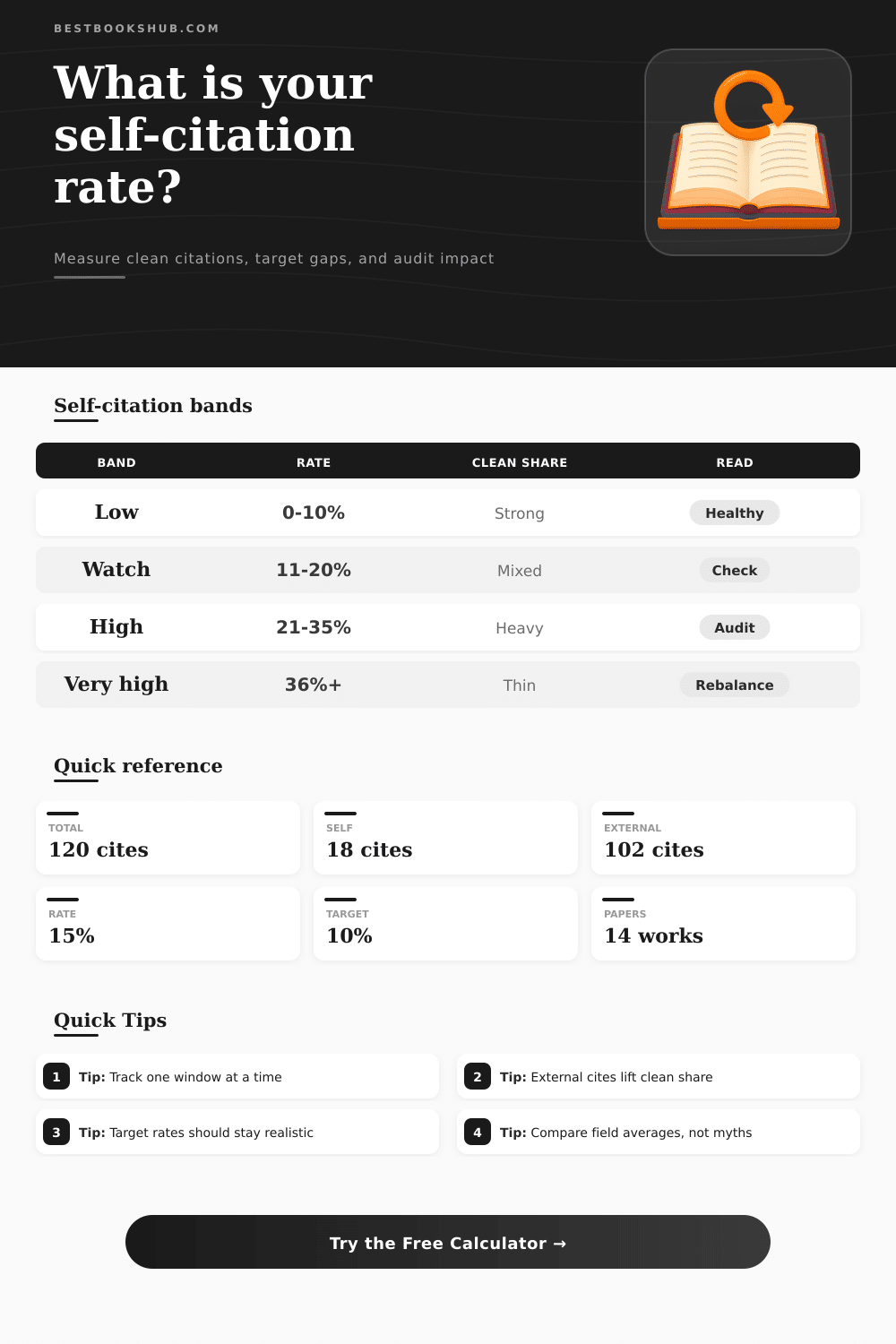
| Band | Rate | Clean share | Read |
|---|---|---|---|
| Low | 0-10% | Strong | Healthy |
| Watch | 11-20% | Mixed | Check |
| High | 21-35% | Heavy | Audit |
| Very high | 36%+ | Thin | Rebalance |
| Profile | Total | Self | Read |
|---|---|---|---|
| Solo author | 28 | 7 | Early base |
| Lab network | 240 | 18 | Wide reach |
| Review-heavy | 64 | 10 | Mixed mix |
| Textbook line | 110 | 9 | Shared base |
| Target | Max self | What it means | Read |
|---|---|---|---|
| 10% | 12 of 120 | Lean profile | Clean |
| 15% | 18 of 120 | Balanced mix | Normal |
| 20% | 24 of 120 | Watch closely | Borderline |
| 25% | 30 of 120 | Heavy self loop | Audit |
| Field | Typical rate | Watchpoint | Read |
|---|---|---|---|
| Monographs | 8-12% | Series loops | Stable |
| STEM articles | 10-15% | Lab clusters | Expected |
| Review essays | 12-18% | Topic overlap | Normal |
| Edited volumes | 8-14% | Chapter reuse | Check |
DISCLOSURE: This post may contain affiliate links, meaning when you click the links and make a purchase, I receive a commission. As an Amazon Associate I earn from qualifying purchases.
The self-citation calculator helps to estimate how many times an author cited his own prior work in new articles or books. The rate of self-citations separates citations of self from all received citations of self and others and both values grow over time. You count such things because they affect how the efficiency of author is measured
Websites as Scopus and ORCID show how many papers are self-citations. In Web of Science you easily count the proportion of self-citations by means of author search and tap on “Create Citation Report“. The report gives total publications, h-index and relevant data.
How to Count Self-Citations
Google Scholar also serves to track citations. Its Metrics ranks the top journals of field according to five-year h-index and h-median. From Google Scholar you can see all citing articles and quickly recognis self-citations.
The definition of self-citation can alter the results. For lands, fields, subfields or institutions you count percentages of self-citations and without them by means of formula in separate sheet. Not all journals match, so it is wrong to use one same formula for everything.
Self-citations matter especially for non-English speaking academic groups.
There is no universal reasonable limit for the proportion of self-citations. It depends on critics and the community to decide what is in order. Self-citation works if it is relevant, necessary and nothing other can prove the spot.
A single author’s self-citations have little impact because they can not be too many. Good calculators however remove self-citations from the count.
Students writing thesis or capstone project can self-cite their early work. It makes sense for every investigator whose new work bases on his prior papers. No self-citations indeed hurt young scientists.
Read one or several first-authored papers of some disclose deep experience and help to understand his focal theme.
When self-citations surpass some amount, you start to dislike them. One sample had 27 self-citations, from that only four or five related. Simple solution would be to not count citations where partner is also author of the citing paper.
The h-index calculation should exclude self-citations instead of that readers must search relevant citations that are usefull.
Citation generators as Citation Machine, Cite This For Me and Zotero help to create precise citations in styles as APA, MLA, Chicago and Harvard for books, websites, journals etc. They produce citations in seconds and support more than thousand styles.