📖 Chapter pacing desk
Chapter Reading Time Calculator
Estimate how long a chapter, group of chapters, study passage, or transcript will take with pages, words, WPM, comprehension mode, breaks, daily sessions, and finish timing.
Use pages when you know the edition layout. Use words for manuscripts, transcripts, exported ebook chapters, and study packets.
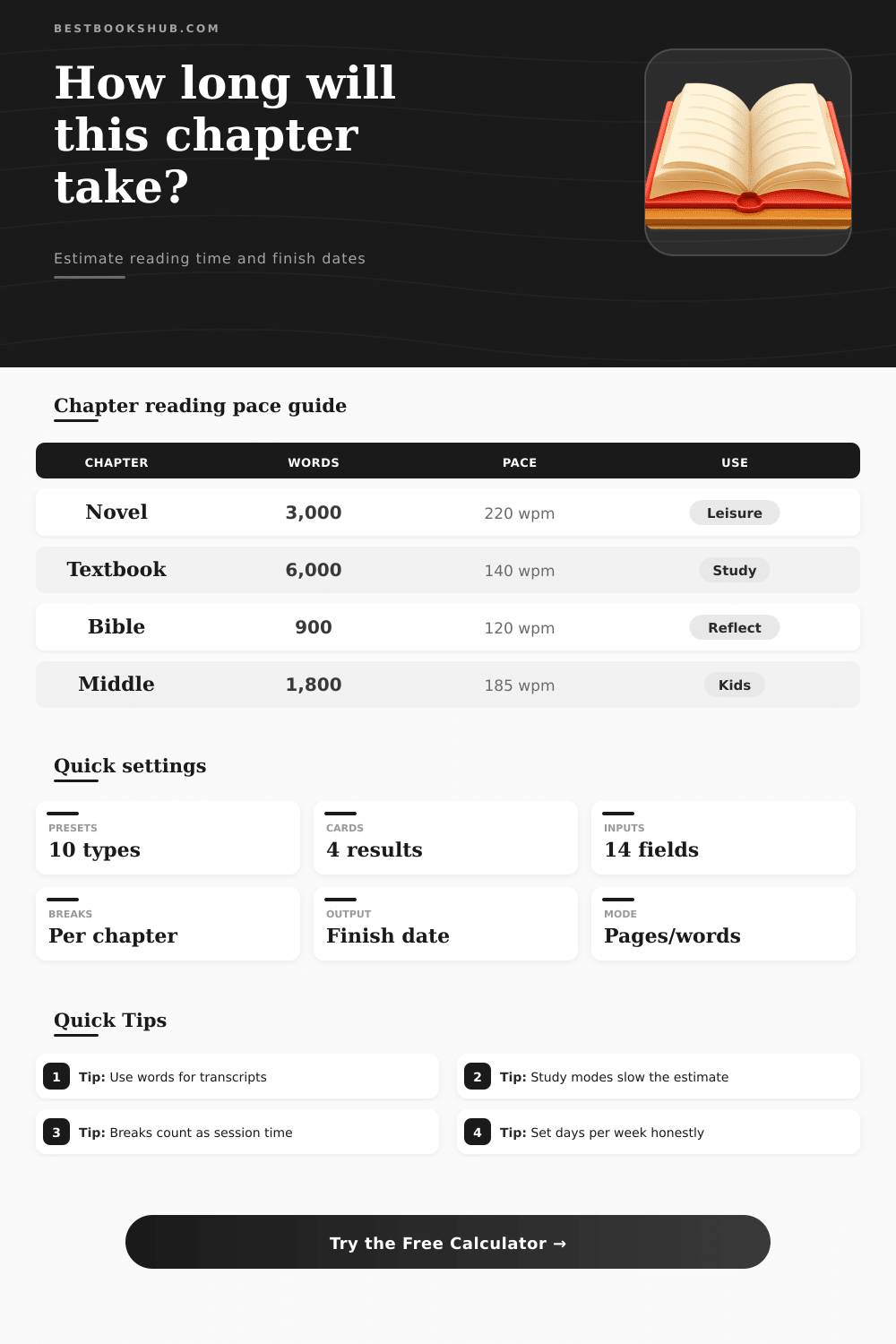
| Chapter type | Typical pages | Typical words | Planning note |
|---|---|---|---|
| Contemporary novel chapter | 10-18 pages | 2,500-4,500 words | Often works well as one bedtime or commute session. |
| Textbook chapter section | 18-35 pages | 5,000-10,000 words | Plan for concept pauses, examples, charts, and end questions. |
| Bible chapter study | 1-4 pages | 600-1,200 words | Reading time is short; reflection and cross-reference time dominate. |
| Audiobook transcript chapter | 12-25 pages | 3,000-6,500 words | Use words mode when exported transcript pages are inconsistent. |
| Middle grade chapter | 6-12 pages | 1,200-2,400 words | Shorter paragraphs make chapter completion easier to schedule. |
| Mode | Best for | Time multiplier | What it adds |
|---|---|---|---|
| Casual read | Light fiction and rereads | 0.95x | Relaxed pace with little marking or review. |
| Focused read | Most book chapters | 1.00x | Baseline reading with normal attention and retention. |
| Study read | Class, nonfiction, book clubs | 1.22x | Slower reading, small pauses, and light margin notes. |
| Close read | Dense prose and analysis | 1.45x | Sentence-level attention, rereads, and careful tracking. |
| Recall mode | Exam review and memorization | 1.65x | Self-testing, summary pauses, and recall checks. |
| Format | Words per page cue | Speed effect | When to use it |
|---|---|---|---|
| Trade book page | 230-280 words | 1.00x | Printed fiction, memoir, narrative nonfiction, and general reading. |
| Ebook reflowed text | Use words mode if possible | 0.98x | Digital reading where font size changes page counts. |
| Textbook with captions | 300-450 words plus visuals | 1.28x | Study chapters with sidebars, diagrams, tables, and exercises. |
| Verse-by-verse study | Variable by edition | 1.55x | Bible study, commentary reading, and reflective reading blocks. |
| Audiobook transcript | Words are better than pages | 1.08x | Transcript cleanup, podcast chapters, and spoken-word chapters. |
| Graphic novel panel flow | 80-180 words plus panels | 0.72x | Visual chapters where panels carry much of the meaning. |
| Available time | Chapter fit | Schedule signal | Practical use |
|---|---|---|---|
| 10-15 minutes | Short chapter or partial study section | Use more sessions | Good for lunch breaks, transit, or scripture study. |
| 20-30 minutes | Most novel chapters | One chapter often fits | Good for steady nightly reading without rushing. |
| 45-60 minutes | Several light chapters or one dense chapter | Breaks matter | Good for textbook reading, book clubs, and review sessions. |
| 90 minutes or more | Long study block | Use breaks deliberately | Good for exam prep, thesis reading, and multi-chapter goals. |
DISCLOSURE: This post may contain affiliate links, meaning when you click the links and make a purchase, I receive a commission. As an Amazon Associate I earn from qualifying purchases.
You may find that you are unable to complete your reading goals despite creating a schedule for your reading time based off the page counts of the books that you intends to read. Page counts isnt an accurate means of measuring the time it takes for an individual to read a book. Some books has fewer words on each page than other books.
For instance, a graphic novel will have fewer words on each page than a textbook. Conversely, a textbook will have more words on each page than a graphic novel. The page count of a book does not consider the amount of text on each page, thus making it an inaccurate means of measuring reading time.
How to Plan Your Reading Time
Word counts are a better means of measuring the time it will take for an individual to read a book. By using word counts to calculate reading time for each book, you can create a more realistic reading plan. The type of reading that you will be doing will also impact how long it will take for you to read a book.
For example, if you are taking casual reading breaks throughout the day to read about specific plot, you will take less time to read than if you were to take close reading notes throughout the text. Close reading takes more time than casual reading because it requires more mental effort to take closer looks at sentences to understand there contribution to the books thesis. Reading with the intention of taking close reading notes will require the use of a multiplier to calculate the accurate amount of time it will take to read the entire book.
Not accounting for the difference between casual reading and close reading will make your reading plan inaccurately. In addition to the type of reading that you will be doing, you must also take into consideration the amount of time that will be required for reading tasks other than scanning the pages of the text that you are reading. For instance, reading will involve taking breaks to look up a word that you cant remember or to write a note in the margin of the book.
These breaks and tasks will take up some of the time required for reading. If you do not account for this time within your reading plan, you may find yourself falling behind in the number of books that you reads. Including time for taking notes on the text and scanning the pages of the book will allow you to follow a more accurate reading plan.
The amount of time that you have available for reading will also play a major role in determining how much reading you can accomplish. For example, thirty minutes may be enough time to read one chapter of a novel but may not be enough time to read one section of a textbook. Textbooks requires longer periods of reading to allow for the brain to enter a state of flow in which the individual can efficiently read the textbook.
If an individual tries to read a textbook during a short period of time, the individual will spend time trying to remember the information that was read before. It is more efficient for an individual to have fewer reading session but for longer durations of reading instead of having many reading sessions of shorter time frames. Finally, if you create a projected finish date for your reading goal, you will be able to see when you will finish your books.
This date will allow you to make decisions about whether or not you will need to add more reading time to your weekend schedule or whether or not you can continue at your current reading pace. By taking into consideration the word count of each book that you will read, the type of reading that you will be doing, the amount of time that you will need to take breaks and write notes throughout your reading plan, and the length of each reading session that you will establish, you will have a reading plan that works for you. A reading plan that considers each of these factor will allow you to manage your reading goal as a project instead of a chore.