⏰ Pace comparison lab
Silent vs oral reading time calculator
Compare quiet reading with read-aloud delivery by words, sentences, pauses, and rehearsal buffer for the same passage.
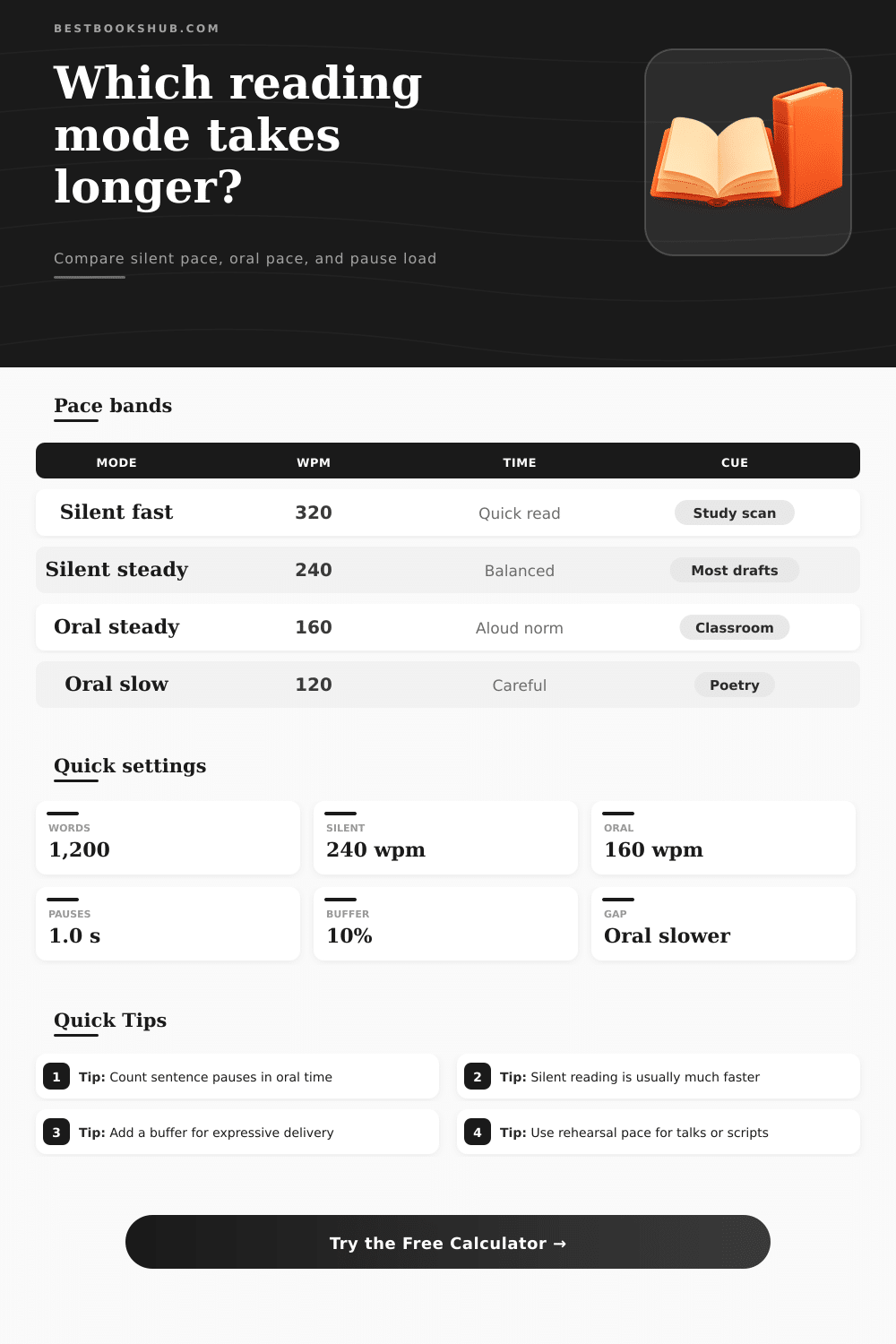
| Mode | WPM | 1,000 words | Use case |
|---|---|---|---|
| Silent quick | 300-350 | 3-4 min | Fast scan |
| Silent steady | 220-280 | 4-5 min | Normal study |
| Oral clear | 140-180 | 6-7 min | Classroom read |
| Oral measured | 110-140 | 7-9 min | Poetry or script |
| Delivery style | Pause load | Timing effect | Best fit |
|---|---|---|---|
| Broadcast | Light | Small delay | Briefing |
| Classroom | Moderate | Clear beats | Lesson read |
| Presentation | Measured | Buffer added | Slide script |
| Storytime | Expressive | Longest gap | Read-aloud |
| Passage type | Words | Sentences | Pace cue |
|---|---|---|---|
| Research abstract | 250-350 | 10-14 | Compact |
| News briefing | 400-600 | 18-28 | Clean and quick |
| Novel chapter | 1,800-3,000 | 90-150 | Steady pace |
| Poetry recital | 120-300 | 12-22 | Breath and pause |
| Scenario | Silent | Oral | Gap |
|---|---|---|---|
| Study excerpt | 4 min | 6 min | +2 min |
| Lecture notes | 3 min | 5 min | +2 min |
| Presentation script | 5 min | 8 min | +3 min |
| Storytime page | 3 min | 6 min | +3 min |
DISCLOSURE: This post may contain affiliate links, meaning when you click the links and make a purchase, I receive a commission. As an Amazon Associate I earn from qualifying purchases.
Many peoples believe that they know the time it will take for them to read a passage. However, there is two different forms of reading: silent reading and oral reading. These two form of reading occur at different speeds.
When reading silent, a person allows there eyes to move quick across the page. When reading orally, a person use there mouth and ears to read the passage. Oral reading takes up more time because of the need to take pauses throughout the passage, to change the rhythm in which they read, and to breathe while reading.
How Long It Takes to Read Out Loud
It is common for a passage to take up more length when spoken then when read silently. The time it take to orally read a passage depends on several specific factor. These factors include the length of the passage in terms of the number of sentences in the passage, the length of the pauses that may occur within the passage, and the amount of buffer time that is allotted for the passage.
The number of sentences in a passage are important because every sentence will end with a pause. Pauses take up time when orally reading a passage. The length of the pauses is variable and may need to be more longer for some types of texts than others.
The amount of buffer time needed for a passage is also a variable as some passages require more time then others to accommodate stumbles or other expressive reading variable. Each of these variable can be entered into the oral reading time calculator so that an individual can determine the total amount of time that it will take to orally read the passage without guessing the total time required. Many people makes mistakes when trying to estimate the time that it will take to orally read a passage.
One of the most common mistake is to use the individuals silent reading speed to calculate the time it will take to orally read the passage. Using the silent reading speed to calculate oral reading will result in the individuals oral reading taking longer then they had calculated for the passage. Another mistake is to add too many pause to the passage when orally reading the passage.
Adding too many pauses will result in the individual spending too much time reading the passage. Using the oral reading time calculator will allow an individual to avoid these mistakes since the calculator will indicate how changes to the sentence count or the length of the pauses will change the total amount of time require to orally read the passage. The context in which an individual is to orally read a passage will impact the total amount of time it takes to orally read the passage.
For instance, it will take longer to orally read a passage in a classroom setting then it will to orally read the same passage on the radio. This is due to the fact that classroom readings are to occur at a slower rate for the student to follow the text and the fact that a briefing on the radio will be at a faster rate so that the audience is provide with the briefing in the least amount of time. These variable can be entered into the oral reading time calculator so that the individual can see how the total time to orally read a passage will change with each of these different context.
There are other factor that will affect the total time for an orally reading passage that cannot be accounted for in the oral reading time calculator. For instance, the level of fatigue that an individual feel will make them read at a slower rate. An audience that laugh or poses question to the orally reading individual will add to the total time to orally read the passage.
An orally reading individual that is well rehearsed will be able to speak at a faster rate since they are very familiar with the passage. These factor will have to be accounted for in addition to the variable that the calculator will determine so that an accurate estimate of the total time to orally read a passage can be provide. Depending on the length of time that the oral reading time calculator calculates, an individual may need to shorten the passage or reduce the number of break within the passage.
If the length of time to orally read the passage is a good fit for an individuals schedule, then there is no need to make change to the passage. Using the oral reading time calculator allow an individual to see the difference between silent and oral reading. By being able to see the difference between the two forms of reading, an individual can plan their schedule for silent or oral reading to ensure that it take place at the most accurate time.