📖 Paragraph rhythm lab
Sentences per paragraph calculator
Paste a draft to measure paragraph segmentation, sentence density, skim rhythm, long and short paragraph flags, and target range fit.
| Writing context | Typical sentences per paragraph | Best rhythm signal | Watch for |
|---|---|---|---|
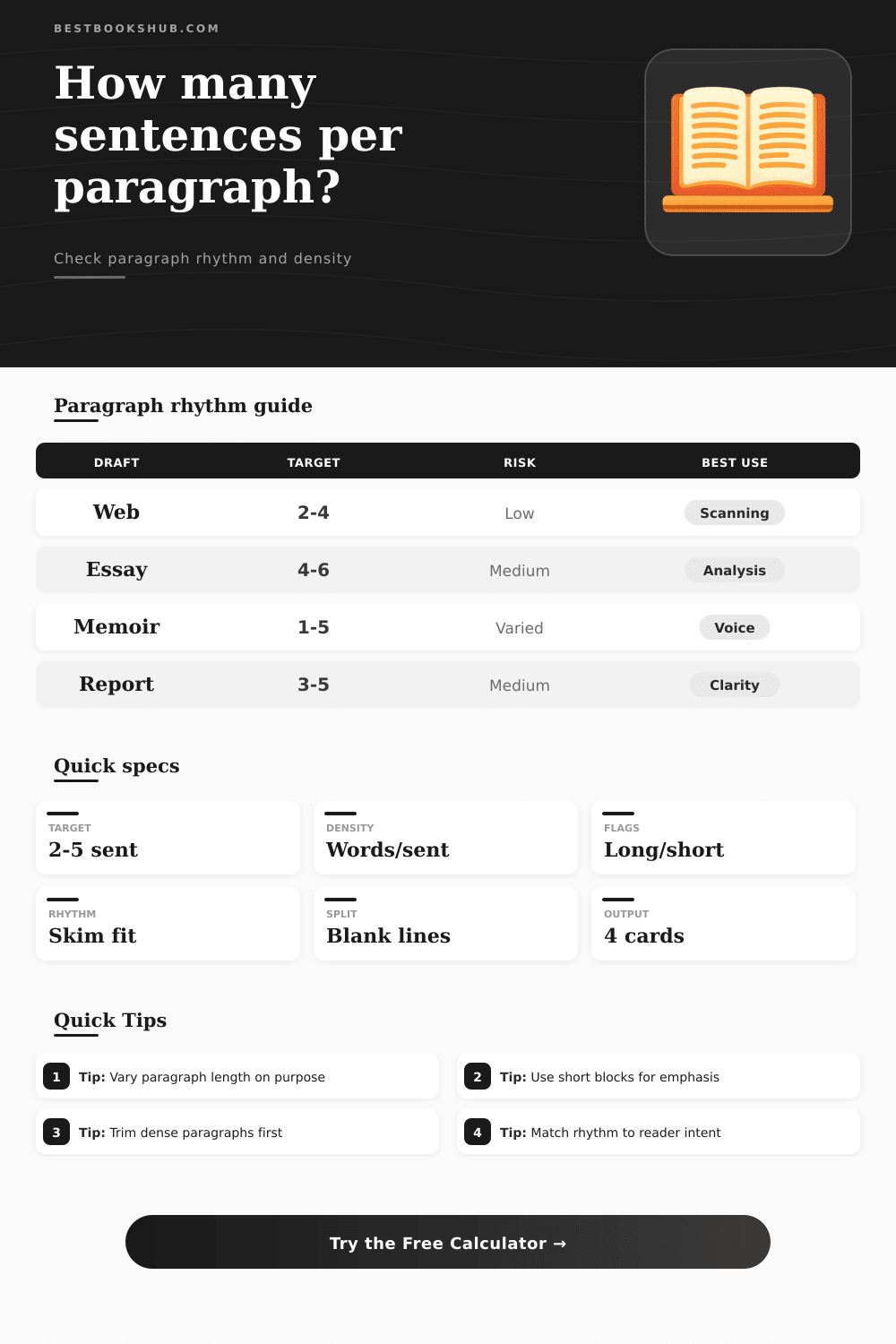
| Web article or blog post | 2 to 4 sentences | Readers can scan without losing the main idea. | Too many one-sentence blocks can feel choppy. |
| Academic essay or paper | 4 to 6 sentences | Each paragraph introduces, supports, and explains one claim. | Long evidence stacks can bury the topic sentence. |
| Business report or memo | 3 to 5 sentences | Findings stay grouped while action points remain visible. | Dense paragraphs can hide decisions or next steps. |
| Fiction or memoir | 1 to 5 sentences | Paragraph length follows voice, tension, and camera movement. | Uniform paragraph length can flatten scene energy. |
| Instructional guide | 2 to 5 sentences | Steps and explanations stay separated for quick use. | Mixing warnings, steps, and context in one block. |
| Email newsletter | 1 to 3 sentences | Short blocks preserve momentum on small screens. | Over-fragmenting every sentence into its own paragraph. |
| Flag type | Default trigger | What it often means | Revision move |
|---|---|---|---|
| Very short paragraph | 1 sentence or fewer | Emphasis, transition, dialogue, or underdeveloped support. | Keep for punch, or combine if it repeats nearby logic. |
| Long paragraph | 6 sentences or more | Several ideas may be competing inside one block. | Split at a turn, example, contrast, or new subclaim. |
| Dense paragraph | High words per sentence | Sentences carry many clauses or compressed information. | Shorten sentences before splitting the paragraph. |
| Out-of-range paragraph | Outside target range | The block does not match the selected reading context. | Adjust only if the rhythm problem is visible in context. |
| Method | How the calculator splits text | Best for | Possible issue |
|---|---|---|---|
| Blank lines separate paragraphs | Two or more line breaks mark a new paragraph. | Drafts copied from editors, documents, and CMS fields. | Single-spaced exports may appear as one paragraph. |
| Each line is a paragraph | Every non-empty line becomes its own paragraph. | Plain-text outlines, email drafts, and pasted line blocks. | Wrapped lines from narrow windows may over-split. |
| Hybrid cleanup | Uses blank lines, then joins very short wrapped lines. | Text copied from PDFs or narrow document panes. | May merge intentional short emphasis lines. |
| Manual review | Use the flag list after calculation. | Final editing when voice matters more than averages. | Numbers support judgment; they do not replace it. |
| Score band | Paragraph pattern | Reader experience | Editing priority |
|---|---|---|---|
| 85 to 100 | Most blocks fit the target and vary naturally. | Easy to scan while still feeling coherent. | Polish transitions and preserve strong emphasis. |
| 70 to 84 | Generally balanced with a few heavy or thin blocks. | Readable, with a handful of places to smooth. | Review flagged paragraphs before changing the rest. |
| 50 to 69 | Several blocks miss the selected range. | Readers may slow down or skim unevenly. | Split dense blocks and combine weak fragments. |
| Below 50 | Paragraph lengths are mismatched for the target. | The page may feel cluttered, heavy, or abrupt. | Revise structure around one idea per paragraph. |
DISCLOSURE: This post may contain affiliate links, meaning when you click the links and make a purchase, I receive a commission. As an Amazon Associate I earn from qualifying purchases.
Paragraph length affect how a reader process information. One sentence can make a reader pause to catch there breath, but six sentences in a row can make a reader feel as if the writer is burying its idea. The perception of a writer’s text can be the result of the groupings of sentences into paragraphs rather than the sentences themselvess.
Measuring the number of sentences in each paragraph can improve a writer’s text. These patterns of paragraphs can either help or hinder the reader. A web article can have a different paragraph rhythm than a literature review.
Why Paragraph Length Matters
The writer can adjust the paragraph rhythm to match the intended use of the writers text. Once the writer paste their text into the paragraph length calculator, the calculator can perform the calculations. Based on the writers selected target range, the calculator will give the text a number.
This number is less important than the questions that the writer should consider after receiving the number from the calculator. The writer can use the number to determine if each paragraph has only one idea or if there are two idea in each paragraph. Additionally, the writer can use the number to determine whether the variation in the length of the paragraphs is intentional or if the writer has written the paragraphs of the same length because the writer is comfortabley with the length of paragraphs.
The different writing context require different approaches to paragraph length. The writer can adjust paragraph length for web articles so that they provide web readers with places to take a breath so that they dont lose the thread of the writer’s text. The length of paragraphs in academic texts can be longer because paragraphs must be developed but the writer must still make transition between paragraphs.
Paragraph length in narratives can be longer or shorter depending on the writers intentions but using the same length of paragraphs throughout a narrative can hide the writers story. In business memos, findings within the paragraphs must be grouped together but not hidden from the reader. It is common for writers to believe that every short paragraph is a problem.
Instead, every paragraph should not have the same length. A common problem is splitting paragraphs without thinking about the sentence density within the paragraphs. The paragraph length calculator will highlight these paragraphs so that the writer can decide whether the writer needs to adjust the sentences within each paragraph before the writer make any adjustments to the paragraphs.
The reference tables help writers to understand the typical number of sentences in paragraphs for different writing situation. For example, the tables can help writers understand that a newsletter might use fewer than three sentences per paragraph to maintain momentum on small screens. Additionally, a product guide might separate paragraphs into warnings from tasks so that readers can avoid missing any important task when they are moving from the page to the task that is explained in the paragraphs.
The segmentation options for the text will determine how the tool read the writers text. Text from editors might contain blank lines to separate paragraphs but text from PDFs might use line breaks that are not actual paragraphs. The writer must make the correct choice to ensure that the tool doesnt mistake line breaks for paragraphs.
Additionally, the writer can use the sentence boundary setting to choose which settings the tool will use to determine where the paragraphs begin and end. For most texts standard punctuation will work but the use of semicolons will require the use of strict mode. None of these settings can fix an argument that is badly structured but they can ensure that the writer has correctly counted the number of sentences in each paragraph.
The paragraph length calculator cannot read a writers text and cannot replace the writers judgment. The writer might have created a paragraph outside of the target range because it is a transition between two idea. The writer might of created a paragraph outside of the target range for a specific reason.
The tool provide a number but it cannot replace the writers judgment of whether a paragraph belong in the text or not. The value of the tool becomes apparent when the writer treat the numbers generated from the tool as a prompt to the writer. The writer can use these numbers to make decisions regarding their text.
The writer should look at each paragraph that is flagged by the tool to determine why that paragraph exist in that specific length. The writer must decide whether the paragraphs serve the reader or if they merely reflect the writers text as it has been written so far. Most writers will likely ignore the need to serve the reader and focus on their writing but focusing on the needs of the reader will change the piece of writing that the writer produces.