📚 Reading difficulty lab
Polysyllabic word counter
Count words at or above your syllable threshold, exclude names and nonwords, then estimate hard-word density, readability pressure, and a Dale-Chall style proxy.
| Threshold | Best use | Typical meaning | Revision cue |
|---|---|---|---|
| 2+ syllables | Children's pages, early readers | Broad vocabulary scan | Look for repeated medium words. |
| 3+ syllables | General readability checks | Standard polysyllabic word count | Shorten dense clusters first. |
| 4+ syllables | Academic abstracts and textbooks | Advanced vocabulary focus | Define specialized terms nearby. |
| 5+ syllables | Technical or scholarly prose | Highly specialized terms | Check if terms are essential. |
| 6+ syllables | Rare long-word audit | Very long terminology | Replace only if meaning survives. |
| Density range | Reader experience | Readability pressure | Suggested action |
|---|---|---|---|
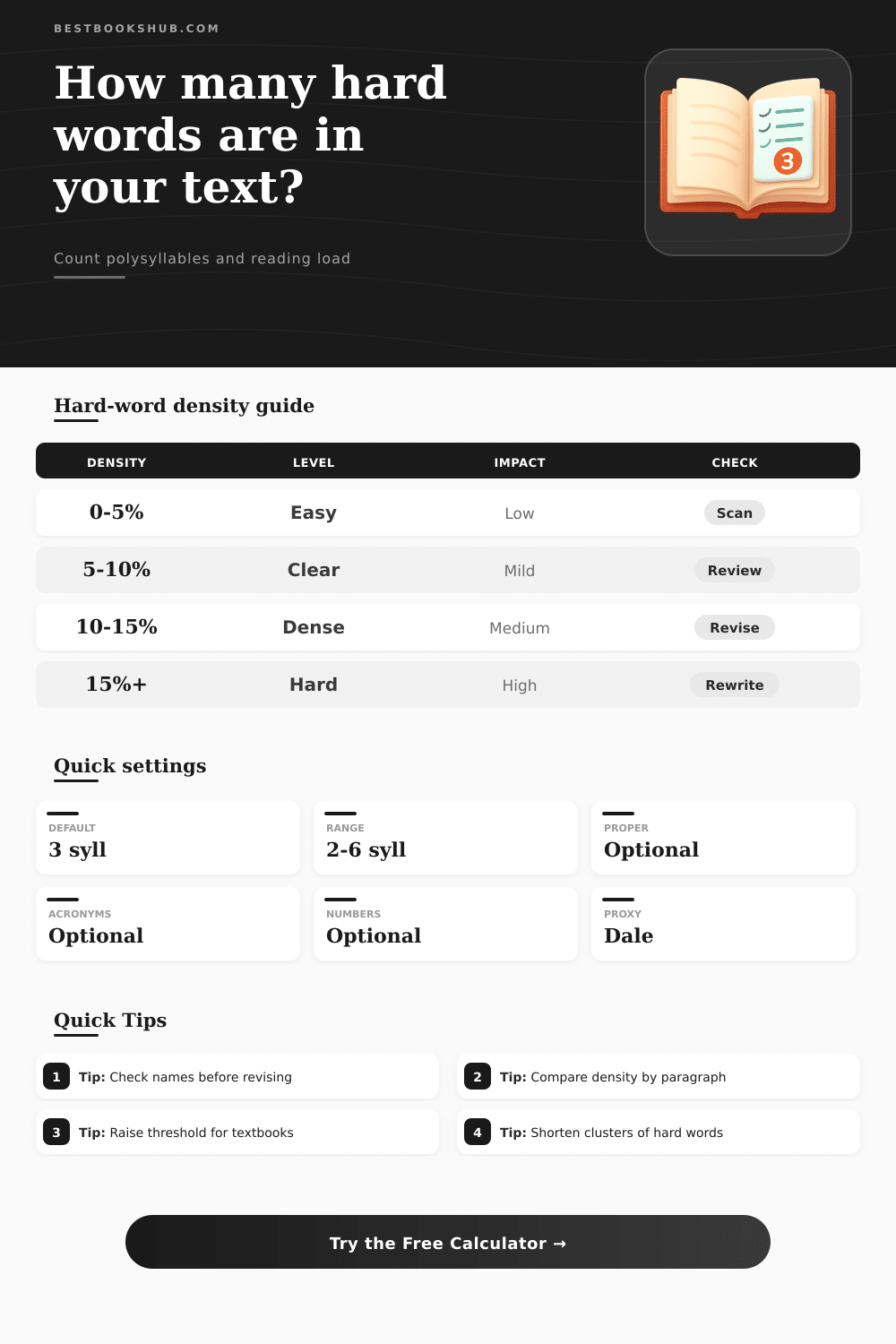
| 0% to 5% | Light vocabulary load | Low | Usually fine for broad audiences. |
| 5% to 10% | Moderate complexity | Mild | Review nearby sentence length. |
| 10% to 15% | Dense but manageable | Medium | Clarify key terms and break clusters. |
| 15% to 20% | Heavy vocabulary load | High | Revise if the audience is general. |
| 20%+ | Specialist or very difficult prose | Very high | Split, define, or simplify hard passages. |
Children's text
Use 2+ or 3+ syllables. Even a small cluster can raise difficulty when sentences are short.
Fiction prose
DISCLOSURE: This post may contain affiliate links, meaning when you click the links and make a purchase, I receive a commission. As an Amazon Associate I earn from qualifying purchases.
Use 3+ syllables. Names may inflate counts, so proper-noun exclusion is often useful.
Academic text
Use 4+ or 5+ syllables. Terminology is expected, but clustering still affects pace.
Book marketing
Use 3+ syllables. Dense adjectives can make blurbs feel slower and less direct.
| Formula or method | Hard-word signal | What this calculator approximates | Important limit |
|---|---|---|---|
| Gunning Fog | Words with 3+ syllables | Polysyllable share and density | Official formula also needs sentence length. |
| SMOG | Polysyllables in sample sentences | Long-word count and sentence estimate | Best with a larger text sample. |
| Dale-Chall | Words outside a familiar list | Simple proxy from hard-word density | Not a real Dale-Chall familiar-word list. |
| Lexile-style review | Word frequency and sentence complexity | Vocabulary pressure direction | No frequency database is used here. |
| Option | When to turn on | What it removes | When to turn off |
|---|---|---|---|
| Proper nouns | Fiction, biography, history | Likely names such as Matilda or Alexandria | When names are part of the teaching load. |
| Acronyms | Academic, publishing, catalog text | All-cap abbreviations such as ISBN or APA | When acronyms must be explained to readers. |
| Numbers | Bibliographies and edition notes | Years, editions, and numeric identifiers | When numerals are part of decoding difficulty. |
| Common endings | General English prose | Some silent or light suffix syllables | For linguistic work requiring strict phonetics. |
A polysyllabic word counter counts the number of words in a text that contain three or more syllables. When a long word appear in the middle of a sentence, it can cause a shift in the rhythm of that sentence. This shift in the sentence’s rhythm can cause a hesitation in the reader as there eyes land on the long word.
While there may be a hesitation in readers when encountering polysyllabic words in a text, a polysyllabic word counter can translate that readers experience into a number. That number provide insight into the text that allow writers to take action to improve their writing. A high count of polysyllabic words does not necessarily mean that the writing within a text is of low quality.
Counting Long Words and How It Helps Writers
However, a high count of polysyllabic words does mean that the vocabulary load for the reader have increased. When the vocabulary load increases for a reader, the writer must make a decision as to whether the polysyllabic words that were included in the text are necessary, or whether shorter words would of been a betterer choice for those of limited reading abilities. Such a decision must be made when writing for a mixed audience, when revising a textbook, or when copywriting marketing copy.
A polysyllabic word counter can alter the syllable threshold that is used. If the threshold is lowered to two syllables, the polysyllabic word counter will count more words. These medium length words may slow the reader, especially younger readers or those with less reading experience.
If the threshold is raised to four or five syllables, the count will focus on words that may be more specialized to the subject matter of the text. Such a focus on specialized vocabulary may be used for academic texts or technical writing on specific subjects. The threshold for polysyllabic words does not indicate whether the writer is to be strict or lenient with word choice.
Rather, the threshold can be adjusted according to the type of text that is being examined. In addition to the factors that impact polysyllabic word count, there are other settings for the polysyllabic word counter that allow for the removal of certain types of words from that count. Words such as proper nouns may inflate the count of polysyllabic words in fiction texts due to the syllabic nature of character names.
However, the syllabic complexity of those names does not necesarily reflect the reading difficulty of those words. Other types of words that can be excluded from the polysyllabic word count are acronyms and number. Using the exclusion feature is not just a way to clean the word count of potentially distorting statistics.
Rather, using the exclusion feature allow writers to make decisions regarding which aspects of the text contribute to the reading experience of the text’s audience. Another feature of the polysyllabic word counter is the density measurement of a text. This feature determine the number of polysyllabic words in a text.
Texts with low density will feel light to the reader, even with long sentences. Texts with medium density are generally acceptable for readers if the polysyllabic words are either evened out throughout the text, or if those polysyllabic words is defined within the text itself. Texts with high density will have polysyllabic words that are clustered together within sentences.
Such clusters will make the reader of the text slow down as their eyes move from one polysyllabic word to the next. The polysyllabic word counter can calculate the density of polysyllabic words in a text after selecting the type of passage that will be analyzed, as well as selecting any exclusions for word types. After seeing the numbers that the polysyllabic word counter provides, the writer can begin to make actual changes to the text.
Depending on the placement of polysyllabic words in the text, one may leave a paragraph containing polysyllabic words alone if it is surrounded by paragraphs with simple words. However, if the density of polysyllabic words is even throughout all paragraphs of a text, then that text should be revised. The difference in density can be seen by comparing different part of the same text.
Depending on the type of writing that is to be published, there will be differences in the density of polysyllabic words that are used in those texts. For example, childrens books will generally have low densities of polysyllabic words because they use short sentences to tell their stories. Literary essays will allow for a higher density of polysyllabic words because the audience of literary essays is prepared to read and understand those complex words.
Marketing copy will use medium densities of polysyllabic words. However, if the copy contains an overwritten sentence, that density will make the marketing copy feel slowly when read by the audience. The reference table that is included in the polysyllabic word counter can show the ranges of polysyllabic word densities and how those densities can feel to the readers of a text.
This table isnt a rulebook for writers to follow. However, it is a table that illustrates the experience of polysyllabic word densities that can be recognized by readers of all types of text. The polysyllabic word counter cannot tell a writer whether any of the long words within the text are the clearest choice for that sentence.
That decision is up to the writer. The polysyllabic word counter simply shows writers the location within their text where their judgment is needed to make word choices.