📚 Sentence rhythm lab
Sentence length distribution calculator
Paste a passage to see short, medium, long, and very long sentence buckets, plus median, percentile, long-sentence flags, and readability pacing.
Average: 0 words
Run the calculator to compare average length with the target range.
Median: 0 words
DISCLOSURE: This post may contain affiliate links, meaning when you click the links and make a purchase, I receive a commission. As an Amazon Associate I earn from qualifying purchases.
Median resists one unusually long sentence.
Long tail: 0%
A high tail share can slow the reading pace.
Variety: 0
Variation helps prose avoid a flat rhythm.
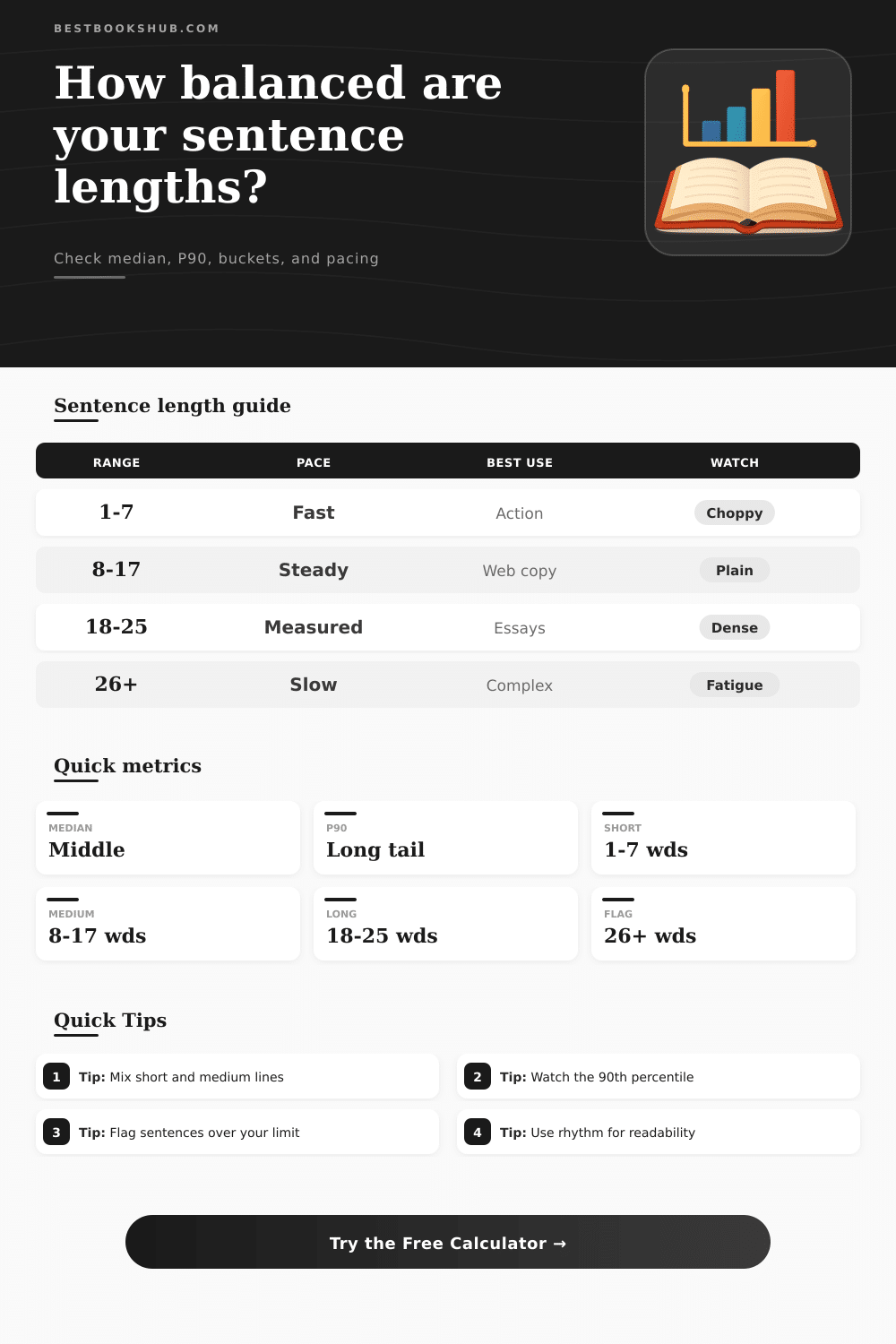
| Sentence range | Typical pacing effect | Useful in books | Editing caution |
|---|---|---|---|
| 1-7 words | Fast, sharp, high emphasis | Action beats, chapter turns, children books | Too many in a row can feel choppy |
| 8-17 words | Steady and easy to scan | Book descriptions, newsletters, reviews, scenes | Too uniform can feel plain |
| 18-25 words | Measured and explanatory | Exposition, reflective prose, nonfiction argument | Needs clear punctuation and subject control |
| 26-35 words | Slow and layered | Academic, literary, technical, complex thought | Flag if the reader must reread |
| 36+ words | Dense and demanding | Rare deliberate cadence or advanced analysis | Often benefits from splitting or trimming |
| Target type | Average words | Long sentence share | Good pacing signal |
|---|---|---|---|
| Children or early reader | 5-10 | Under 8% | Short lines with clear subject and verb |
| Web article or book page | 12-17 | Under 18% | Mostly medium sentences with occasional short emphasis |
| General nonfiction | 14-20 | Under 24% | Medium base with controlled explanatory lines |
| Commercial fiction scene | 9-18 | Under 22% | Varied rhythm that follows scene tension |
| Academic or technical prose | 18-27 | Under 38% | Longer sentences balanced by signposting |
| Literary or reflective prose | 14-28 | Under 40% | Deliberate variation with readable long arcs |
| Metric | What it tells you | When to trust it | Revision move |
|---|---|---|---|
| Median | The middle sentence length | Best for typical rhythm | Compare with the audience range |
| 75th percentile | Upper everyday sentence length | Useful for web and teaching copy | Smooth paragraphs with too many upper lines |
| 90th percentile | Long-tail pressure | Useful for edits that reduce fatigue | Review the longest 10% of sentences |
| 95th percentile | Extreme outlier length | Useful for dense academic drafts | Split or clarify the hardest sentences |
| Writing sample | Usual distribution | Median cue | Pacing note |
|---|---|---|---|
| Picture book page | Mostly short and medium | 5-8 words | Clarity matters more than variety |
| Book description | Medium with short hooks | 10-15 words | Long sentences can bury the promise |
| Thriller scene | Short bursts plus medium setup | 8-14 words | Short lines raise speed and pressure |
| Literary excerpt | Wide variation and longer arcs | 12-22 words | Variation should feel intentional |
| Academic abstract | Medium-long and very long | 20-28 words | Signposts help readers through density |
A person who opens a page may notice a wall of texts. When a person sees a wall of text, a person may feel an instinct to skim over the text. The brain of a person who skims read the page for any indications that the sentences in the text are all of a similar length.
The length of the sentences is one of the factor that controls a persons reading speed. Additionally, the length of the sentences determine if the paragraph of text is making a person who reads the passage feel as if they are moving forward in reading or stopping to read each sentence. You can use the sentence length calculator to analyze your text.
Why Sentence Length Matters
Using the calculator, the mathematical calculations will be performed for you after you paste your passage into the calculator. The calculator will split your passage into individual sentence. Additionally, the calculator will count the number of word in every sentence in your passage.
The calculator will sort the counts of the words in each sentence to show you the median sentence length in your passage. Furthermore, the calculator will calculate and show you the length of the longest sentences in your passage, as well as the number of sentences that fall into specific word counts. Each of these outputs from the calculator is important because they transform the feeling of your text into a specific number.
A median sentence length of fourteen words is more different than a median sentence length of twenty-two words, even with the same total word count for the passage. Many writers become aware of the sentences in their passages being too slowly to read when they are writing; however, most writers guess as to the cause for the slow reading of the passage. Writers may shorten a few of the sentences in their passage to make it read faster when they are editing; however, shortening a few sentences may not help to even fix the problem of the slow reading of the passage.
Using long sentences in a passage may change the average sentence length. However, one very long sentence may not change the median sentence length in the passage. The sentence length calculator will separate average and median sentence length for writers to determine if the problem is created by a few long sentences or many medium length sentences.
This information is important for writers to understand because it will change the way that they edit there passages. The length of the sentences in a passage will depend on the type of audience that you are writing for your passage. Passages that are written for early readers will have sentences that is ten words or less.
Passages written for readers on the web will have a variety of sentence lengths because web readers will skim over the text; however, they will also skip over text if the passage does not contain text breaks. Passages written for academic purposes may allow for long sentences but require that each sentence before the sentence to be read aloud to remain oriented in the passage you are reading. Using the sentence length calculator to determine what sentence length you should use will allow you to compare your results to these standard.
There are a few common mistakes that occur in many types of writing. One common mistake is treating each sentence as if it weighs the same as each other sentence. Using short sentences after long sentences will change the reading pace for the reader.
Using three short sentences in a row may make the passage look like it is written as a list, so avoiding using short sentences in a row is one editing mistake that can be avoided. Another common mistake is ignoring the dialogue and description in a passage. Long passages of dialogue may contain long sentences that slow the reader down.
After editing a scene for dialogue, running the passage through the sentence length calculator will allow the writer to spot long sentences before the reader do. The table to the right of each definition offers sentence length ranges for different types of writing so that writers dont have to memorize the specific number of words for each sentence length range. Short sentences will provide a sense of movement in the text.
Medium-length sentences carry the majority of readable text. Long sentences are used to add detail to a passage when the subject and verb is clear. Each sentence length has a specific use in writing.
After comparing your sentence length to the ranges offered in the reference table on the page, writers will have a better idea of editing their text to use the correct sentence lengths. Writers do not have to aim for a specific median sentence length; however, they must ensure that their sentence length distribution create the reading experience that they want the reader to have when reading the passage. Although the sentence length calculator may provide writers with a map of the sentence lengths in their passage, it is up to the writer to use the map to edit their text.