✍ Book text analysis
Capitalized word counter
Count capitalized words in chapters, titles, notes, and manuscript pages. Filter sentence starts, acronyms, hyphens, and mixed-case names with precision.
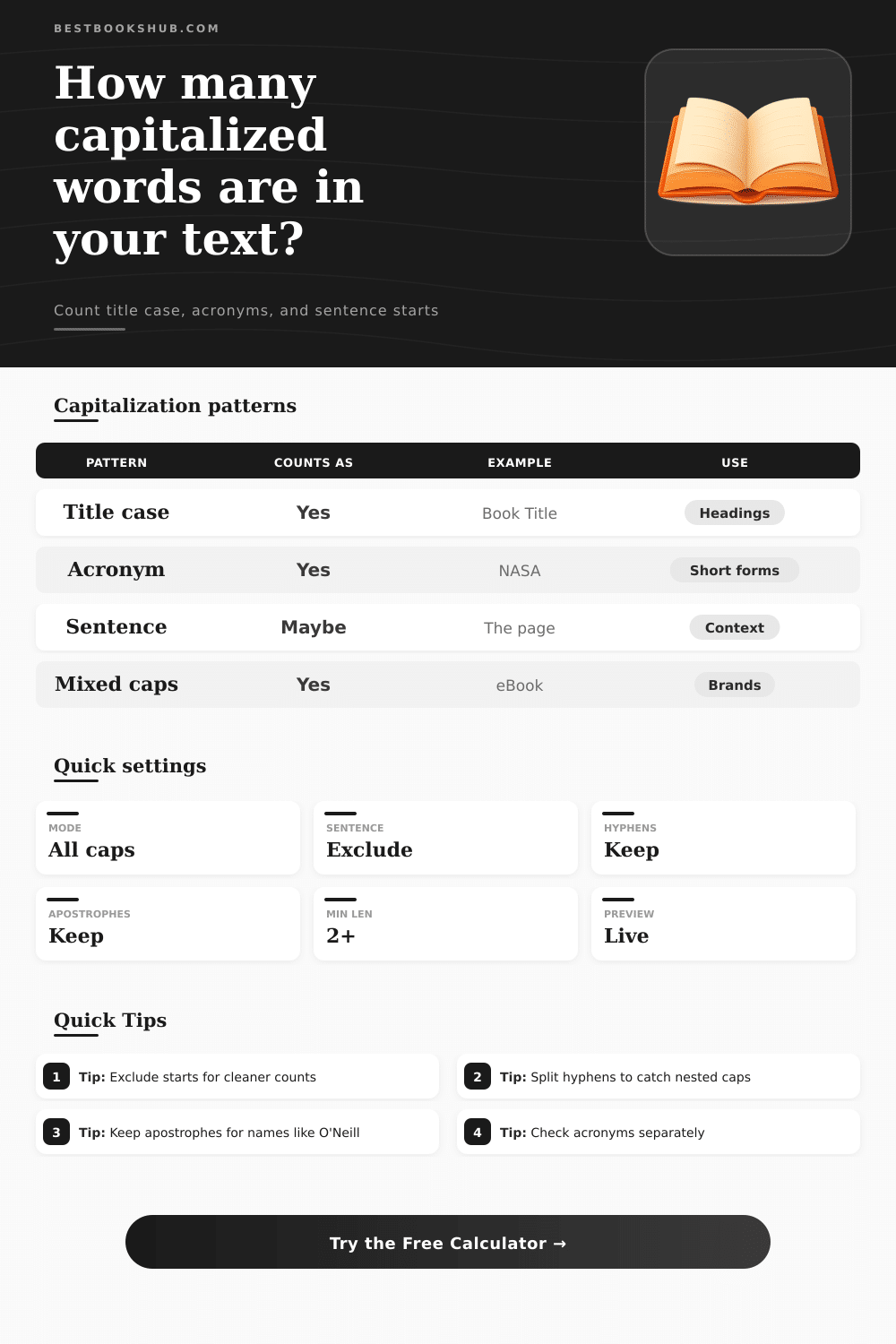
| Pattern | Counts as | Example | Use |
|---|---|---|---|
| Title case | Yes | Book Title | Headings |
| Acronym | Yes | NASA | Short forms |
| Sentence start | Maybe | The page | Context |
| Mixed caps | Yes | eBook | Brands |
| Sentence context | Typical clue | Count rule | Example |
|---|---|---|---|
| Paragraph open | First token | Often yes | The first line |
| After period | New sentence | Often yes | Ends. Starts. |
| After colon | List or quote | Sometimes | Note: The page |
| After quote | Embedded line | Depends | "The Title" |
| Book text profile | Common mix | Best scope | Risk |
|---|---|---|---|
| Chapter page | Title case | All capitalized | Sentence starts |
| Dialogue page | Mixed caps | Initial-cap | Names and quotes |
| Catalog note | Acronyms | Acronyms only | ISBN clutter |
| Title list | Heavy caps | Title case only | False positives |
| Cleanup mode | Keeps | Removes | Best use |
|---|---|---|---|
| Keep hyphens | Self-editing | Nothing | Compound names |
| Split hyphens | Self editing | Joiners | Separate counts |
| Keep apostrophes | O'Neill | Nothing | Proper names |
| Strip apostrophes | Oneill | Marks | Loose matching |
DISCLOSURE: This post may contain affiliate links, meaning when you click the links and make a purchase, I receive a commission. As an Amazon Associate I earn from qualifying purchases.
When you counts the number of capitalized words in a manuscript, you may not get a complete understanding of the text from that total. Chapter headings may contain many capitalized word, but the paragraphs within that chapter may have few capitalized words altogether. Capitalized words are important in that they tell the reader where to look and they indicates where the editor must make decisions regarding the text.
You must decide what word will be counted as capitalized words in the manuscript. Words like sentence openings are capitalized, but those sentences may contains words that you are more interested in counting. Tools that allow editors to exclude sentence openings will provide count that are more beneficial to editors who are attempting to understand the text.
How to Count Capitalized Words in a Manuscript
Acronyms and brand name require specific rules to be followed when counting capitalized words in a manuscript. Words like NASA contain acronyms that is visually different than regular words. However, if only the initial capitals of words are counted, the acronyms may appear the same than the regular words.
By isolating all acronyms and brand names, editors can prevent other important elements of the text from inflating the count of capitalized words. Words that contain hyphen and words with apostrophes also require specific rules to be followed. Words with hyphenated compounds and words with apostrophes can be treated as containing a single word or as containing multiple word.
Depending on how capitalized words that contain these elements are counted, the total word count will change. Additionally, how the words are counted may change what the count of capitalized words indicates about the text. For instance, if capitalized words with hyphenated compounds are split into individual word, it is possible to compare the use of title case between two chapters.
However, if editors treat capitalized words with hyphenated compounds as single words, it is also possible to compare the rate at which words is capitalized throughout the manuscript. The context of the text is another important factor to consider when counting capitalized words. If the sentences are from a title page, there will be a high percentage of capitalized words due to the use of title case.
However, a page of dialogue will have fewer capitalized words. Capitalization calculator can calculate the percentage of capitalized words once the editor decides on the scope of the manuscript and the rules for sentences. However, the calculator will never be able to recognize if the percentage of capitalized words is a problem for the text.
For example, a childrens book may contain many capitalized words to adhere to conventional publication standards for those types of book. Additionally, a reference list may contain many capitalized words due to the inclusion of a bibliography that was import into the manuscript. One mistake that editors should avoid when counting capitalized words in a manuscript is treating every capital letter as important.
Capital letters are used after punctuation marks like colons and quotation marks. However, these words will not necessarily be capitalized if they are to be used for emphasis. By filtering these words, editors can focus on the words that is capitalized for other reasons.
Additionally, editors should also avoid ignoring the length of the capitalized words. Words like “A” may contain the necessary capital letter but are very short capitalized word. These words can still impact the total count of capitalized words in the manuscript.
These numbers are only useful if they can be compared with the actual text of that manuscript. A rate of twenty percent of words that are capitalized may indicate a high rate of capitalization for the words within a narrative chapter. Twenty percent may, however, be more normal for the rate of capitalized words within a catalog note that contains many ISBNs and DOIs.
The tool will not only provide the word count and the list of all the words that match the criteria for being counted as capitalized words. Editors can use these two lists to move from the general count of capitalized words to the specific sentence within the manuscript that contain these capitalized words. By checking the different instances of capitalized words, editors may find that they have developed an understanding of how to read the manuscript over time.
They may recognize when a title case are used within the body of the text or when an acronym is suddenly used within the text. These recognitions will help editors to shape the manuscript in the way that they intend for it to be shape.