✍ Text analysis tool
Punctuation counter
Count commas, periods, quotes, brackets, dashes, and ellipses from any excerpt, then compare balance, density, and standout marks.
Pick a realistic punctuation mix, then tune scope and quote settings to match the draft in front of you.
DISCLOSURE: This post may contain affiliate links, meaning when you click the links and make a purchase, I receive a commission. As an Amazon Associate I earn from qualifying purchases.
Use the scope filter to focus on one punctuation family, then decide whether smart quotes should stay distinct or collapse together.
| Rank | Mark | Count | Share |
|---|---|---|---|
| Load text to view the top punctuation rows. | |||
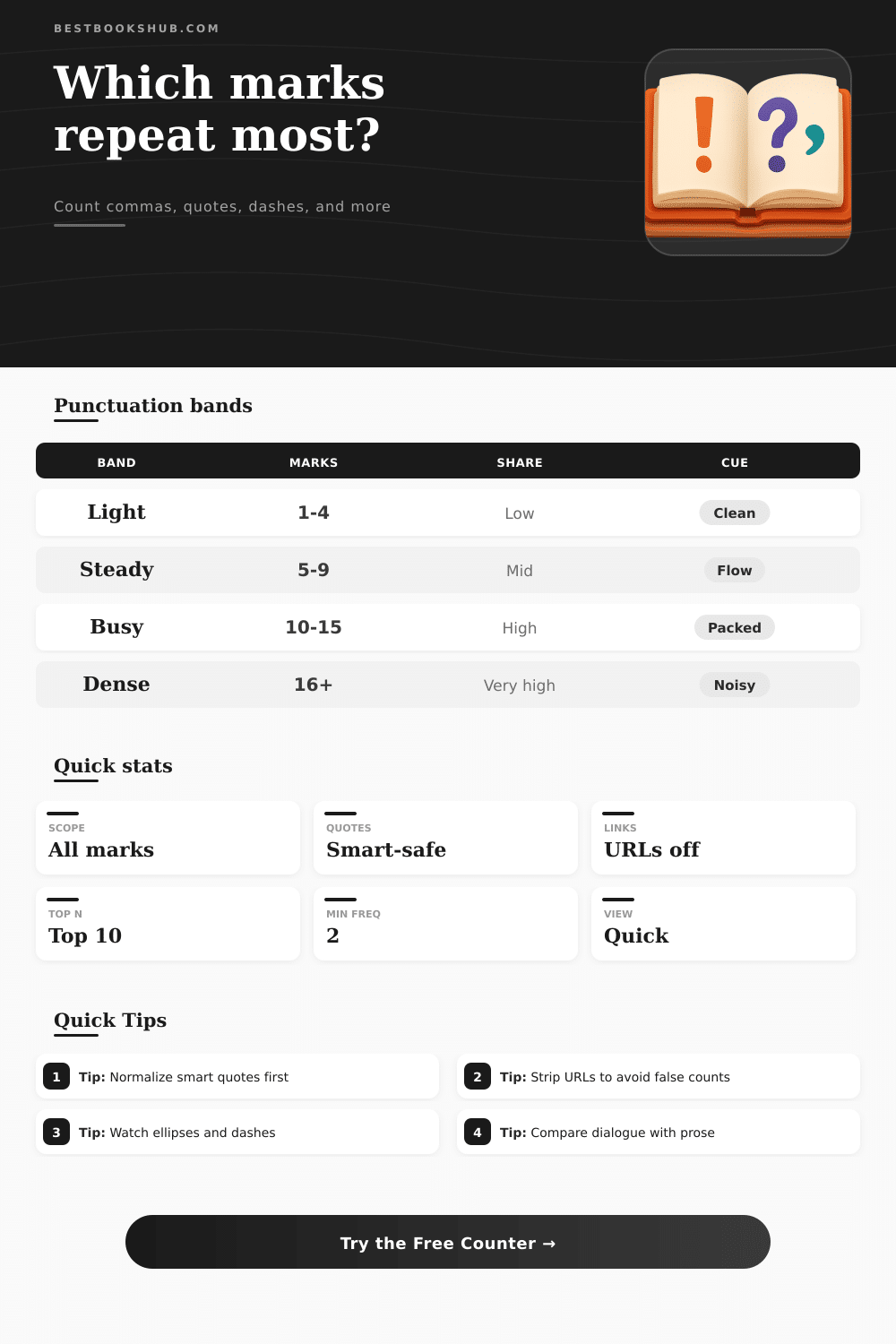
Use these bands to compare punctuation balance, scope behavior, and mark families without guessing what moved the totals.
| Band | Marks | Share | Cue |
|---|---|---|---|
| Light | 1-4 | Low | Clean |
| Steady | 5-9 | Mid | Flow |
| Busy | 10-15 | High | Packed |
| Dense | 16+ | Very high | Noisy |
| Scope | Includes | Skips | Best use |
|---|---|---|---|
| All | Every mark | Nothing | Full scan |
| Sentence | Stops | Pauses | Ending rhythm |
| Quote | Speech marks | Others | Dialogue |
| Bracket | Parentheses | Others | Aside check |
| Class | Example | Counted as | Note |
|---|---|---|---|
| Sentence | ., ?, ! | Stops | Ends the thought |
| Pause | , ; : | Flow marks | Lists and clauses |
| Quote | ' \" | Speech | Dialogue and emphasis |
| Dash | - -- | Breaks | Range or interruption |
| Sample | Heavy mark | Main cue | Typical use |
|---|---|---|---|
| Dialogue | Quote | Voices | Fiction |
| Essay | Comma | Flow | School |
| Legal | Bracket | Aside | Clauses |
| News | Period | Stops | Reports |
Punctuation marks affects the rhythm of a text. A comma can be used to slow the reader down to read two idea as connected, but a period can be used to stop a sentence so that a new sentence can begin. Without proper punctuation marks, the rhythm of the writing will likely seem accidental.
A punctuation counter help a writer to understand the patterns of punctuation marks in their text. A punctuation counter allows a writer to adjust the punctuation marks in their text prior to finalising their draft. The punctuation counter allow a writer to choose which punctuation marks they would like to count in their text.
How to Use a Punctuation Counter
They can choose to only count the sentence-ending punctuation marks in their text. They can also choose to only count the pause punctuation marks in their text. Finally, they can also choose to only count the quote marks in their text.
Each of these settings allows a writer to focus on one problem with their punctuation marks. A period is not the same than an ellipsis. Each of these punctuation marks have a specific function within a text.
An ellipsis can be used to show hesitation by a quoted speaker, but a period can be used to end a thought completely. Brackets can be used to include an aside to a reader that can be skipped, but a period can also be used to end a sentence. These punctuation mark categories allows a writer to see if one punctuation mark is being overused to the detriment of other punctuation marks.
A reference table on the punctuation counter allows writers to see the bands of punctuation counts that relate to specific concept. A low count of punctuation marks is often used to keep a page feeling clean and a high count of punctuation marks may indicate that the writer’s prose has too many interruption. These bands are not rules, but they can help a writer to compare one draft to another.
These bands of punctuation marks can help a writer to understand if a section of a text feels steady in the use of punctuation marks. If a writer is working on a section of text that is supposed to have alot of action, the bands can help a writer to understand if that section has become too busily. The punctuation mark counter is likely most helpful for comparing two different drafts of the same paragraph.
A writer can use the punctuation counter to analyze the first draft of a paragraph, and then apply the same process to the second draft. The difference in punctuation marks in these two drafts will likely be reflected in the number of pause punctuation marks. Many commas and semicolons can be used in the first draft of a paragraph when a writer is developing their argument, but these marks will likely decrease when the relationship between the idea in a text is clear.
Dialogue often requires different type of punctuation marks than the rest of the text in a writing project. The dialogue must include quote marks and sentence-ending punctuation marks, but the narration around the dialogue may require comma and dashes. If a writer isolates the quote mark category in the punctuation counter, they can see how many punctuation marks are used in the spoken line.
The punctuation marks can be used to determine if the description of the characters is doing too much work in the paragraph. Ellipses and dashes can often become overused by a writer who is not aware of the impact of overusing these punctuation marks. Ellipses can be used to leave a trailing thought hanging in the text, but using many ellipses in one paragraph may indicate a habit of leaving thoughts trailing off.
Dashes can be used to make a sudden turn in the thought of a quoted speaker or writer, but using too many dash can make for a fractured thought. The punctuation counter can help to highlight the overuse of these punctuation marks if they are set to appear at a minimum frequency, and the writer can use the punctuation counter marks to decide if the use of these marks is intentional. These settings for embedded text and quotes is included to account for other punctuation marks that are often in documents.
URLs and emails often contain punctuation marks. Words that are converted to smart quotes often split into two separate punctuation mark categories. These settings allow a writer to clean up the punctuation counts so that the writer can see their actual punctuation marks.
After obtaining the breakdown of each punctuation mark in the text, the next step is to examine which punctuation marks appear the most frequent. A writer should consider if the most common punctuation mark for that text is appropriate for the tone that they intended for the text. For instance, commas may be the most common punctuation mark for a reflective paragraph, but they may be too common for a scene in a story.
This awareness of the use of different types of punctuation marks will assist a writer in future writing projects. A writer will begin to recognize when a comma should be used instead of a period, and they will recognize when a period should be used instead of a dash. The punctuation counter allows a writer to translate their writing instincts to measurable count.