📖 Syllable density lab
Average syllables per word calculator
Paste a passage to estimate average syllables per word, total syllables, counted words, sentence pace, polysyllabic share, and reading-density signals.
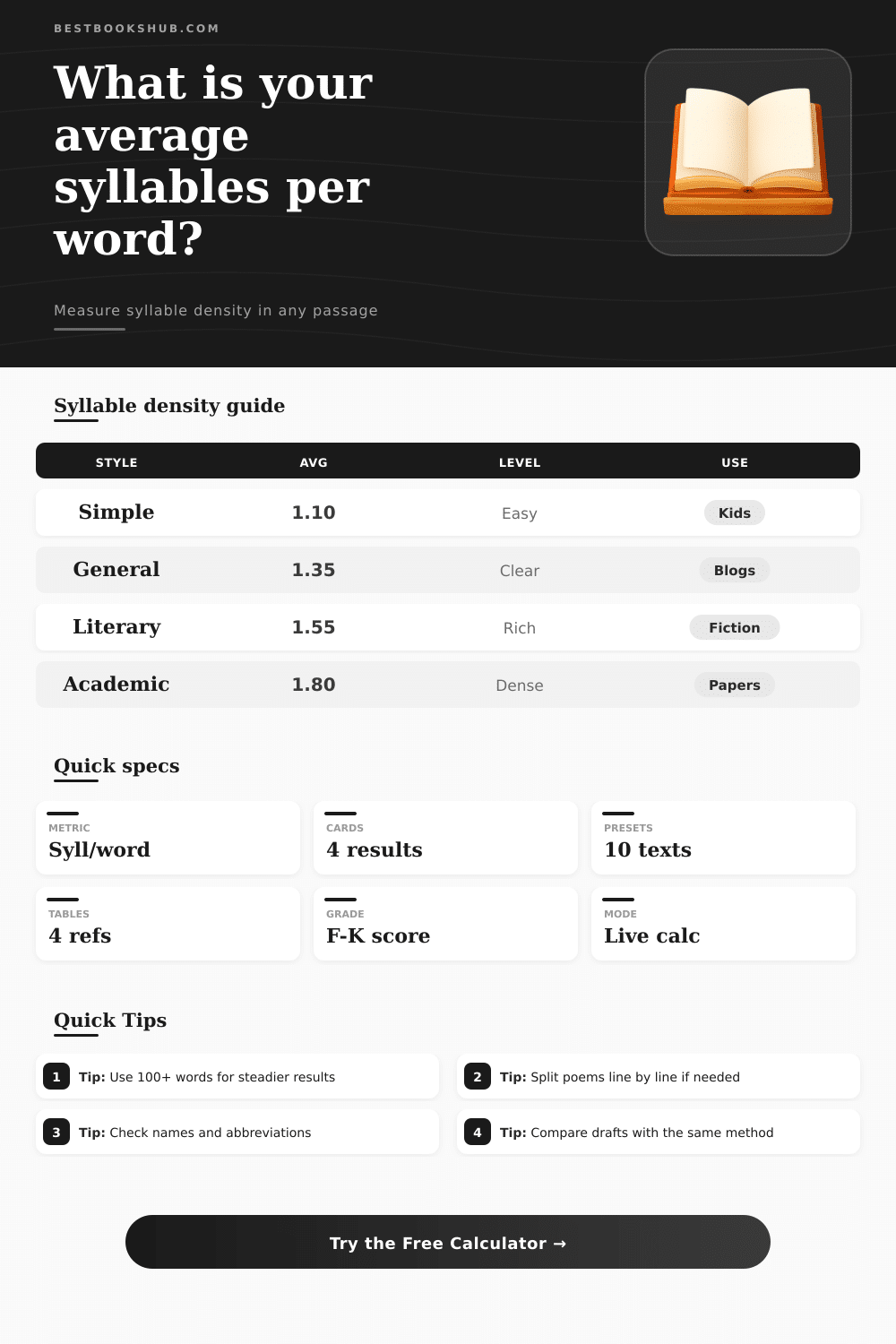
| Writing context | Usual avg syllables per word | What it often means | Best use |
|---|---|---|---|
| Picture book or decodable reader | 1.05 to 1.25 | Short, concrete word choice with many one-syllable words. | Young readers, read-aloud pages, phonics practice. |
| Middle grade or accessible article | 1.25 to 1.40 | Clear language with occasional longer terms. | General web copy, educational summaries, study notes. |
| Adult trade nonfiction | 1.35 to 1.55 | Moderate vocabulary density and flexible sentence rhythm. | Essays, book chapters, newsletters, explanatory prose. |
| Literary fiction or criticism | 1.45 to 1.70 | More abstract nouns, descriptive modifiers, and varied diction. | Style checks, manuscript comparison, editorial review. |
| Academic or legal writing | 1.65 to 2.05 | Heavy terminology, nominalizations, and multisyllable concepts. | Abstracts, reports, contracts, dense research passages. |
| Average syllables per word | Density band | Likely reading feel | Editorial signal |
|---|---|---|---|
| Below 1.20 | Very light | Fast, plain, speech-like, and highly concrete. | Works well for clarity, but may feel too thin for formal tone. |
| 1.20 to 1.40 | Balanced | Clear and natural for most general audiences. | Good default for public-facing nonfiction and web writing. |
| 1.40 to 1.60 | Moderate | More varied, textured, and concept-rich. | Often right for polished essays, fiction, and book prose. |
| 1.60 to 1.85 | High | Slower and more abstract, with more long words. | Review if the audience expects speed and transparency. |
| Above 1.85 | Very dense | Technical, specialized, or formally compressed. | Consider defining terms or shortening noun-heavy phrases. |
| Counting choice | Calculator option | Effect on average | When to use it |
|---|---|---|---|
| Hyphen compounds | Combined or split | Combined usually raises syllables per word for compounds. | Use combined for readability formulas; split for phonics review. |
| Contractions | Written, expanded, or stripped | Expanded can add words and shift the denominator. | Use written form for prose style, expanded form for speech study. |
| Abbreviations | Count, spell, or skip | Spelling letters can raise total syllables sharply. | Use spell mode for scripts and spoken presentations. |
| Short words | Minimum length filter | Ignoring tiny words raises the reported average. | Use only for vocabulary-density analysis, not readability formulas. |
| Sentence boundaries | Punctuation or lines | Changes words per sentence and Flesch-derived estimates. | Use line mode for poetry, lyrics, and fragment-heavy drafts. |
| Tricky word type | Example | Why it matters | Manual review note |
|---|---|---|---|
| Silent endings | make, archive, narrative | Written vowels do not always create spoken beats. | Check final e and final ed words in close edits. |
| Liquid endings | table, little, circle | Consonant plus le can create a final syllable. | The estimator adds a syllable for many consonant-le endings. |
| Names | Io, Naomi, Siobhan | Proper names vary by language and pronunciation. | Use the proper noun flag if a text is name-heavy. |
| Acronyms | APA, NASA, UNESCO | Some are read as letters and some as words. | Choose spell mode when analyzing spoken delivery. |
| Poetic elision | o'er, ev'ry, heav'n | Poetry may compress or expand expected syllables. | Treat the result as a first pass for scansion work. |
DISCLOSURE: This post may contain affiliate links, meaning when you click the links and make a purchase, I receive a commission. As an Amazon Associate I earn from qualifying purchases.
Syllable density are a term used to describe the number of sounds that a reader must make in order to read a given word. In addition, syllable density is used to determine the difficulty or ease of reading of a text. Syllable density isnt the same as the length of the words in a text; it is a measure of the number of sounds that must be made when reading each word.
If the average number of syllables for the words in a passage is high, the text will be more difficult to read. If the average number of syllables for the words in a passage is low, the text will be more easier to read. Finally, because the syllable density of a passage will affect the reading speed of the reader, syllable density is an important element of reading fluency.
What Is Syllable Density and How to Use the Calculator
To use the syllable density calculator, a person will have to input the paragraph that the calculator is to analyze. In addition, the reader will have to make a few choice regarding specific types of words in the paragraph. For example, the calculator will ask if words that contain a hyphen should be treated as one word or if each portion of a hyphenated word should be treated as a separate word.
These type of choices will affect the average syllables per word that the syllable density calculator calculates, so it is important that the writer choose the same settings when comparing two versions of the same text. Syllable density can provide information about a passage that sentence length cannot. For example, a passage may contain sentences of varying lengths, but if the words within those sentences has a high syllable density, those sentences will be difficult to read.
In addition, a passage may contain long sentences with relatively short words; in this case, it may be easy to read the passage. Syllable density is of particular use to writers who are creating texts for children or for audiences whose native language is not the language being used in the text. By using the syllable density calculator, it is also possible to find specific sentences within a paragraph that may be too difficult to read.
For example, if a paragraph is recognized as difficult to read, but the sentences around that paragraph are relatively easy to read, the syllable density calculator can be used to determine which sentence within that paragraph contains the words with the most syllables. These highlighted words can help a writer to change a difficult word to an easier word that has fewer syllables. Writers can use syllable density to ensure that texts have consistency in various sections.
For instance, the dialogue between characters in a novel may have a low syllable density, but the descriptions of settings may have higher syllable densities. If the descriptions in a novel have a higher syllable density than the dialogue, readers may become aware of the difference in the two type of sections within the novel. The syllable density calculator can be used to ensure that the different sections of a novel have the appropriate syllable densities.
Finally, the calculator can reveal if a rewrite of a passage has had an effect upon the difficulty of the text. For instance, if a writer is rewriting a passage to reflect a younger audience, the average syllables per word will decrease. The syllable density calculator will reveal this decrease in average syllables per word.
The settings within the calculator are important because they will change the way in which the calculator calculates syllable density. For example, if one-letter and two-letter words are ignored, the average syllables per word will increase. Additionally, if line breaks in the text are treated as sentence endings, the calculator will reflect this change in the average syllables per word.
There is no way to correctly set the calculator. However, before using the calculator, a writer must make a decision as to what the calculator will measure. Overall, syllable density is a tool for writers to gain an understanding of their text in a way that no other tool can provide.
Thus, it does not replace a writer’s judgement, but it can help a writer to understand their text and to reduce the guesswork that they must perform when editing their passage.