📖 Prose rhythm lab
Average Syllables per Sentence Calculator
Paste a passage to estimate syllables, sentence count, words per sentence, and the average syllable load that shapes reading pace.
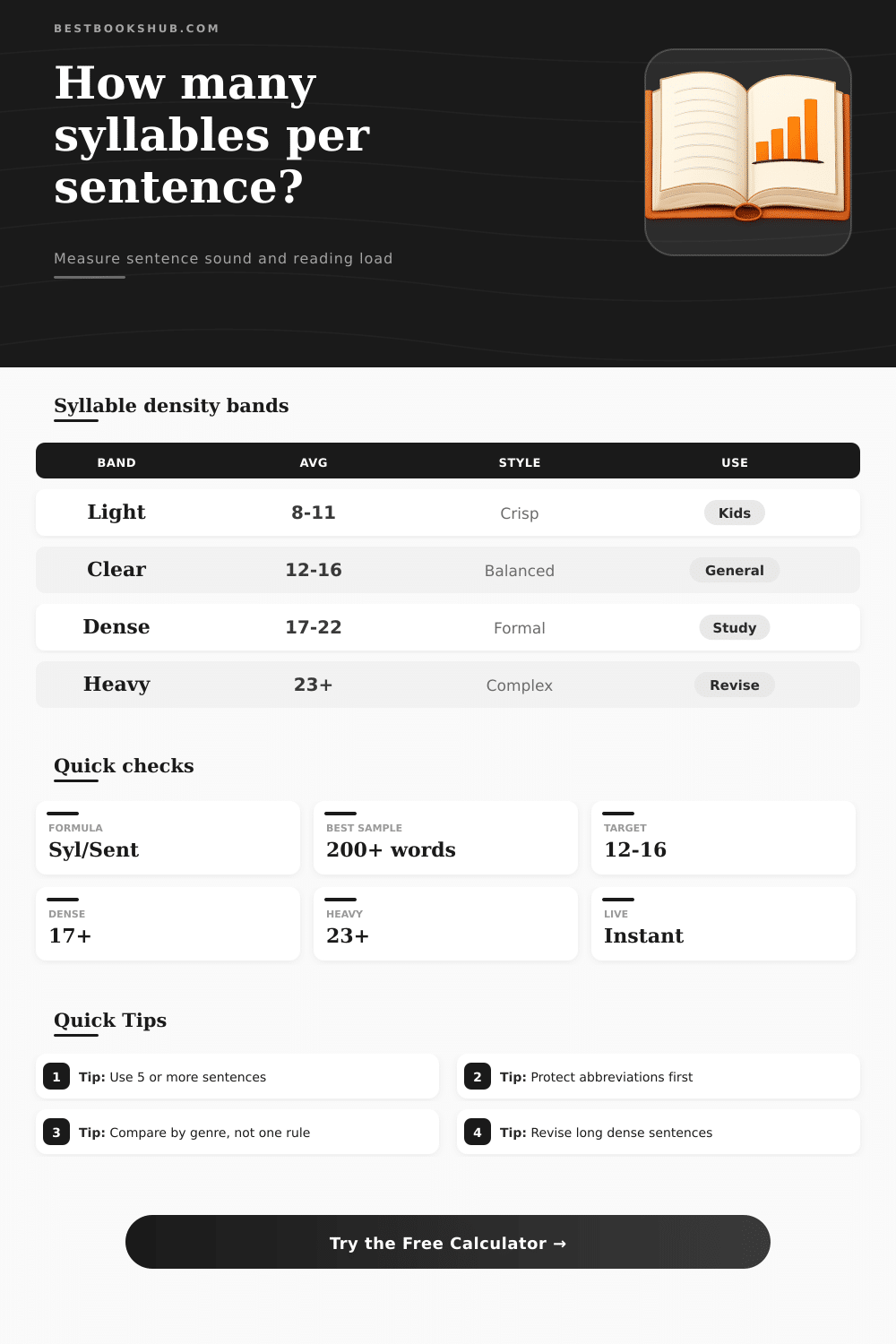
| Average syllables per sentence | Typical feel | Common use | Editing note |
|---|---|---|---|
| 8 to 11 | Light, fast, spoken | Picture books, dialogue, captions | Good for read-aloud clarity; may feel choppy in formal prose. |
| 12 to 16 | Clear and balanced | General nonfiction, web copy, many essays | Usually comfortable for broad audiences and mixed sentence lengths. |
| 17 to 22 | Dense but manageable | Literary description, advanced essays, analysis | Check whether the long sentences carry enough rhythm and signposting. |
| 23 and above | Heavy or demanding | Academic abstracts, legal language, technical explanation | Consider splitting sentences or replacing needless polysyllabic phrasing. |
| Passage type | Useful target | Sentence note | Syllable note |
|---|---|---|---|
| Early reader or read-aloud page | 8 to 11 | Short sentence units support pacing. | Use familiar one- and two-syllable words where possible. |
| Middle grade chapter scene | 10 to 15 | Dialogue and action lower the average. | Names and fantasy terms may raise syllable counts. |
| Book review or jacket copy | 12 to 17 | Varied sentence lengths keep momentum. | Abstract adjectives often add density quickly. |
| Popular nonfiction paragraph | 13 to 18 | Explanatory transitions add length. | Technical terms should be balanced with plain verbs. |
| Academic abstract | 18 to 26 | Compression increases sentence load. | High averages are common, but clarity still matters. |
| Dialogue-heavy fiction | 7 to 13 | Fragments and questions reduce the score. | Contractions usually make spoken rhythm feel lighter. |
| Counting option | What it changes | Use when | Risk if ignored |
|---|---|---|---|
| Protect abbreviations | Keeps Dr., U.S., e.g., and similar forms from splitting sentences. | Your passage includes names, initials, citations, or academic shorthand. | Sentence count may be too high and average syllables too low. |
| Lenient boundaries | Treats semicolons and some line breaks as sentence-like units. | You are measuring oral delivery, poetry, or heavily punctuated prose. | Dense clauses may be hidden inside one long sentence. |
| Spoken numerals | Turns 42 or 2026 into an approximate spoken syllable count. | Numbers are meant to be read aloud. | Data-heavy passages can look artificially light. |
| Remove citations | Excludes parenthetical source notes from the running prose. | You want style analysis without APA or MLA citation clutter. | Author names and years can inflate syllable totals. |
| Syllable pattern | Calculator rule | Example | Why it matters |
|---|---|---|---|
| Vowel groups | Each vowel cluster usually starts one syllable estimate. | reading = 2 | English spelling often groups vowel sounds. |
| Silent final e | Final e is often subtracted unless it follows a consonant plus le. | make = 1 | Prevents many common words from being overcounted. |
| Consonant + le | Final ble, dle, tle, and similar endings add a syllable. | table = 2 | The ending is normally pronounced as its own beat. |
| Known exceptions | Common irregular words use a built-in override list. | queue = 1 | Some spellings do not match simple vowel logic. |
| Hyphen compounds | Split mode counts each part, then combines the total. | well-written | Useful for analyzing editing style and prose density. |
DISCLOSURE: This post may contain affiliate links, meaning when you click the links and make a purchase, I receive a commission. As an Amazon Associate I earn from qualifying purchases.
The syllable per sentence calculator are a tool that will allow you to calculate the number of syllables in each sentence. By using a syllable per sentence calculator, you can understand the impact that the rhythm of your writing have upon the readability of your text. Text that contains many short sentences is often considered to have a faster reading rhythm then text that contains long sentences.
Thus, it is useful to use a syllable per sentence calculator to find a middle ground between too short sentences and too-long sentences. The syllable per sentence calculator allow for several settings to be made within the tool to account for different types of punctuation in your text. For example, you can choose whether you wish to count semicolons as sentences or not, as well as whether you wish to count contraction and citations.
How to Use a Syllable Per Sentence Calculator
If you choose to remove parenthetical citations from your text, the calculator will provide only a count of the syllables within your actual prose rather than inflating that count due to the need to reference other word in your text. Many writers uses a syllable per sentence calculator to compare different versions of the same idea. One version of the text may have a low average syllable count while a different version may have a high average count.
Low counts of average syllables often creates a conversational writing style while high counts of average syllables often creates a more formal writing style. Neither is better than the other, however, as the best average syllable count for a text will depend upon the goal for that text. For instance, the syllable count for a picture book will be different than that of an academic abstract.
Thus, writers should use the syllable per sentence calculator to ensure that their writing reflect the appropriate audience. In addition to calculating the average syllable count for the text, the calculator will also calculate the number of words that are written per sentence. The writer should review these two value at the same time.
For example, a passage may have a relatively low words per sentence figure yet it may have a high syllable count if the words in the passage are long and technical in nature. Additionally, a passage may have a high words per sentence count yet it may have relatively low syllable counts if the words in the passage are short and easily to read. Thus, reviewing both numbers will allow writers to separate sentence length from word choice.
The reference tables provide a list of common syllable counts for various types of writing. For instance, early reader material will typically use the lowest counts of syllables per sentence while nonfiction text will use a medium count. For literary and academic writing, a writer can use a higher count of syllables per sentence but with the caveat that the writer must ensure that the ideas within the text is clear and not potentially easy lost by the readers.
These reference tables should be used as a means of establishing common benchmarks for writers, but they should not be treated as rule that must be followed in all writing projects. While a few long sentences may be acceptable, a whole page of long sentences may create reading challenge for the target audience for that text. An effective use of the calculator is to calculate the same passage of text with two different target.
For instance, running the same chapter through the calculator will provide a result for both the general range of syllables for prose and for literary writing. Comparing those results will provide writers with an understanding of the formal tone of their writing. This information can be utilized during the revision of that writing to determine if any sentences should be split or if there is issues with the words that are being used.
Finally, using the syllable per sentence calculator will allow writers to identify pattern within their writing. By recognizing the patterns that are formed by their writing and sentences, writers will be able to more easily edit their writing to create a better final product.