📖 LIX text difficulty lab
LIX readability calculator
Paste a passage to calculate LIX from words per sentence plus long-word percentage, then compare the score with category bands, language notes, and text-type targets.
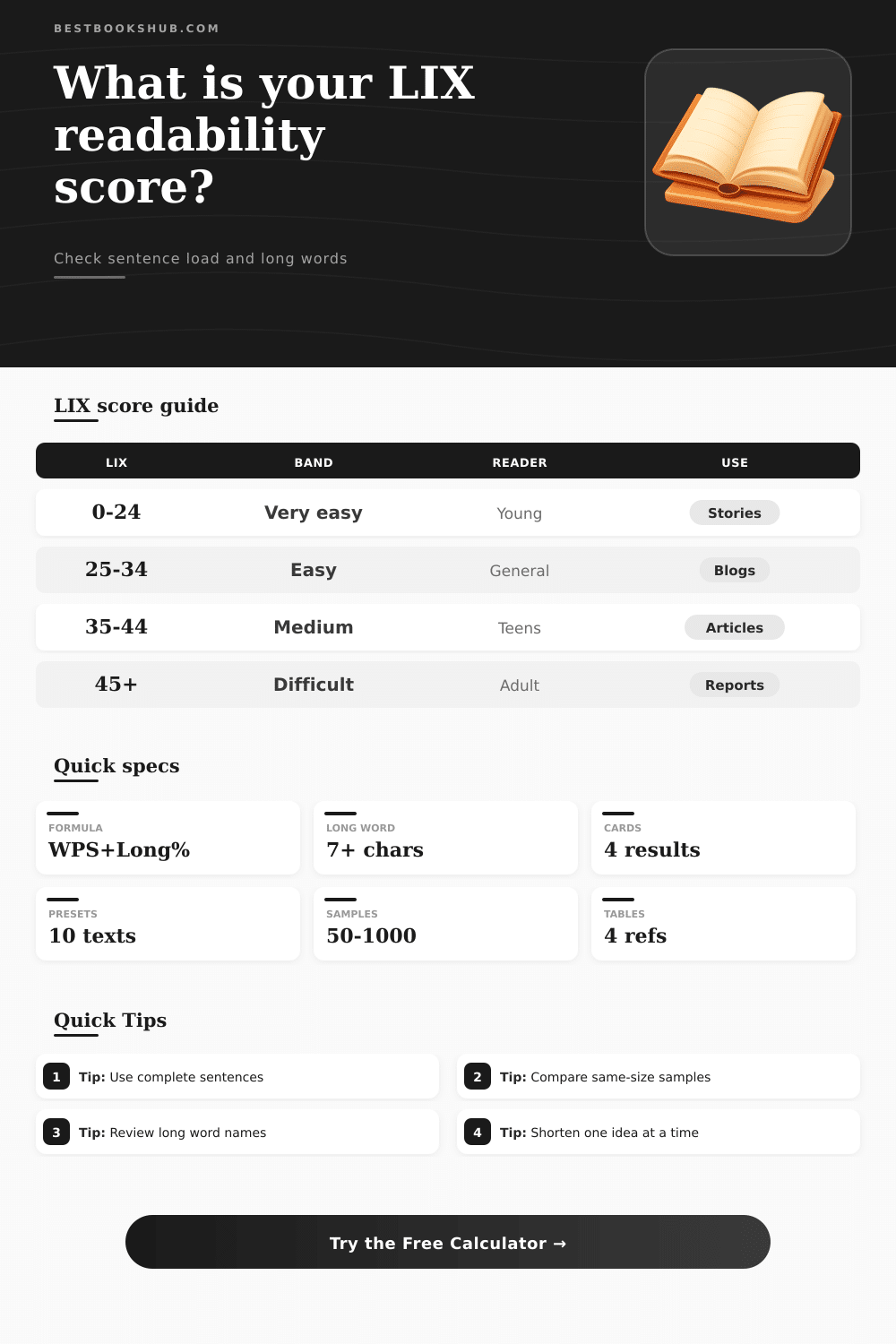
| LIX score | Common category | Typical reader fit | Editing signal |
|---|---|---|---|
| Under 25 | Very easy | Early readers, short web copy, simple notices | Check that the style is not too choppy for adult readers. |
| 25 to 34 | Easy | General readers, youth fiction, practical guides | Usually clear if the ideas are also well organized. |
| 35 to 44 | Medium | Newspapers, adult fiction, common nonfiction | Balanced for many public-facing texts. |
| 45 to 54 | Difficult | Specialist articles, policy explanations, reports | Look for overloaded sentences and unexplained terms. |
| 55 and above | Very difficult | Academic, legal, technical, or dense reference text | Revise if broad comprehension is the goal. |
Children and middle grade
Usually works best with short sentences, familiar words, and a LIX below the adult-news range.
Adult fiction
DISCLOSURE: This post may contain affiliate links, meaning when you click the links and make a purchase, I receive a commission. As an Amazon Associate I earn from qualifying purchases.
Can tolerate a medium LIX when sentence rhythm varies and long words serve voice rather than clutter.
News and web copy
Often targets easy to medium bands so scanning readers can understand the point quickly.
Technical instructions
May score high because exact terms are necessary, so pair LIX with step clarity and glossary checks.
Academic writing
Dense vocabulary and long clauses raise LIX fast; abstracts should still avoid avoidable sentence stacking.
Translated text
Compare passages in the same language where possible because compound and inflection patterns affect long-word rates.
| Language profile | Long-word effect | Sentence effect | Best comparison method |
|---|---|---|---|
| English | Long words often mark technical, formal, or abstract vocabulary. | Sentence length usually drives the biggest readability swings. | Compare with English samples from the same genre. |
| Swedish, Danish, Norwegian | LIX was popularized in Nordic contexts and handles many public texts well. | Medium scores are common in news and public information. | Use classic bands, then inspect compounds manually. |
| German and compound-heavy text | Compounds can lift long-word percentage even when the concept is familiar. | Clause stacking can also raise WPS sharply. | Try both combined and split hyphen/compound settings. |
| Romance languages | Inflection and word endings can increase letter counts compared with English. | Longer sentence traditions may be acceptable in some genres. | Compare within the same language, not across languages. |
| Mixed or translated passages | Names, loanwords, and direct translations can distort long-word counts. | Literal translations may retain source-language sentence shape. | Review the long-word list before changing style. |
| Sample size | Best use | Risk | Recommendation |
|---|---|---|---|
| 50 words | Quick check for a caption, notice, or single paragraph. | One long sentence can dominate the score. | Use only for short forms or early diagnostics. |
| 100 words | Fast excerpt comparison across chapters or article leads. | Dialogue-heavy sections may look easier than exposition. | Compare the same passage type each time. |
| 200 words | Balanced view of a page, section, or classroom handout. | Still sensitive to a glossary-heavy paragraph. | Good default for revision checks. |
| 500 words | Chapter opening, report section, or long article sample. | Can blend easy and difficult sections together. | Pair with long-word review and paragraph checks. |
| All words | Complete short texts, landing pages, emails, and brief reports. | May hide one difficult section inside a broad average. | Run section-by-section if the full score feels vague. |
| Text type | Usual LIX target | Sentence pattern | Long-word pattern |
|---|---|---|---|
| Children's story | 15 to 28 | Short sentences with clear action beats. | Long words are rare or repeated with support. |
| Middle grade chapter | 22 to 34 | Mostly short to medium sentences. | Some place names and vivid vocabulary. |
| Young adult fiction | 28 to 40 | Dialogue and internal thought create variation. | Long words appear through voice and setting. |
| Adult general prose | 34 to 44 | Medium sentences with occasional long ones. | Moderate abstract and descriptive vocabulary. |
| News or magazine article | 32 to 44 | Clear lead sentences and compact explanation. | Names and institutions may inflate long-word share. |
| Web help or blog guide | 25 to 38 | Short explanatory sentences and scannable steps. | Terms should be introduced near first use. |
| Technical instructions | 38 to 52 | Procedural sentences with conditionals. | Necessary terms raise the long-word percentage. |
| Academic or policy text | 45 to 65 | Long clauses and dense transitions. | Many specialized, abstract, or institutional terms. |
A LIX score are a measurement of readability. More specificaly, a LIX score measure the difficulty of a texts for a reader to read. Looking at two factor: the length of the sentences within a text, and the length of the word within those sentences, calculates a LIX score.
A LIX score does not measure the quality of the idea within a text. Instead, it measures the amount of cognitive work that a reader must employ in order to read the text. Text that has long sentence and long word will have a high LIX score.
How the LIX score shows how hard a text is to read
Text that uses short sentence and short word will have a low LIX score. The length of the sentences within a text is one of the primary factor that is considered in calculating the LIX score. A reader must decode each sentence into individual clause to understand what the author wrote within that sentence.
When author use many long sentences, the reader must decode many clause within each sentence, making it more difficultly for the reader to understand the author’s idea. By using a calculator to calculate the LIX score, the writer can understand if the high LIX score is due to the long sentences or the long word within the text. By understanding this cause of the high LIX score, writers can decide if they need to change their sentences from long to short, or if they need to change their long word to shorter words.
Another factor to consider in calculating the LIX score is the length of the word within a text. Words that are long within a text can make it more difficult for the reader to read the text. There are some long word that are required in some scenario to increase the precision with which an author describes a concept.
However, in many instances, an author may replace a long word with another synonym to increase the variety of their vocabulary. The LIX score will count each of the words in the text that have more letters than a certain number. The LIX score will provide a list of the long word in the text.
While a single long word will not make a paragraph difficult to read, a paragraph that includes many long word will be difficult for the reader. By reviewing the list of long word in the text, writers can decide which of those word are necessary to the text, and which can be replaced with shorter words. Another feature of the LIX score calculator is the table that provide examples of the different type of LIX scores for different type of writing.
Each type of writing requires certain type of LIX scores. For instance, picture books require low LIX score because young child are meant to read them easily. In contrast, research paper may require high LIX score because they contain technical concept that must be described in detail.
A high LIX score for a blog post may be normal for a research paper. Thus, writers should not use the LIX score as their final grade on the readability of their text. A LIX score is a diagnostic tool.
The score can show that a writer is using long sentence or long word within their text. Using different word threshold on the calculator can test the sensitivity of the LIX score. By testing these different threshold, writers can learn what the LIX score will be under certain condition within a text.
An additional consideration for the LIX score is the language that is used within a text. Languages like German and Swedish include many compound word. These compound word can increase the LIX score.
Romance language include many extra letter at the end of word or before word (like article). These extra letter will increase the LIX score, as. By adjusting the settings on the LIX score calculator, writers can ensure that the LIX score reflect the language that is being used in the text.
A potential mistake that many writer make is using inconsistent sample of text in calculating the LIX score. Different type of text have different LIX score. For instance, a dialogue scene will have a different LIX score then a paragraph that explains a concept.
A news lead will have a different LIX score than a methods paragraph within a research paper. Therefore, writer need to ensure that the type of text that is being measured has consistency in its type of content. Once writer have a breakdown of their texts LIX score, they can begin to make change to that text.
They may choose to shorten their sentence, or they may replace the long word in their text with shorter word. Finally, writer should of remember that the LIX score does not consider the importance of the idea that is being shared in the text. Thus, while the LIX score can reveal if a writer needs to change the readability of their text, the LIX score does not convey whether or not the writer should change the content of that text altogether.