📖 Long-word readability lab
RIX readability calculator
Paste a passage to calculate RIX, the long words per sentence readability score, with adjustable sentence detection, long-word thresholds, and text-type targets.
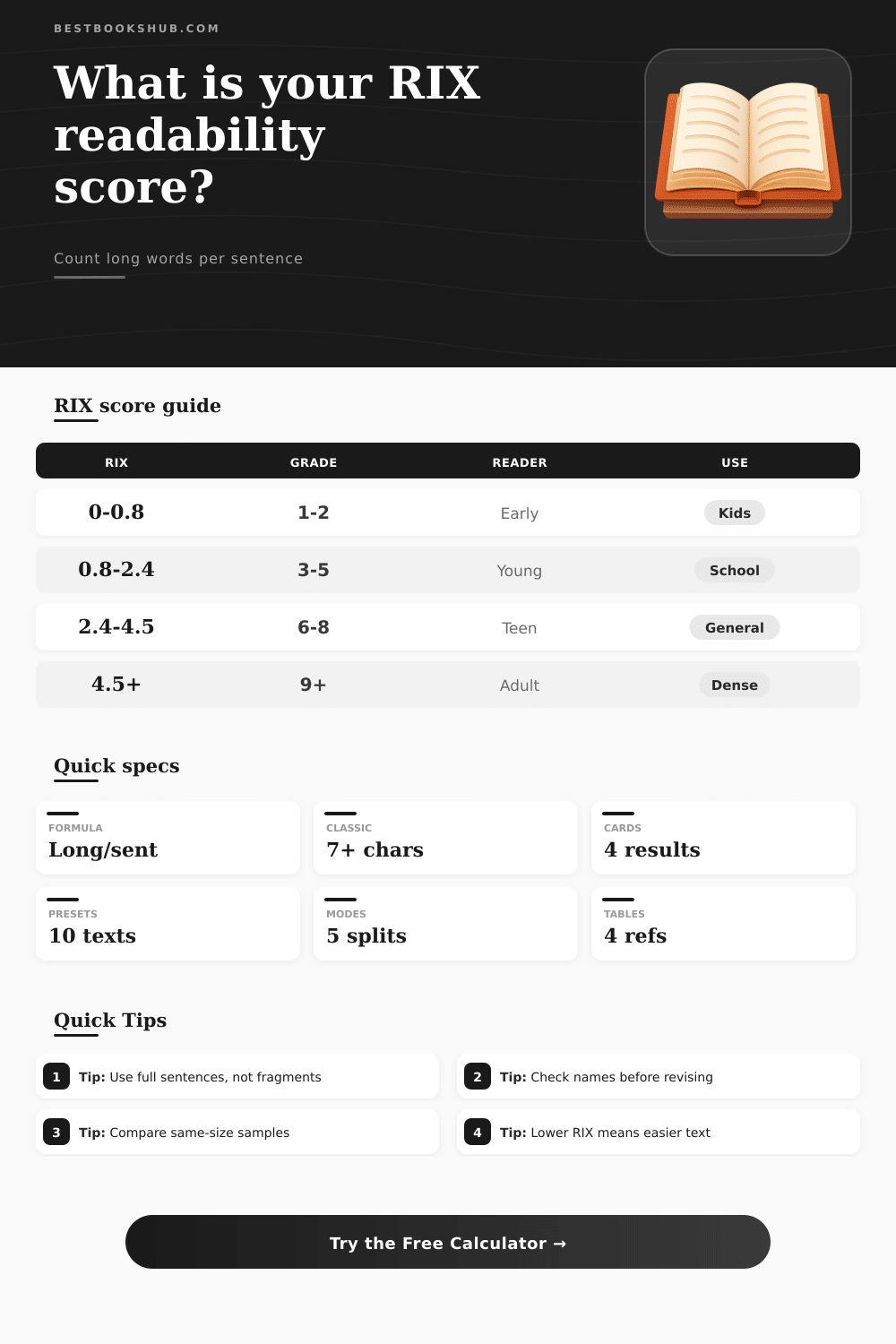
| RIX score | Approx grade | Reader band | Typical use |
|---|---|---|---|
| 0.00 to 0.20 | Before grade 1 | Emergent | Very short early passages |
| 0.20 to 0.80 | Grades 1 to 2 | Early reader | Simple classroom or picture-book prose |
| 0.80 to 1.80 | Grades 3 to 4 | Developing reader | Elementary articles and chapter books |
| 1.80 to 3.00 | Grades 5 to 6 | Upper elementary | Middle grade exposition and lessons |
| 3.00 to 4.50 | Grades 7 to 8 | Teen or general | YA scenes, web essays, and reviews |
| 4.50 to 6.20 | Grades 9 to 10 | High school | Dense nonfiction and literary prose |
| 6.20 to 7.20 | Grade 11 | Advanced teen | Formal essays and specialist articles |
| 7.20+ | Grade 12+ | Advanced adult | Academic, legal, and technical passages |
| Text type | Useful RIX range | Watch point | Editorial action |
|---|---|---|---|
| Picture book or early reader | 0.0 to 0.8 | Names can dominate short samples | Check repeated long names separately |
| Middle grade passage | 0.8 to 3.0 | Exposition raises RIX quickly | Break long information sentences |
| YA, article, or book review | 2.4 to 4.8 | Jargon may hide inside short sentences | Define terms near first use |
| Adult nonfiction or literary prose | 3.7 to 6.2 | Long clauses can stack with long words | Vary sentence length around dense terms |
| Academic or technical text | 5.3 to 8.5 | Necessary vocabulary may be counted hard | Use signposts rather than deleting terms |
| Option | Best for | What changes | When to use |
|---|---|---|---|
| Balanced sentence mode | Book excerpts and articles | Protects common abbreviations before splitting | Use for most prose samples |
| Line sentence mode | Poems, verse, and bullets | Each non-empty line becomes one sentence | Use when punctuation is intentionally sparse |
| Hyphen split mode | Compound-heavy copy | Breaks self-contained compounds into parts | Use for style guides that count compounds separately |
| Proper noun soften | Fantasy, history, and names | Requires one extra letter for capitalized names | Use when character names inflate the score |
| Custom threshold | Editorial comparisons | Changes the long-word definition | Use only when comparing with the same rule |
RIX
Focuses on long words per sentence, so it is fast to inspect and easy to explain to editors.
LIX
DISCLOSURE: This post may contain affiliate links, meaning when you click the links and make a purchase, I receive a commission. As an Amazon Associate I earn from qualifying purchases.
Adds average sentence length to long-word percentage, which makes it more sensitive to sentence pace.
Flesch grade
Uses sentence length and syllables, which can react differently to short technical words or names.
Manual review
Checks whether counted long words are necessary terms, avoidable jargon, or proper names.
| Metric | Core count | Strength | Limitation |
|---|---|---|---|
| RIX | Long words / sentences | Simple density signal | Does not include total word count directly |
| LIX | Words per sentence plus long-word rate | Captures both pace and vocabulary | Less compact than RIX |
| Flesch-Kincaid | Syllables, words, and sentences | Common grade-level reference | Syllable estimates can vary |
| Long-word share | Long words / total words | Shows vocabulary load alone | Misses sentence clustering |
| Sentence average | Words / sentences | Shows pacing and clause load | Misses complex vocabulary |
The RIX readability score are a measurement of the density of long words in a text. The RIX readability score is also helpful in that it can show when long words is clustered together in a sentence. If long words is clustered in a sentence, then it can make that sentence harder to read.
The RIX readability score dont take into account syllables or the length of sentences. To calculate the readability score for a text, you must count all word with seven letters or more, and that number is to be divided by the total number of sentences in that text. That calculated number will show how many long word must be read for every sentence completed by the reader.
How the RIX score works
The RIX readability score can be used in two different situations: when revising a draft of a manuscript, and when checking a passage of text in a classroom. For example, if a picture book have a readability score near 0.5, it will be light for the reader. However, if a chapter book written for middle-grade readers has a readability score higher then 2.5, it may mean that the text has a high number of character name or exposition describing the characters in the story.
The readability calculator allow for authors to choose a sentence-boundary rule and to choose the threshold for counting long words. Each author can use these two different options to compare the two different versions of a scene from a story. The threshold for long words is an important part of calculating the readability score of a text.
The choice of threshold can affect the readability score more than the author may think when first reading about the readability score. For instance, if the author counts every six-letter word in a text of fiction, the readability score will be higher than if every eight-letter word is counted. Proper nouns will impact the readability score of a text, as well.
If there are many proper nouns in a manuscript that contain invented names for characters, the readability score will be higher. To combat this possibility, some writer choose to ignore capitalized words. The way in which the software detect the sentences in a passage will also impact the readability score.
For instance, if every line break is treated as a sentence boundary, the readability score will be higher than if the sentences is detected using balanced mode, which recognize common abbreviations. These two sentence detection modes can be set on the same text to determine whether readability score issues are caused by vocabulary choice or punctuation. The reference tables for the RIX readability scores provide grade bands for each readability score.
These bands is approximations only, though. For example, an academic abstract will typically have a readability score around 5.8 due to the precise definition of many of the terms in the abstract. A young adult scene in a story may have a readability score of 4.2, though the scene may still be appropriate for that age group.
The readability score will highlight instance in which long words are clustered together in sentences. The author can then use that information to decide whether to keep or eliminate those long words. One way for writers to establish a habit in their writing is to calculate the readability score of a passage using two different thresholds for long words.
The first pass through the passage with two different thresholds will show which words are long words. The second pass will show whether shortening some of those long word will cause the readability score to fall into a more comfortable grade band for the target age group of readers. While not every long word need to be eliminated, it is helpful to at least have a list of long words that can be reviewed to determine which to keep and which to eliminate from the text.
Overall, the readability score return a single number to authors and editors. That single number is helpful in that it forces the reader of this passage to look at the text for a second time. For example, the readability score will not tell the author if a sentence is elegant or beautiful.
The readability score will not tell an author if a paragraph contains emotional weight. However, the readability score will tell the author how many sizable word appear in a sentence. Knowing that number provide the editor or author with enough information to make an edit to the text.