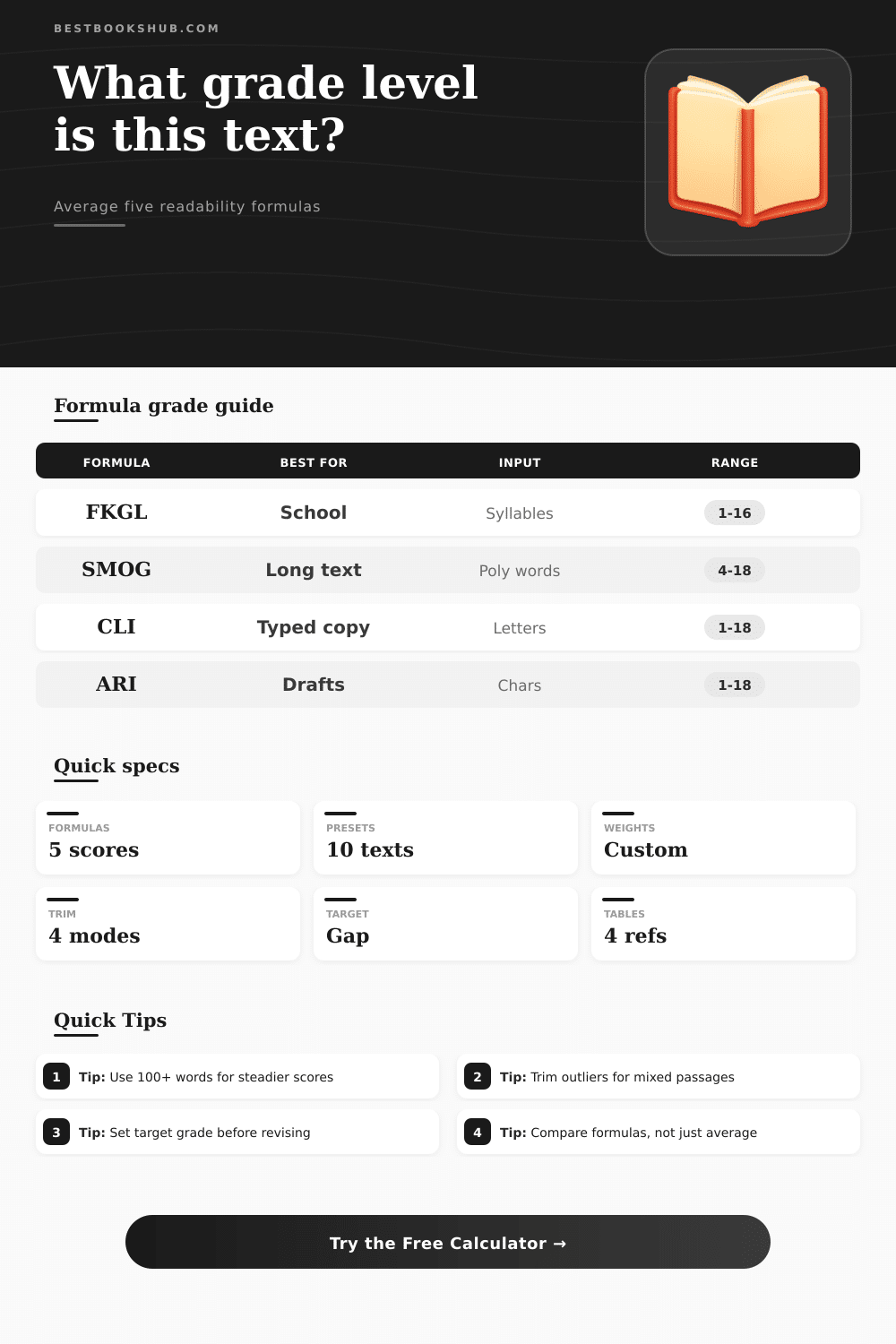
📖 Multi-formula readability lab
Readability grade level averager
Paste a passage to combine FKGL, SMOG, Coleman-Liau, ARI, and a Dale-Chall-like estimate with custom weights, outlier trimming, and a target grade gap.
Set a target grade, choose sample handling, adjust formula weights, and decide whether outlier scores should be retained, dropped, or capped.
| Average grade | Reader band | Typical use | Revision signal |
|---|---|---|---|
| 1 to 4 | Early elementary | Beginning readers, decodable passages, simple classroom copy | Keep sentences short and concrete. |
| 5 to 6 | Upper elementary | Middle grade chapters, simple instructions, broad web explainers | Watch rare vocabulary and sentence chains. |
| 7 to 8 | Middle school | General nonfiction, book reviews, accessible study guides | Good default for broad public readers. |
| 9 to 10 | High school | YA analysis, dense articles, policy summaries, classroom essays | Trim long clauses if targeting casual reading. |
| 11 to 12 | Advanced high school | Literary criticism, technical lessons, advanced course notes | Define terms and reduce sentence length. |
| 13 plus | College or specialist | Academic abstracts, legal text, specialist documentation | Use headings, examples, and simpler phrasing. |
| Formula | Core inputs | Displayed output | Best caution |
|---|---|---|---|
| FKGL | Words, sentences, syllables | Grade = 0.39 x ASL + 11.8 x ASW - 15.59 | Syllable heuristics can miss unusual names. |
| SMOG | Sentences and 3+ syllable words | Grade = 1.043 x sqrt(poly x 30 / sentences) + 3.1291 | Short samples make the score jumpy. |
| Coleman-Liau | Letters, words, sentences | Index = 0.0588 x L - 0.296 x S - 15.8 | Letter-heavy terms can raise the result. |
| ARI | Characters, words, sentences | Index = 4.71 x chars/words + 0.5 x ASL - 21.43 | Abbreviations and numerals affect characters. |
| Dale-Chall-like | Unfamiliar words and sentence length | Adjusted score is mapped to a grade estimate | The familiar-word list is approximate. |
| Mode | What it does | When to use | Effect on average |
|---|---|---|---|
| No trimming | Uses every enabled formula with its weight | Balanced samples where scores agree | Most transparent and repeatable |
| Drop highest and lowest | Removes the most extreme formula grades before weighting | Mixed passages or very short excerpts | Reduces one high and one low pull |
| Drop 2+ from median | Removes any formula more than two grades from the median | Technical copy with one noisy metric | Keeps formulas clustered near consensus |
| Winsorize to median band | Caps extreme formulas at two grades above or below median | When you want all formulas represented | Softens outliers without removing them |
| Sample size | Confidence | Useful for | Suggested action |
|---|---|---|---|
| Under 100 words | Low | Headlines, blurbs, very short excerpts | Use as a quick signal only. |
| 100 to 249 words | Moderate | Short passages, jacket copy, blog sections | Compare with another sample if possible. |
| 250 to 599 words | Strong | Chapter excerpts, lessons, articles | Good default for revision planning. |
| 600 plus words | Very strong | Long articles, reports, manuscript sections | Check sub-sections for local difficulty spikes. |
DISCLOSURE: This post may contain affiliate links, meaning when you click the links and make a purchase, I receive a commission. As an Amazon Associate I earn from qualifying purchases.
When you calculates the readability score of a text, you are trying to determine whether the text is at an correct level for the readers. A readability score help to determine if a page, lesson, or chapter in a text is going to be easy or difficult for the reader to read. However, there are different readability score formula, and no single readability formula will tell you if a text is easy to read.
One readability score formula may reward you for using short sentence, but another readability score formula may give you a more higher score for using long words. Each readability score formula have different guidelines for what will provide the best readability score for a given text. Because of the possibility of receiving differing readability score from different readability score formulas, the best way to determine the readability score of a text is to calculate the average readability score from each readability formula.
How to Check If Your Text Is Easy to Read
There are five most common readability formulas use by writers. These readability formulas are the Flesch-Kincaid, SMOG, Coleman-Liau, ARI, and the Dale-Chall style count readability formulas. The Flesch-Kincaid and the SMOG readability formulas calculates the number of syllable that words have in a text.
The Coleman-Liau, ARI, and the Dale-Chall readability formulas do not calculate the number of syllables in a text. Instead, the Coleman-Liau, ARI, and the Dale-Chall readability formulas calculate the number of letter and characters in a text. This is particularly useful in readability formulas such as the Coleman-Liau and the ARI readability formulas because proper names in a text can affect the number of syllables that words have and thus impact the readability score of a text.
Finally, the Dale-Chall readability formula calculates the number of word in a text that are not on a list of the most common words in the language. Each of these readability formulas will provide different analyses of the same text due to the different aspects of the text that they analyze. By reviewing the readability score of a text with each of these formulas, writers can edit their text to ensure that they are not presenting difficulty in any specific aspects of their texts.
The difference between the highest readability score and the lowest readability score that was calculated for a text can help writer to edit their texts. The gap between the highest readability score and the lowest readability score within a text indicate to writers that certain sentences within that text may need to be edited. This gap help writers to identify the specific sentences that should be edited instead of editing the entire text.
Additionally, trimming the most extreme readability scores will provide writers with a more accurate readability score. By trimming these scores, writers will not be impacted by one particularly high or low readability score for the text. However, it is still important for writers to review each readability score that was calculated for their text so that they is aware of each of the reactions that readability formulas have towards their texts.
The target grade level for a text is used to help writers understand how they should use the readability scores that were calculated for their text. For example, if the grade level that a writer is targeting is eighth grade and the readability score is two grades higher than eighth grade, then the sentence in the text would need to be shortened. Additionally, if the readability score for a text was lower than the target grade level for the text, readers may begin to feel that the writer is condescending towards those readers.
The length of the sample of text that is analyzed will also have an impact upon the trustworthiness of readability scores for that text. For example, readability scores may not be trusted for a sample of text that is fifty word in length. However, readability scores can be trusted for samples of text that are a few hundred words in length.
For this reason, many writers will calculate the readability score for the entire passage of text as well as calculate readability scores for the middle section of that passage. The readability score for each of these sections will help writers to ensure that the readability of their text is steady throughout the passage rather than having some section of their text more difficult to read than others. Readability formulas are based upon old research into the readability of texts in classrooms.
Therefore, readability formulas may not work well for texts that contain dialogue, poetry, or other forms of stylized narratives. Additionally, readability formulas may not work well for texts that contains names or quoted text. In these instances, treating proper noun as if they are made up of familiar words can make readability scores more accurate.
Additionally, changing the mode in which the text is analyzed to ignore the first and last paragraph of the text can make readability scores more accurate. Although readability formulas offer writers a way to determine the readability score of their text, it does not replace the actual readability test that real readers can perform on the text. Real readers will always be able to provide writers with feedback regarding the readability of specific sentence within the text.
However, using the readability formulas will give writers a reliable starting point for any editing of their texts. Furthermore, readability formulas will help writers to avoid over-editing their text. Through reviewing the readability scores that were calculated using each of the readability formulas, writers can have an understanding of the readability of their text and how to best edit their text.