📖 Vocabulary load studio
Flesch vocabulary load calculator
Paste a passage to measure syllables per word, long-word share, complex word burden, Flesch-style vocabulary load, reader vocabulary level, and simplification targets.
Load a passage style, then adjust the thresholds and target reader level to see how the vocabulary burden changes.
DISCLOSURE: This post may contain affiliate links, meaning when you click the links and make a purchase, I receive a commission. As an Amazon Associate I earn from qualifying purchases.
Vocabulary load combines Flesch syllable density with long-word and complex-word burden. Automatic syllables are estimates, so manual totals can override final samples.
Manual totals and overrides
Add text or totals to calculate a target.
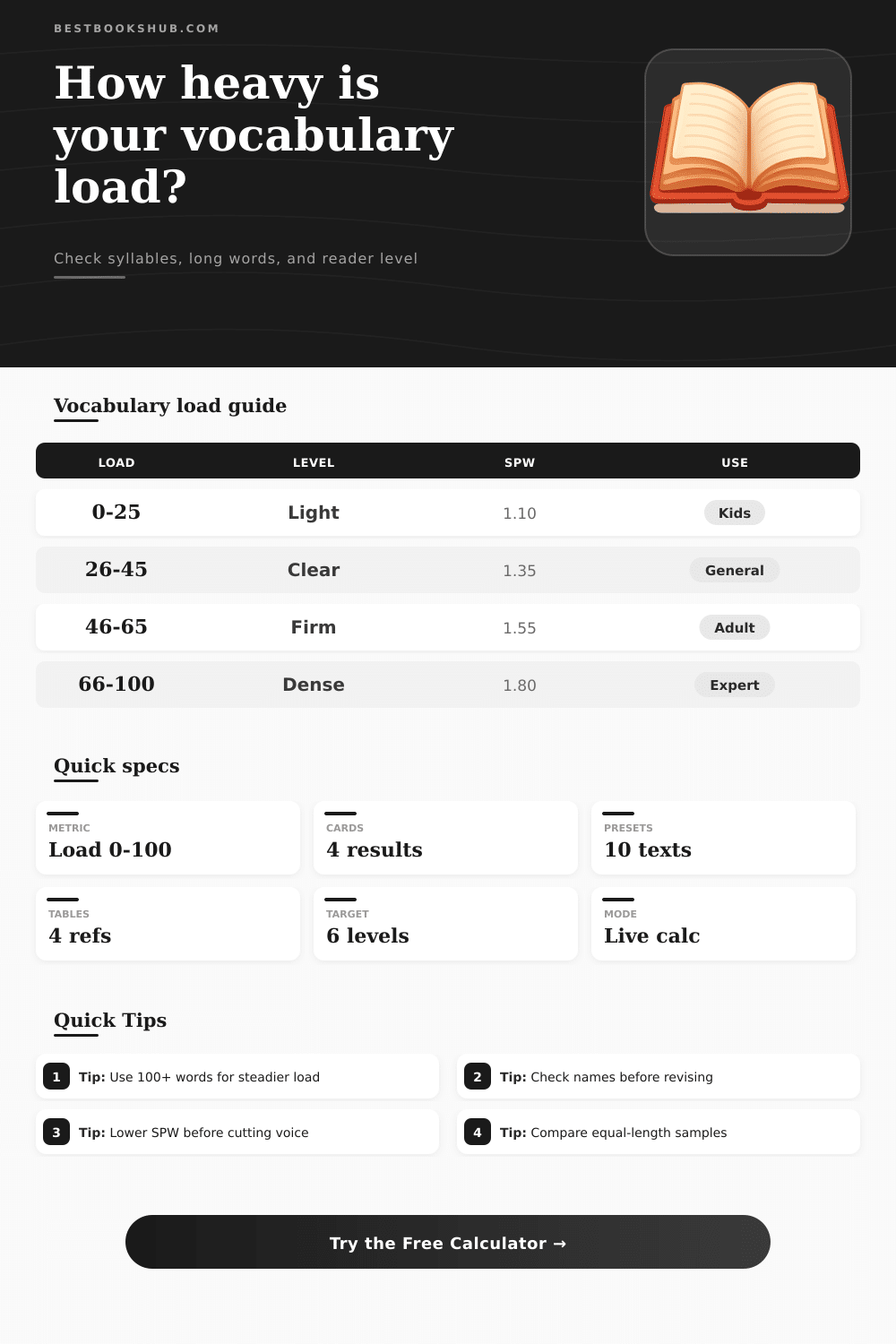
| Load index | Reader vocabulary level | Typical syllables per word | Editing signal |
|---|---|---|---|
| 0-25 | Starter / early reader | 1.05-1.25 | Mostly familiar short words; check sentence rhythm before simplifying further. |
| 26-45 | Developing to general | 1.25-1.45 | Usually clear for broad readers if sentence length stays controlled. |
| 46-65 | Confident adult | 1.45-1.65 | Look for clusters of long words and define key terms near first use. |
| 66-80 | Advanced reader | 1.65-1.85 | Vocabulary is carrying substantial burden; simplify if speed matters. |
| 81-100 | Specialist / technical | 1.85+ | Expect high prior knowledge demand or discipline-specific terminology. |
| Target reader | Suggested load cap | Long-word share | Complex-word share |
|---|---|---|---|
| Starter reader | 25 or lower | Under 8% | Under 4% |
| Developing reader | 35 or lower | Under 12% | Under 7% |
| General adult reader | 45 or lower | Under 18% | Under 10% |
| Confident reader | 58 or lower | Under 25% | Under 16% |
| Advanced reader | 72 or lower | Under 34% | Under 24% |
| Specialist reader | 88 or lower | Varies by field | Term clusters expected |
| Feature | Calculator control | Why it matters | Common adjustment |
|---|---|---|---|
| Syllables per word | Estimated or manual syllables divided by words | Directly affects Flesch reading ease and perceived vocabulary weight. | Replace some multisyllable terms with shorter familiar terms. |
| Long-word share | 7, 8, 9, or 10 plus letters | Long visual forms slow scanning even when syllables are moderate. | Break compounds, use pronouns carefully, or define repeated terms. |
| Complex-word burden | 3, 4, or 5 plus syllables | High-syllable terms often signal abstract, academic, or technical load. | Swap only the terms that are not required for precision. |
| Sentence support | Words per sentence and sentence count | Long sentences amplify the effect of dense vocabulary clusters. | Split sentences near long noun phrases or definitions. |
| Preset type | Expected load pattern | Best target | What to review first |
|---|---|---|---|
| Early Reader | Low SPW, few long words, short sentences | Starter or developing | Do not overcut necessary story words. |
| YA Scene | Moderate SPW with dialogue-driven pacing | General reader | Keep voice while trimming abstract phrasing. |
| Academic Note | High complex burden and term clusters | Advanced or specialist | Define key terms and split loaded sentences. |
| Technical Help | Mixed simple verbs with precise technical nouns | Confident or advanced | Replace process words before replacing required terms. |
You can use the readability calculator to determine the difficulty of a text, as well as to help you decide how to revise your text for best results. The readability calculator analyze the vocabulary of a passage. More specifically, the readability calculator will count the total number of words within a passage, the total number of sentences within the passage, and the total number of syllables within the passage.
Based off these three counts, the readability calculator calculate three specific signals for the passage: syllable density, long-word share, and complex-word burden. Each of these three signals are used to calculate a single load score for the passage. The load score dont determine whether a passage is good or bad, but the load score indicates the level of attention that a reader must use in order to understand the passage.
How to Use the Readability Calculator
To calculate the load score, the readability calculator will ask you to choose a reader target. Passages that are written for general audiences and readers will have a lower load score than passages written for specialists within a field. This is due to the fact that a specialist audience will understand many of the more difficult words in the passage.
The length of sentences in a passage can also have an impact on the load score. For instance, longer sentences will make it more difficult for a reader to understand dense vocabulary within that passage. The readability calculator measures the number of words that are used within each sentence.
Consequently, a long word can be kept within a short sentence, or a long word can be kept within a sentence that contains only simple words. The names of individuals within the passage may have an impact upon the load score. For this reason, the readability calculator allow you to skip over or soften the names of individuals in your passage.
A name may be long, but it does not necessarily make the passage more difficult to read for an audience. The use of abbreviations within a passage can also impact the load score of your passage. Abbreviations may not be recognized by all readers of a passage.
Consequently, you should not change every long word in your passage to a shorter word, but it is possible to change some of the long words in a paragraph that contains a cluster of long words. The readability calculator will provide you with an indication of the new load score that your passage will have after you make such changes to its words. You should not use this tool to compare the load scores of passages of different lengths, and passages of different purposes.
Each passage will have different results with the readability calculator than the next. This tool works best when comparing the load scores of passages that are similar to each other. The readability calculator includes a number of presets for different types of passages that you can use to help you start your passage with the appropriate style.
In addition to these presets, there are also reference bands for the readability calculator. For example, a light load score is created for passages written for early readers, a clear load score for passages written for general audiences, a firm load score for confident readers, and a dense load score for passages written for audiences that are already familiar with the specific field. These reference bands are not rules that you should follow for all writing projects, but they do provide a means of discussing the readability of a passage in relation to its audience.
Assuming that the load score of the passage is higher than the target load score for that audience, you will have to make some changes to your passage. One area that you can focus upon is the syllable density of the passage. Every word in your passage impact the syllable density of that passage.
For instance, if you change one three-syllable word to a one-syllable word, the syllable density of your passage will decrease. The long-word share and complex-word burden for your passage may not change as quickly in response to your changes. For instance, if you change a long word to a short word, the long-word share for your passage may not change until you have changed a number of long words in your passage.
However, the readability calculator will show you these distinctions within the passage. Consequently, you can decide what changes to make within the passage. The value of using the readability calculator is that it allows you to see the different trade-offs that you can make within your passage.
For instance, you can choose to leave a precise word in your passage as is, but make other changes to the passage that will lower the load score. The readability calculator makes your decisions regarding your writing more deliberate due to the load score that it calculates for your passage.