📖 Fiction structure planner
Novel Chapter Count Calculator
Estimate a workable chapter count from total word count, target chapter length, scene count, act percentages, POV rotation, genre pacing, and your acceptable chapter range.
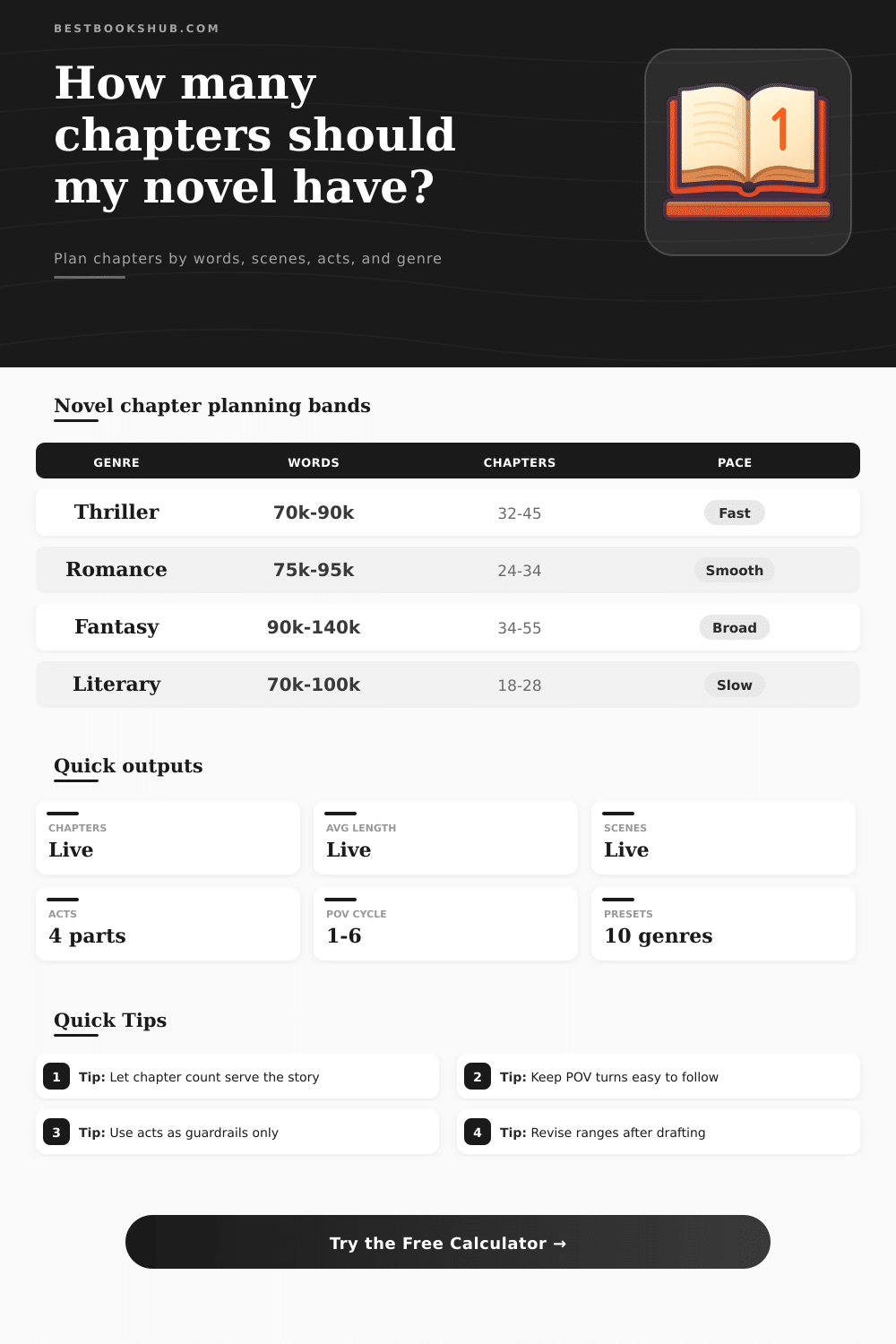
| Genre band | Typical word count | Chapter length | Chapter range | Planning signal |
|---|---|---|---|---|
| Commercial thriller | 70,000-90,000 | 1,800-2,800 | 32-45 | Use short turns and frequent hooks. |
| Romance | 75,000-95,000 | 2,500-3,800 | 24-34 | Balance emotional beats and POV turns. |
| Epic fantasy | 90,000-140,000 | 2,800-4,200 | 34-55 | Track subplot and world threads. |
| Literary novel | 70,000-100,000 | 3,200-5,000 | 18-28 | Longer chapters can carry interiority. |
| Middle grade | 35,000-60,000 | 1,500-2,500 | 18-30 | Keep chapters clear and momentum-led. |
| Act segment | Percent | Chapters | Word target | Scene target |
|---|
| POV | Suggested chapters | Approx words | Rotation note |
|---|
| Chapter length band | Best fit | Effect on count | Watch point |
|---|---|---|---|
| 1,200-2,000 words | Serial, thriller, horror | Raises chapter count | Too many cliffhangers can feel mechanical. |
| 2,000-3,200 words | Commercial fiction, YA | Balanced count | Check that each chapter has a turn. |
| 3,200-4,500 words | Fantasy, literary, historical | Lowers chapter count | Long chapters need internal movement. |
| 4,500+ words | Expansive or braided novels | Much lower count | Use section breaks when scenes shift hard. |
DISCLOSURE: This post may contain affiliate links, meaning when you click the links and make a purchase, I receive a commission. As an Amazon Associate I earn from qualifying purchases.
When you is beginning to write your novels, you must make a decision about the chapter count for your novel. The chapter count for your novel will help to determine the pace at which your novel will unfolds. For instance, a novel that is based upon thrillers may require that many of the chapters be short in lengths to allow for the story to have a fast pacing, while a literary novel may require fewer chapters of longer length to provide the slow pacing that is required for that type of novel.
If the chapter count is too low for your novel, the pacing of the story may end up being too slowly. If the chapter count is too high for your novel, however, an audiences may end up feeling the chapters too choppy when read. The calculator will allow you to input certain data regarding your novel to determine a chapter count for your novel.
How to Find the Right Number of Chapters
For example, you must input the word count for your novel, the chapter length that you intend to utilize for each chapter, the scene count within your novel, the percentages that you intend to allocate to each act within your novel, the point-of-view (POV) rotation for your novel, and the pacing of the story within your novel. Each of these factors will impact your calculated chapter count. For instance, if your novel contains many scenes that include reversals, the chapter count will be higher than if your story contains scenes that occur in only a single POV.
You will use the act structure for the novel to determine how many chapters will be allocated to each of the four movements within the novel, the POV rotation will ensure that each of the different points of view in your novel have enough chapters to provide sufficient attention to each of the characters with those points of view, and the pacing of the story will impact the chapter count due to the inclusion of cliffhanger or quiet, literary story elements. Furthermore, the min-max range for your novel will limit the calculated chapter count to ensure that the chapter count remains within the boundaries that you desire for your story. In most cases, writers will have to revisit the chapter count after the completion of a first draft of the novel.
During the editing of the novel, some writers may combine two scene into one scene, or they may edit the novel to split one scene into two scenes. The revision buffer allows writers to determine how many chapters may change during the editing phase of the novel. The chapter count is a number that will change during the editing of the novel, and having this buffer is helpful for writers to understand the extent of the changes that will be required for the editing process.
Furthermore, some writers may encounter certain problems when using this chapter count calculator. For instance, some writers may choose a chapter count before they are certain of the movement of the story. Other writers may choose to ignore the relationship between the scenes within the story and the chapter count.
The calculator recognizes these types of problems to ensure that the writer adjusts the chapter count prior to the completion of the first draft of the novel. The reference tables provide typical chapter counts for novels of different genres. These tables can help writers to understand where the chapter count for their novels sit in relation to other novels of the same genre.
These tables are not rules for the novel writers, but they can help writers understand if the chapter count that they have calculated for their novel is within the common range for that type of novel or if their chapter count is outside of the common range for that type of novel. For example, if the writers chapter count is outside of the common range for that type of novel, they will have to decide if the difference between the calculated chapter count and the common range for that type of novel is intentional or if it indicates that the chapter count should of been changed. The chapter count calculator will calculate the chapter count for the writers novel, but it will not be able to measure the quality of the prose within the novel.
Furthermore, the calculator will not be able to determine how the chapter feels to the reader. For instance, 2,500 words within a chapter may feel long if there are no scenes of action within the chapter, while 1,800 words within a chapter may feel complete if there are important developments within the chapter. Thus, the writer should utilize these calculated numbers as a map for the novel that they are writing, but they are not a contract as to the length of each chapter that will exist within the novel.
The chapter counts will have to be continuously monitor during the writing of the novel, and any chapter breaks will be allowed to follow the natural story of the novel. The most effective writing plans are those that allow for the manuscript to change. Thus, the fact that the calculated chapter count for the novel is different than the actual chapter count in the manuscript is normal; the manuscript is more accurate than the calculated numbers.
However, the chapter count calculator makes it visible to the writer that there are differences between the calculated and actual counts, which allows the writer to make decisions about which chapter counts should be changed.