📖 Scene architecture planner
Scene Word Count Calculator
Estimate scene word ranges from manuscript target, planned scenes, chapters, act placement, genre scene length, dialogue/action density, POV count, and pacing band.
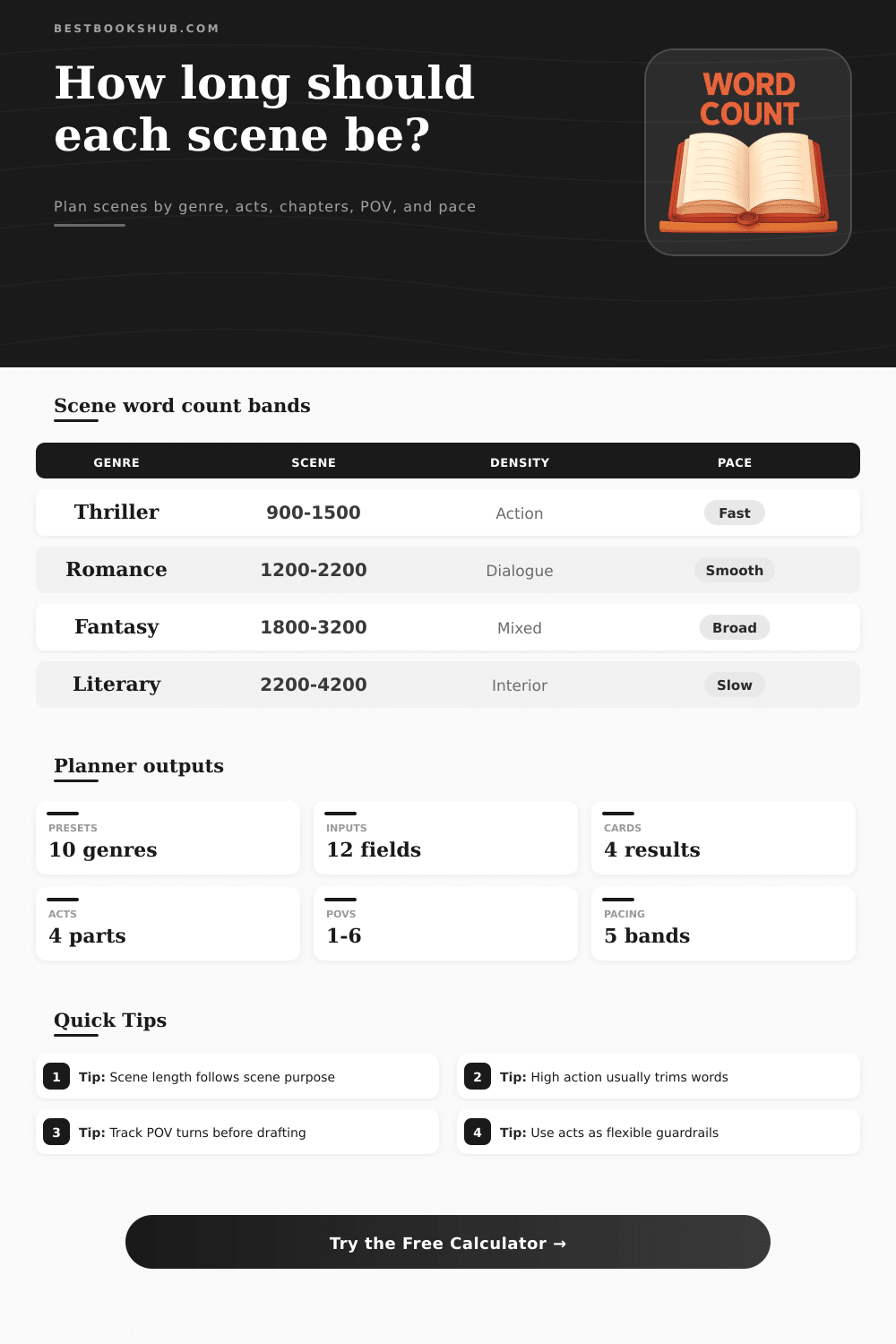
Use these tables as planning bands. The calculator adapts them to your scene count, chapter count, density choices, POV count, and act structure.
| Genre band | Common scene words | Typical scene count | Chapter rhythm | Planning signal |
|---|---|---|---|---|
| Thriller / suspense | 900-1,500 | 55-90 scenes | 1-2 scenes per chapter | Use tight cuts and decisive reversals. |
| Romance | 1,200-2,200 | 42-70 scenes | 1-3 scenes per chapter | Balance emotional beats across leads. |
| Cozy mystery | 1,100-1,900 | 45-70 scenes | 1-2 scenes per chapter | Separate clue, suspect, and reveal beats. |
| Epic fantasy | 1,800-3,200 | 50-95 scenes | 1-3 scenes per chapter | Track world, quest, and subplot load. |
| Literary fiction | 2,200-4,200 | 25-48 scenes | 1-2 scenes per chapter | Longer scenes need clear internal turns. |
| Density choice | Multiplier | Scene effect | Watch point |
|---|---|---|---|
| Sparse dialogue | 1.08x | More summary and description lengthens scenes. | Check that dialogue is not withheld too long. |
| Dialogue-heavy | 0.92x | White space and fast exchanges shorten pages. | Make sure the scene still turns. |
| Kinetic action | 0.82x | Short beats and cuts reduce average length. | Avoid confusing geography. |
| Quiet interior | 1.12x | Reflection and observation expand scenes. | Give each passage a pressure point. |
| Act segment | Scene share | Scene target | Word target | Placement use |
|---|
| POV lane | Scene target | Approx words | Rotation note |
|---|
DISCLOSURE: This post may contain affiliate links, meaning when you click the links and make a purchase, I receive a commission. As an Amazon Associate I earn from qualifying purchases.
Scene length planning is the process of deciding how long each scenes in the novel will be. Scene length planning is important because the length of the scenes in a novel will depend on a variety of different factors. These factors include the purpose of the scenes in the story, the number of viewpoints that will be used in the story, and the genre of the book that will be published.
For many writers, scene length become a problem after the completion of the first draft of the novel. This is because writers often find that their chapter breaks for their novels dont match the tension that is present in their stories. Thus, the writer should occur scene length planning before the writer begin to compose the first draft of their novel.
How to Plan Scene Length in Your Novel
The writer will need to make a decision of how many scenes will be present in the novel, and how those scenes should be distributed throughout the act of the novel. The density of dialogue that will be used within the scenes and the density of action that will be represented in those scenes will affect the length of those scenes. Scenes that has a high density of dialogue will generaly have the characters in the scene speaking rapid to one another, and these types of scenes will generally take place more quickly within the novel.
Scenes that have a high density of action will have the characters in those scenes executing a variety of physical movement, and scenes that have a high density of action will generaly have shorter sentences within those scenes and a focus on the geography of the scene in which the action takes place. A calculator is provided to assist the writer in managing the scene length based on the density of dialogue, action, and the target length of the manuscript. This calculator will make it easier for writers to avoid guessing at the math that should calculate scene length.
The number of points of view that will be used within the story will also impact the length of the scenes within the story. Stories that use only a single point of view will generaly have longer scenes than stories that utilize multiple point of view within those scenes. When a story uses multiple points of view, the word count for the story must be divided among the multiple character in the story.
Because of this division of the word count, the scenes in the story must end for each character more quick than if the story were using only a single point of view. A tool is provided to the writer that will allow the writer to experiment with the inclusion of multiple points of view and how this may affect the length of the scenes in the story. Another of the factors that will impact scene length is the structure of the acts within the story.
Many writers tend to use a four-act structure for their novels, with each act containing the same number of scenes. However, not all novels will require this type of structure. For instance, some novels will require the second act to be longer than the other act, or the early acts of the story may contain a greater number of scenes than the latter acts of the story.
The writer can change the percentages of each act, which will change the number of scenes that is represented in each quarter of the story. Thus, scene length will be affected by the percentage of each act in the novel. Another of the factors that will impact scene length is the pacing of the story.
The different type of novels require different types of pacing within the story. For instance, a literary novel may use a slow-burn pacing for the story. Slow-burn pacing allows for scenes in the story to be longer than the average scene length for the story.
In contrast, serial web novels may require that the scenes in those novels be shorter in length. The reason for this type of pacing is to encourage the readers to continue to read the story by providing some type of hook for the readers at the end of each scene. A calculator is provided to allow writers to test the pacing styles for their novels to determine whether the pacing that they envision for their stories will mathematical align with their target length for their novels.
The reference tables included in this scene length planning document provide writers with the average scene length for the various genre of novels. These tables are not rules for writers to follow in their novels, but they do indicate the types of scene lengths that other writers have found to work well in their publications. Writers often make the mistake of establishing the number of scenes that will be used in their novel prior to establishing the scene length for each scene.
Furthermore, many writers tend to make each scene the same length within the novel. However, not all scenes in a novel are created equal. For instance, some scenes may need to end with a reversal of the situation for the story to continue forward in the novel, but other scenes may need to be used to reveal information about the world in which the story take place.
The scene length planning tool is helpful for writers to determine whether each scene in the novel will be the same length, and whether the number of scenes in the novel align with the genre of the novel. Writers also tend to make the mistake of establishing the chapter count for their novel prior to the writer having completed the scene plan for their story. Chapter counts are merely containers for the scenes in the novel, and the writer should establish the scenes in the novel prior to determining the chapter count.
One of the most helpful features of the scene length planning tool is the suggestion of scene counts for the novel based on the scene density, pacing, and target scene count that the writer had set for their novel. If there are discrepancies between the target scene count and the scene count that is suggested by the scene length planning tool, the writer will know whether they need to expand their scenes or contract their scenes. A percentage value is also included in the scene length planning tool for writers to account for the fact that the writer may deviate from their original scene plan during the drafting of the novel.
For instance, certain scenes may merge with other scenes, or certain scenes may need to be split during the writing process. Additionally, the scenes may need to be moved from one act in the novel to another. A 10 percent buffer to the scene count will allow for these types of changes without forcing the writer to rewrite the scene plan for the novel.
Finally, although the scene length planning tool will assist the writer in determining the length of each scene in the novel, the calculator will not be able to capture the feel of the scenes in the novel while they are being written. The scene length planning calculator will provide a map for the writer of the length of each scene in the novel, but the writer will have to write the sentences for the scenes in their novel.