🔁 Repetition density analyzer
Word repetition density calculator
Measure how much of a passage is carried by repeated terms, how dominant the top repeated word is, and where repetition clusters by paragraph or chapter.
Start with a realistic writing sample, then adjust stopwords, minimum length, repeat threshold, and segment mode to match your draft.
DISCLOSURE: This post may contain affiliate links, meaning when you click the links and make a purchase, I receive a commission. As an Amazon Associate I earn from qualifying purchases.
This is not a general frequency list. It only surfaces terms that meet your repeat threshold, then shows each term's share and its repeat burden.
| Term | Count | Share | Extra repeats | Per 100 words | Signal |
|---|---|---|---|---|---|
| Paste text to see repeated terms. | |||||
Use this table to see whether repetition is evenly distributed or clustered inside one scene, paragraph group, or chapter block.
| Segment | Words | Repeated share | Top repeated term | Concentration |
|---|---|---|---|---|
| Segments appear after analysis. | ||||
| Density band | Repeated share | Top dominance | Editorial reading |
|---|---|---|---|
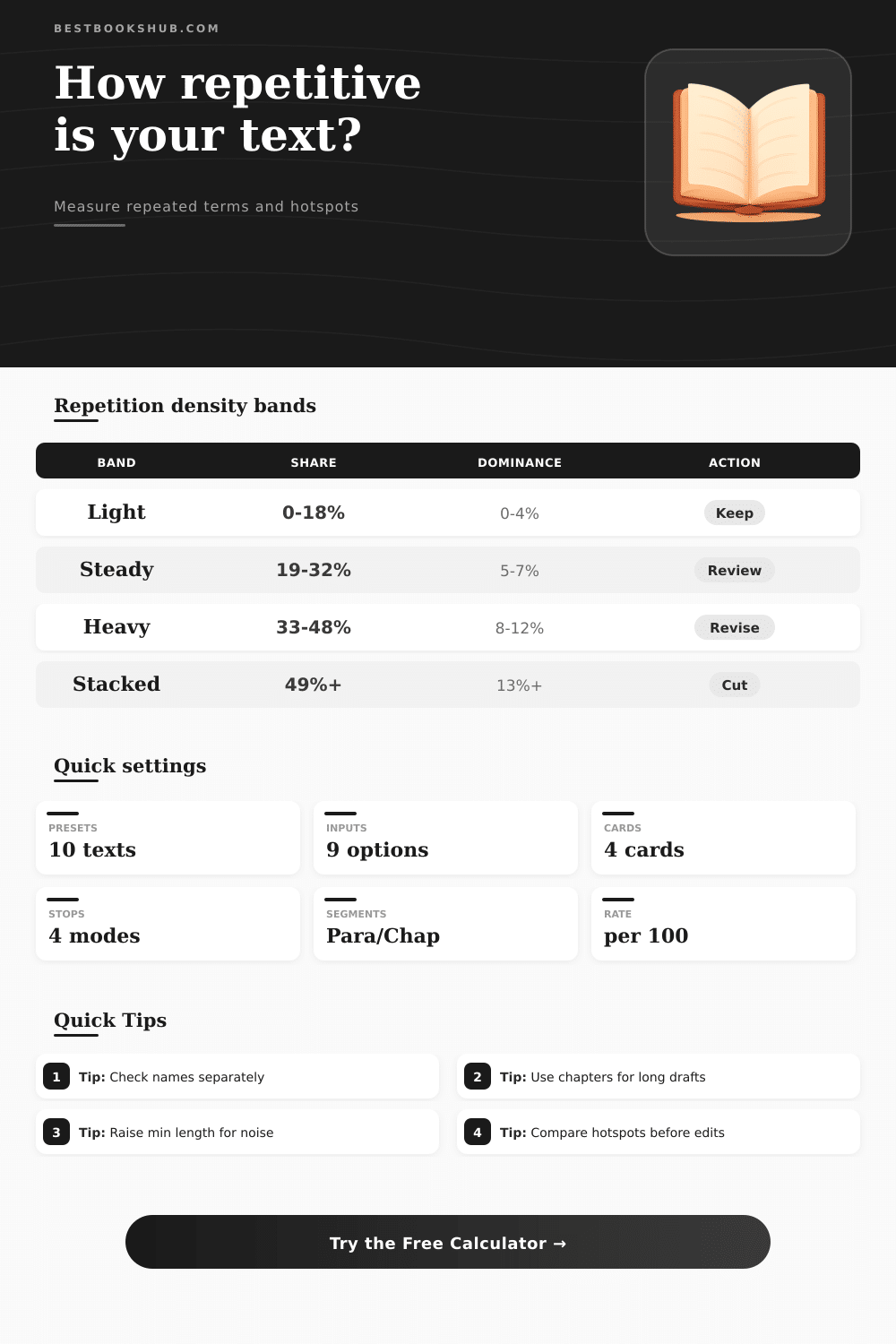
| Light | 0% to 18% | 0% to 4% | Normal variety; repetition is unlikely to distract. |
| Steady | 19% to 32% | 5% to 7% | Topic terms are visible; review only if the prose feels narrow. |
| Heavy | 33% to 48% | 8% to 12% | Repeated wording may be shaping the reader's impression. |
| Stacked | 49% or higher | 13% or higher | Likely worth revising unless repetition is intentional style. |
| Stopword mode | Best use | What it removes | Density effect |
|---|---|---|---|
| None | Speech rhythm | No common terms | Shows natural function-word repetition. |
| Common prose | Most drafts | The, and, of, to, in, is | Balances style and topic terms. |
| Editorial light | Fiction edits | Common prose plus said, like, just | Highlights overused prose habits. |
| Strict | Keyword checks | Broad filler and connector words | Raises content-term dominance. |
| Minimum length | Good for | Risk | Suggested pass |
|---|---|---|---|
| 1 to 2 | Poetry, dialogue, exact style | Many small function words | Use with no stopwords only when needed. |
| 3 | General prose | Some short noise remains | Best first-pass setting. |
| 4 to 5 | Content-term scans | May hide short names | Useful for essays and blurbs. |
| 6+ | Concept repetition | Misses short repeated cues | Use for technical or academic drafts. |
| Segment mode | Best sample | What it reveals | When to choose |
|---|---|---|---|
| Paragraphs | Short excerpts | Local echo pockets | Most revision passes. |
| Chapters | Long manuscripts | Section-level overuse | Drafts with chapter headings. |
| 100-word blocks | Mixed pasted text | Small rolling hotspots | When paragraph breaks are messy. |
| 250-word blocks | Long essays | Broader concentration | When scenes are several paragraphs. |
Repetition density calculator
Measures the share of filtered words occupied by repeated terms, plus dominance and segment concentration. Best for deciding whether repetition changes the feel of a draft.
Repeated word detector
Finds immediate duplicate words or close accidental repeats. Best for catching errors such as "the the" or a repeated adjective in one sentence.
Word frequency calculator
Ranks every term by count and density. Best for broad vocabulary mapping, not for judging repeated-term burden or chapter concentration.
A word repetition density calculator can help you find how many times each word in your writing is being used. Many writer use this tool because it is common for writers to have repetition of the same word in their writing. A word repetition density calculator can highlight these repeated word for you so that you can review them and determine if you should change your vocabulary or if you should simply change your use of specific word.
A word repetition density calculator has several different setting that will alter the outcome of the calculation of your texts word repetition. The minimum term length allow you to determine if word of a certain length will be counted by the calculator. Stopword removal allow you to remove common word from your text.
How to Use a Word Repetition Calculator
Segment mode allow you to determine whether only one section of your text will be calculated for repetition, or if the entire chapter will be evaluated. Each of these setting will change the outcome of the calculation, so you must ensure that the settings you choose reflect the text draft that you are reviewing. The word repetition calculator will provide three different calculation that will show you different statistic about the repetition of word in your text.
The repeated term share will tell you what percentage of your text is comprise of repeated word. Top-word dominance will tell you if one word is repeated more than the other. Hotspot concentration will tell you if the repeated word are local to one section of your text, or if they are distribute throughout your text.
If the top-word dominance is high, you likely have one word that you use too often. However, if the repeated term share is high but the top-word dominance is low, you likely have a narrow vocabulary. You should not assume that the word that are repeated in your writing as shown by a word repetition calculator are a mistake.
For example, if you are using a dialogue in your writing, the character will have to use the same word so that the reader are aware of whom is speaking. Additionally, there may be concept that you use in your text that must be stated repeatedly for reader to understand your argument. Therefore, while the word repetition calculator can highlight these instance of repetition, it does not tell you whether they are good or bad for your writing.
This decision is yours to make. If there is a hotspot in one segment of your text, you should not only focus on changing the top word. If you only change the top word, that segment may still have a high concentration of that word.
You should look at that segment to see how the other sentence may contribute to the repetition. In this case, you can either focus on changing the word within that segment, or you can focus on increase your vocabulary as a whole. The word repetition calculator also provide categories for repetition within your text.
For example, light repetition will not impact the reader as much as repetition that is categorize as steady repetition. However, heavy repetition can impact the readers experiencing of your text, and stacked repetition mean that your text may be entering a loop with repeated word that is no longer accomplishing its purpose. These category are simply starting point for your consideration of the repetition within your text.
The word repetition calculator does not understand your intention with your text. Finally, you should use the word repetition calculator during two different stage in your writing process. For example, you can use it early in your writing process with light stopword removal.
Then, you can use your text with all settings strict at the end of your writing process. Using it at both stage will allow you to find the part of your text that need the most work.