📖 Writing flow analyzer
Transition Word Counter
Paste a passage to count addition, contrast, cause, and sequence transitions; measure paragraph density; compare academic and narrative target bands; add custom transitions; and flag repeated connectors.
Load a realistic text type, then adjust the dictionary, target band, and overuse rules. Presets are intentionally varied so the category mix changes.
DISCLOSURE: This post may contain affiliate links, meaning when you click the links and make a purchase, I receive a commission. As an Amazon Associate I earn from qualifying purchases.
Phrase-safe matching counts multi-word transitions such as "on the other hand" and "as a result" before single words.
These tables update from your text: top transition terms, category totals, paragraph density, and overuse alerts.
| Rank | Transition | Category | Count | Share | Use flag |
|---|---|---|---|---|---|
| Load a preset or paste text to populate this table. | |||||
| Category | Count | Share | Density | Main role |
|---|---|---|---|---|
| No category data yet. | ||||
| Paragraph | Words | Transitions | Per 100 words | Primary category | Flag |
|---|---|---|---|---|---|
| No paragraph data yet. | |||||
| Alert | Evidence | Severity | Revision cue |
|---|---|---|---|
| No overuse alerts yet. | |||
| Band | Per 100 words | Best fit | Watch for |
|---|---|---|---|
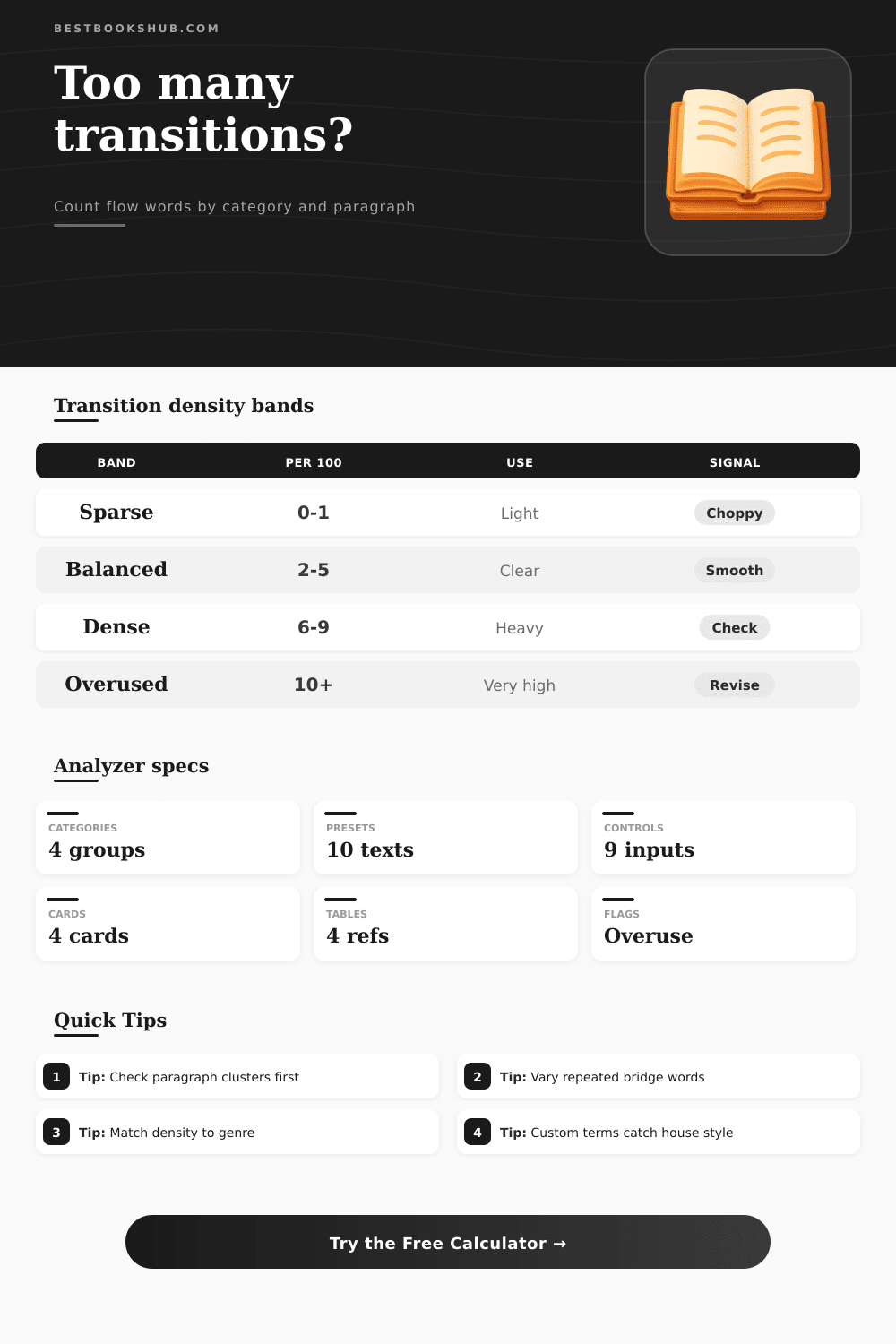
| Sparse | 0 to 1.9 | Minimal prose | Choppy jumps |
| Balanced | 2.0 to 5.5 | General prose | Category gaps |
| Dense | 5.6 to 8.5 | Academic prose | Over-signaling |
| Overused | 8.6 plus | Revision pass | Mechanical flow |
| Category | Examples | Reader signal | Revision use |
|---|---|---|---|
| Addition | also, moreover | Builds points | Combine if stacked |
| Contrast | however, yet | Turns argument | Use before real shifts |
| Cause | therefore, since | Shows logic | Check if claim follows |
| Sequence | first, finally | Orders ideas | Avoid list rhythm |
| Text type | Low band | High band | Main category |
|---|---|---|---|
| Narrative | 1.0 | 4.5 | Sequence |
| General nonfiction | 2.0 | 5.5 | Addition |
| Persuasive | 2.5 | 6.5 | Contrast |
| Academic | 3.0 | 7.0 | Cause |
Transition word are used to connect the ideas within a piece of writing. Transition words act as bridges between sentence. The purpose of using transition words is to tell a reader if a sentence is adding to the argument that was made previously, if it is changing the topic of discussion, if it is discussing the reasons for an argument, or if it is discussing the passage of time within the story or discussion.
If a writer choose not to use any transition words within a piece of writing, the reader will encounter choppily sentences. If a writer uses too many transition words, though, the writing may feel mechanic. Because the incorrect use of transition words can result in friction within a writers text, the writer must use transition words apropiately for the specific type of writing that they must create.
Use a Counting Tool for Transition Words
One tool that can assist a writer is the counting tool. This tool allow for the writer to select the target writing band, the dictionary depth, and the density basis for that writing. With these parameters establish, the writer can determine if the draft of text is too sparse or too dense for the type of writing that is to be create.
Furthermore, the counting tool can help the writer to identify instance of repetition of terms within the text that may result in the development of a rhythmic tic within that writer’s text. A rhythmic tic may indicate repetition of ideas within the writing that may make the writing feel repetitive to the reader. Through adjusting the repetition window and the overuse threshold, a writer can decide how strict the rules will be for the text create with these parameters.
Some writers may desire a tight window to ensure that repetition is catch as early as possible in the writing process. Other writers, though, may be comfortable with having some repetition within there writing. Additionally, the counting tool can reveal any issues regarding the paragraph density within the writer’s text.
For instance, if a writer find that most of the transition words appear within a single paragraph, the writer may indicate that the paragraphs surrounding that one paragraph lack a logical development of the ideas within the text. Through the revision of the sentence that contains a cluster of transition words, the remainder of the writers text may even itself into an even rhythm. Furthermore, if there are too few or too many transition words for the selected writing band, the writer can use that information to adjust the writing.
Custom terms allow for a writer to insert specific terms into the counting tool. Many editorial house or classrooms have lists of terms that they should of used in the writing that is publish or submitted. By adding these specific terms to the counting tool, the writer ensure that the published or submitted writing will reflect any requirement of that specific editorial house or classroom.
The value of using a counting tool for measuring the number of transition words within a text is apparent in the decision that a writer makes after measuring the number of words of that type. For instance, a high count of contrast transition words may be appropriate for a persuasive writing assignment, but may appear argumentative in the context of a personal essay. Thus, the count of each type of word provide the writer with information of which to consider any intention for that text.
During the final read-through of a writers text, the writer can open the text and examine the placement of the transition words. Through this final read-through, the writer can decide if any repeated connectors within the text are of value to the text, or if they are simply filling the space between ideas for that writer. Even more specifically, the writer can test whether removing any transition words from a sentence improve that sentence.
Removing a transition word may improve a sentence when the sentence already inherently contains the elements of the relationship between the two idea that would otherwise be indicated with a transition word. However, removing a transition word may also introduce a gap within the writers sentence that can be fixed by using a different type of transition word. Performing these steps is part of an iterative process in which the writer adjust the text, performs the count again with the counting tool, and makes further adjustment to the writers text.
Through this process, the writer can eventually recognize when the writers text has reach an equilibrium, and the counting tool can make that recognition faster then the writers ear alone.