📖 Prose style analyzer
Contraction Counter
Paste prose to count contractions, estimate expanded equivalents, compare formal versus informal balance, split dialogue from narration, and inspect apostrophe patterns against style-guide target bands.
Load a realistic passage, then adjust dictionary breadth, apostrophe handling, quote splitting, and target style to match your draft.
DISCLOSURE: This post may contain affiliate links, meaning when you click the links and make a purchase, I receive a commission. As an Amazon Associate I earn from qualifying purchases.
The analyzer treats known contractions as informal style signals, separates possessives and quoted speech when requested, and estimates how many extra words would appear after expansion.
The first tables update from your text. Use them to find repeated forms, expansion pressure, and whether contractions live mostly in speech or narration.
| Rank | Contraction | Expansion | Count | Category | Signal |
|---|---|---|---|---|---|
| Load a preset or paste text to see top contractions. | |||||
| Pattern | Count | Share | Examples | Revision cue |
|---|---|---|---|---|
| Apostrophe pattern rows will appear after analysis. | ||||
| Style band | Contractions per 100 words | Typical fit | Revision cue |
|---|---|---|---|
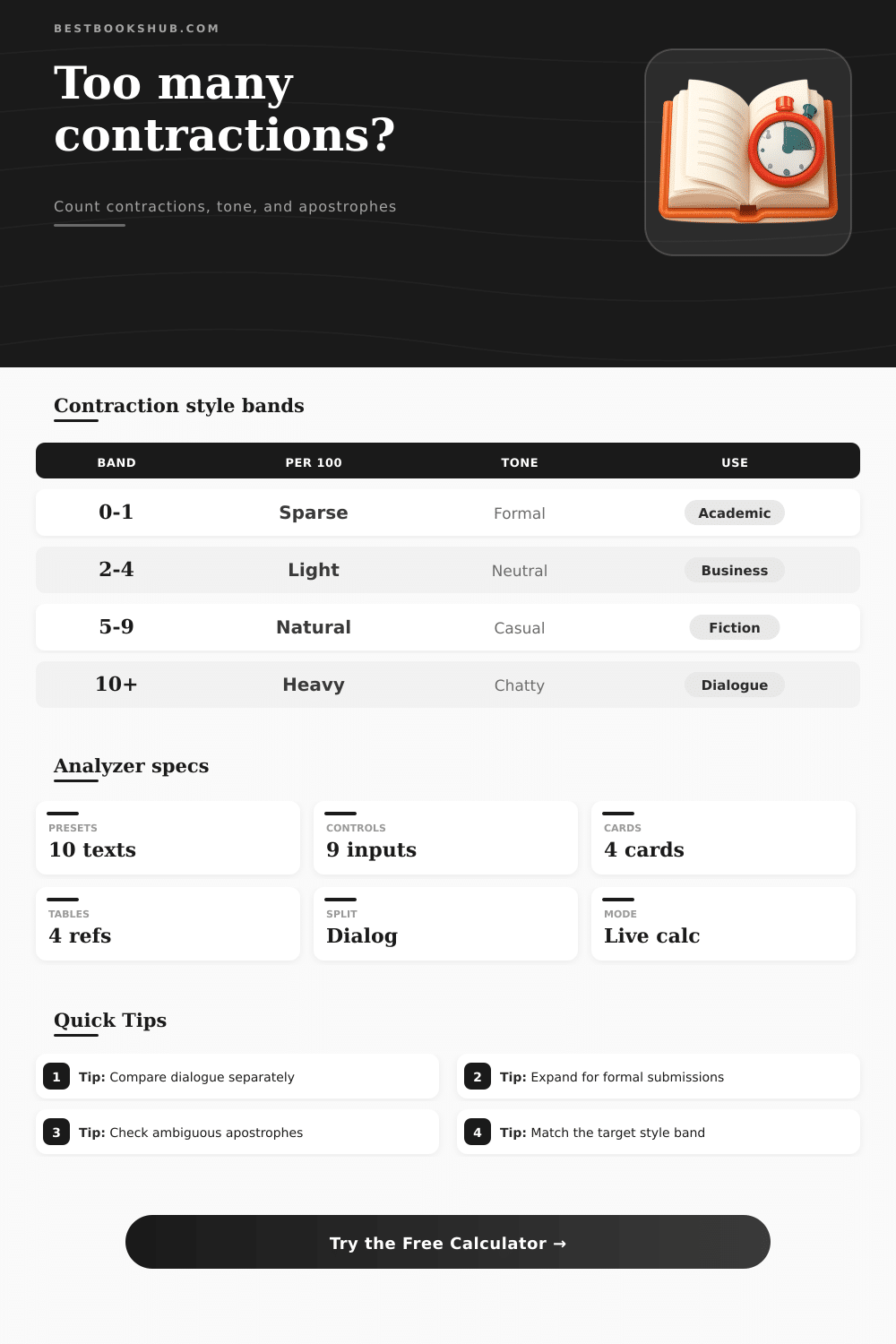
| Sparse | 0 to 1 | Academic, legal, formal reports | Expand most forms; keep quoted speech if needed. |
| Light | 1 to 4 | Business email, documentation, neutral web copy | Keep common forms that reduce stiffness. |
| Natural | 4 to 9 | Fiction narration, memoir, editorial voice | Watch repeated can not / do not alternation. |
| Conversational | 9 to 18 | Dialogue, transcript, character voice | Compare dialogue and narration separately. |
| Heavy | 18+ | Highly colloquial speech or stylized voice | Check readability and audience expectation. |
| Contraction family | Examples | Expansion pattern | Style note |
|---|---|---|---|
| Negative | don't, can't, isn't | Verb + not | Strong informality signal in formal prose. |
| Be forms | I'm, you're, she's | Pronoun + be | Natural in speech and friendly copy. |
| Have forms | I've, we've, they'd | Pronoun + have / had | Often subtle but can pile up. |
| Will / would | I'll, we'll, you'd | Pronoun + modal | Useful for momentum and voice. |
| Informal fixed | let's, y'all, o'clock | Phrase contraction | Audience and character dependent. |
| Apostrophe pattern | Usually means | Counted as contraction? | Risk |
|---|---|---|---|
| n't | Negative contraction | Yes | Can sound casual in formal passages. |
| 's | Is, has, or possessive | Only when matched | Ambiguous without context. |
| 're / 've / 'll | Pronoun plus verb | Yes | Can cluster in dialogue. |
| s' | Plural possessive | No | Should not inflate contraction count. |
| Name apostrophe | O'Neill, d'Artagnan | No | Needs separate pattern tracking. |
| Use case | Target band | Dialogue policy | Best next check |
|---|---|---|---|
| Essay submission | 0 to 1 | Keep quotations separate | Expand all narration forms. |
| Client email | 1 to 4 | Usually not split | Keep only natural common forms. |
| Novel scene | 4 to 9 | Split dialogue from narration | Make characters distinct. |
| Interview transcript | 8 to 18 | Dialogue mode on | Preserve speech authenticity. |
| Marketing page | 3 to 7 | Split quotes if testimonials appear | Balance clarity and warmth. |
Contractions involve the shortening of word and can change the tone of writing. For instance, there may be a paragraph that reads correctly if contraction were to be omitted from that paragraph, or there may be instances in which a paragraph may otherwise be correct if there were to be an increase in the use of contractions. Academic writing avoids contractions, while business and fiction writing do not.
Based off the goal of the writing, writers can determine whether the use of contractions is appropriate. Many writer dont use contractions as a means of incorrect writing. Writers typically write as they speaks.
When to Use Contractions and How to Check Them
Some writers use too many contractions, while others do not use any contractions in their writing due to the belief that it make their writing appear more professional. Writing that does not use any contractions may come across as stiff to the reader. Recognizing the habits that writers have in using contractions will allow writers to recognize whether or not such use is appropriate in their writing.
The analyzer tool do more than simply count the number of contractions that are used in the writing. It can separate out instances of quoted text from the writing. It can also treat possessive phrase as a separate category from contractions.
Additionally, it can calculate the potential increase in the word count if the writer expanded all of the contracted words. Each of these functions is helpful in that the high number of contractions within quoted text will differ than the high number of contractions within narrative text. Additionally, the dictionary within the tool can be adjusted to ignore rare word in the text that is being analyzed.
By ignoring these rare words, the tool can provide an accurate count for the number of contractions in the writers text. The style bands provide examples of the type of writing that utilize different levels of contractions. For instance, academic and legal writing avoid contractions almost entirely.
Business writing may use a light number of contractions to keep the tone of the writing to potential customers or readers approachability. Fiction writing may use contractions in narrations to convey the voice of the characters that are referenced in the text; however, the narration that explains the text may have fewer contractions than the dialogue within the text. Dialogue or transcripts from media may contain high instances of the use of contractions to allow the dialogue to sound natural when the characters speak it.
The style bands are not rules that writers should follow, but they can serve as reference points for writers to recognize whether their text contains the correct number of contractions to match the tone that they intend to create. Writers should avoid treating every instance of an apostrophe as an implied contraction. For instance, text such as “the author’s argument” contains an apostrophe but is not a contraction.
Additionally, writers should avoid the use of numerous negative contractions (such as “don’t” or “can’t”) within a paragraph. While the writer may intend this type of writing, it may make the paragraph feel more informal then the writer may want. The analyzer tool can help writers to understand if such high number of negative contractions within a paragraph are appropriate for the writers text.
The context of a writing project will have an impact upon the number of contractions that are used in that project. For instance, a marketing page for a business may contain more contractions than a client proposal from that business. The marketing page is meant to appear friendly towards the audience of the website.
Additionally, the novel by young adult authors may contain more contractions than a memoir by an older author. The analyzer tool cannot understand the context of the writers text or project, but it removes the guesswork from the writer by providing the raw count of the number of contractions that is used in the writers text. Writers should perform this analysis in the early stages of their writing projects, rather than towards the final stage of the proofreading of their text.
By using the numbers provided by the analyzer tool, writers can easily recognize if their text features the same voice as their intended writing. If there are too many contractions in the writing, writers do not have to remove each contraction entirely. Instead, the writer can choose to expand the contractions in the narration portion of the text while leaving the contractions in the spoken dialogue alone.
This will allow writers to restore the balance of their text. As the writer becomes more accustomed to using the analyzer tool, the numbers will become a mirror for the writer to their writing habits. Writers will recognize which contractions they use when they are tired.
Writers will become more accustomed to which contractions will help to make the writers text the most clearest to the reader. Writers do not have to strive for the perfect number of contractions for any style of writing. Instead, the writer should of become aware of why they use contractions in their writing.