📖 Poetry meter lab
Syllables per Line Counter
Paste a poem to estimate syllables line by line, group results by stanza, compare a target line length, and manually correct lines with names, dialect, or deliberate elision.
Exact meter
Best when every line must hit a fixed syllable count, such as strict haiku, tanka, or accentual-syllabic exercises.
Near meter
DISCLOSURE: This post may contain affiliate links, meaning when you click the links and make a purchase, I receive a commission. As an Amazon Associate I earn from qualifying purchases.
Useful for ballads, songs, and children verse where one extra light syllable can still read smoothly aloud.
Variable meter
Best for free verse and spoken word where average, variance, and stanza contrast matter more than a single number.
Manual scan
Use overrides for names, dialect, contractions, or deliberate elisions that an automatic English estimate cannot hear.
| Poetry form | Typical syllable pattern | Line grouping | How to use the counter |
|---|---|---|---|
| Haiku | 5, 7, 5 | Three lines | Use the haiku target preset and exact tolerance. |
| Tanka | 5, 7, 5, 7, 7 | Five lines | Check line-by-line pattern and stanza total. |
| Sonnet line | Often 10 syllables | Quatrains and couplet | Use 10 as target, then review stresses separately. |
| Ballad meter | 8, 6, 8, 6 | Four-line stanza | Use ballad preset and inspect alternating lines. |
| Limerick | Often 8, 8, 5, 5, 8 | Five lines | Use pattern fit and read aloud for comic rhythm. |
| Free verse | No fixed count | Flexible stanzas | Track average, range, and variance for pacing. |
| Rule area | Calculator treatment | When it may differ | Best correction move |
|---|---|---|---|
| Silent final e | Balanced mode usually drops final e after consonants. | Poetic, archaic, or sung readings may pronounce it. | Use keep mode or override that line. |
| Hyphenated compounds | Split mode counts each part separately. | Some compounds are spoken as a tighter unit. | Try smooth mode for songlike diction. |
| Elision | Poetic mode treats forms like o'er as one syllable. | Performance may restore omitted sounds. | Use the manual correction field. |
| Names and places | Estimated from vowel groups and exceptions. | Proper names often have regional pronunciations. | Override exact line counts after reading aloud. |
| Dialect and accent | Uses a general English estimate. | Dialect can merge, stretch, or split vowel sounds. | Prefer manual scans for performance poems. |
| Variance band | Line rhythm signal | Common use | Revision question |
|---|---|---|---|
| 0 to 1 | Very regular syllable length | Strict syllabic forms, chants, simple songs | Does the regularity feel intentional? |
| 1 to 4 | Mostly controlled with small variation | Sonnets, ballads, rhymed stanzas, formal drafts | Are the off-target lines expressive or accidental? |
| 4 to 9 | Noticeable line-length movement | Lyric free verse, narrative poems, spoken word | Does each long or short line create emphasis? |
| 9 plus | Wide swing between short and long lines | Experimental poems, dramatic pacing, collage forms | Would stanza breaks clarify the rhythm? |
| Grouping option | Best for | What it reveals | Watch point |
|---|---|---|---|
| Blank lines create stanzas | Most pasted poems and drafts | Average and spread for each visible stanza | Extra blank lines may create empty breaks. |
| Every 3 lines | Tercets, haiku sets, villanelle samples | Pattern drift across repeated three-line groups | Final groups may be shorter. |
| Every 4 lines | Quatrains, ballads, hymn meter | Alternating line pattern and stanza consistency | Use ballad target for 8-6-8-6. |
| Whole poem only | Single-block free verse or pasted fragments | Overall average, range, and target fit | Stanza-level pacing will be hidden. |
When you use this syllable calculator, you can analyze the syllable count within a poem. Often, the lines within a poem will contain a different number of syllable. Some lines may contain many syllables within the line, while other lines may contain few syllable within that line.
By using this syllable calculator tool to track the syllable counts within each line in the poem, you can begin to understand the rhythm of the poem. To use the syllable calculator, all you have to do is paste in your poem draft. The syllable calculator will automatically break your poem into line, and then calculate the number of syllables in each line.
Count Syllables in Your Poem
Additionally, you can set parameter within the syllable calculator to account for silent letters, hyphenated words, and even to treat lines with blank lines as stanza breaks. Each of these features are important when considering that poems should be read aloud. As a reader reads aloud, some word may contain a different number of syllables depending on an individual’s dialect or pronunciation of those words.
As such, there is a manual field that allows a user to correct syllable count for specific lines. By using this field to enter the true count of syllables for each line, the syllable calculator will allow you to provide an accurate analysis of your poem. In addition to calculating the number of syllables within each line, there are also reference tables for different form of poems.
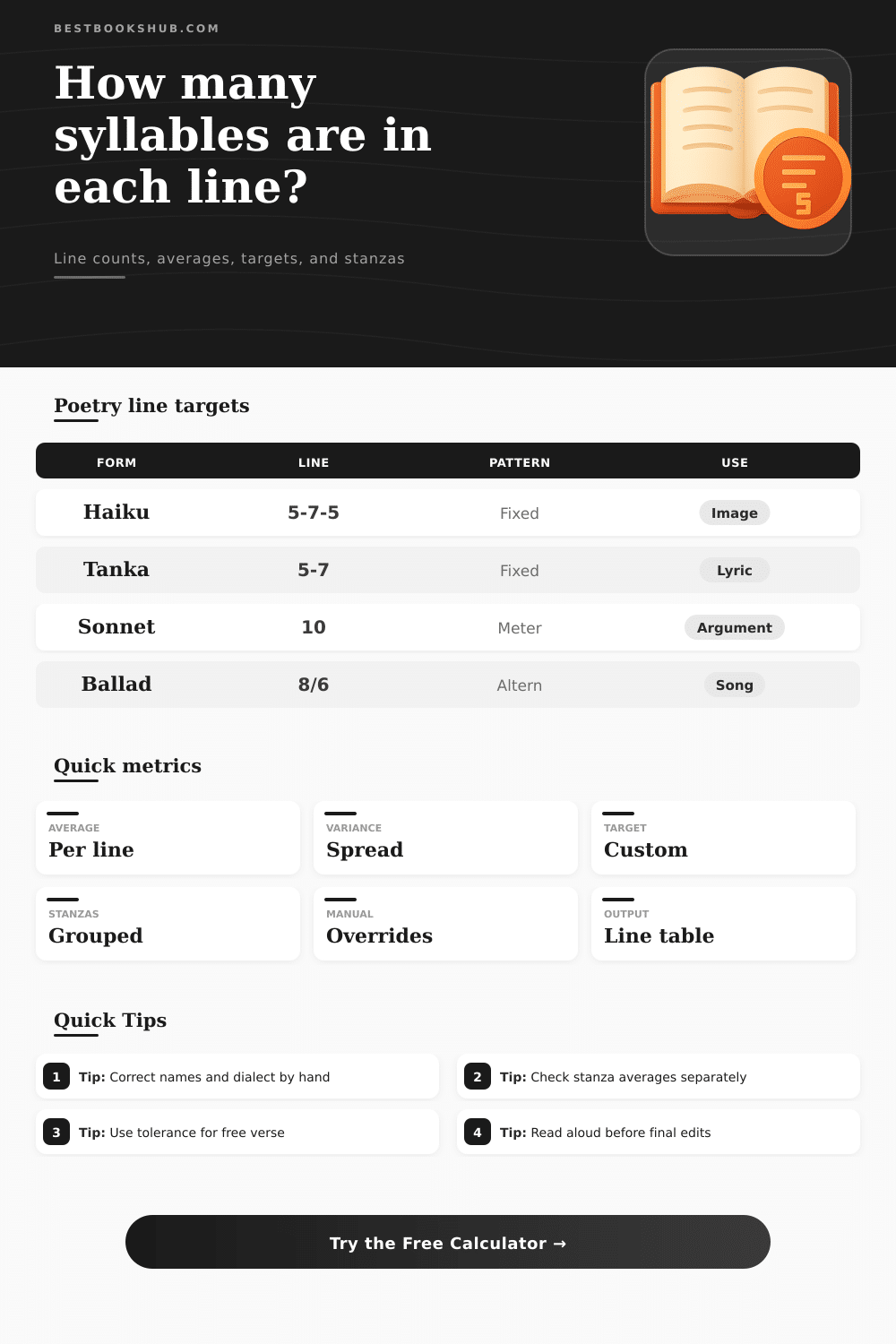
For instance, haikus contain 17 syllables in total, sonnets contain 14 lines with 10 syllables each, and ballads contain 10 lines with 8 syllables each. These reference tables will allow you to see if your poem adheres to the requirements of the form that you are writing. Additionally, even if your poem is free verse and does not adhere to any form requirement, these reference tables will allow you to see what a regular line of poetry can contain.
This will allow you to notice any irregularities that you have introduced into your free verse poem. Beyond providing an analysis of the number of syllables within each line, the syllable calculator can also determine the variance of syllable counts within your poem. A low variance score within your poem will indicate that each line contain approximately the same number of syllables.
A high variance score, however, will indicate that some lines contain many more syllable than others. Each of these scores is not inherently better than the other; you must make a determination of whether the syllable count within your poem is appropriate for it’s effect. Additionally, the syllable calculator can analyze your poem by stanza.
By treating blank lines as stanza break, the syllable calculator can calculate the average syllable count for each stanza within your poem. This will allow you to see if some stanzas contains a different average number of syllables than others. This feature will allow you to recognize any shift within your poem, which can make the stanza revision process more concrete and targeted.
Consider this syllable calculator output to be your first analysis of your poem. While this syllable calculator is fast, it cannot hear how you pronounce each word within your poem. After seeing the syllable counts for each line in your poem, read your poem aloud again.
By reading your poem aloud, you may find some lines that you would like to revise. These revisions will become part of the record for your poem. With frequent use of this syllable calculator, you will begin to sense when a line contains too many syllables before you even write the line into your poem.
Additionally, you will be able to learn of the requirements for different forms of poems, and you will understand the tension between adhering to those requirements versus the words that you write. While this syllable calculator is faster than counting syllables on your fingers, it is also faster than any individual are capable of remembering the syllable count of every line in there poem. Thus, the goal of this tool is to allow individuals to become more aware of how their poems use syllables, so that they can make decision about whether or not their poem is achieving the desired effect.
You should of used this tool more often to improve your writing. It can help you with alot of things. Dont wait to start your next moddern poem.