📖 Poetry form checker
Haiku Syllable Validator
Check a three-line haiku draft against 5-7-5 syllables, modern haiku flexibility, cut marker placement, seasonal-word signals, and manual syllable overrides.
Classic 5-7-5
Best when a worksheet, class assignment, or contest asks for exact English syllable lines.
Loose draft mode
DISCLOSURE: This post may contain affiliate links, meaning when you click the links and make a purchase, I receive a commission. As an Amazon Associate I earn from qualifying purchases.
Allows one syllable of drift on each line while keeping the familiar short-long-short shape.
Modern haiku
Checks three lines, a short total, and optional cut or season features without forcing 5-7-5.
Workshop count
Shows counts, detected words, and line balance so you can revise without pass-fail pressure.
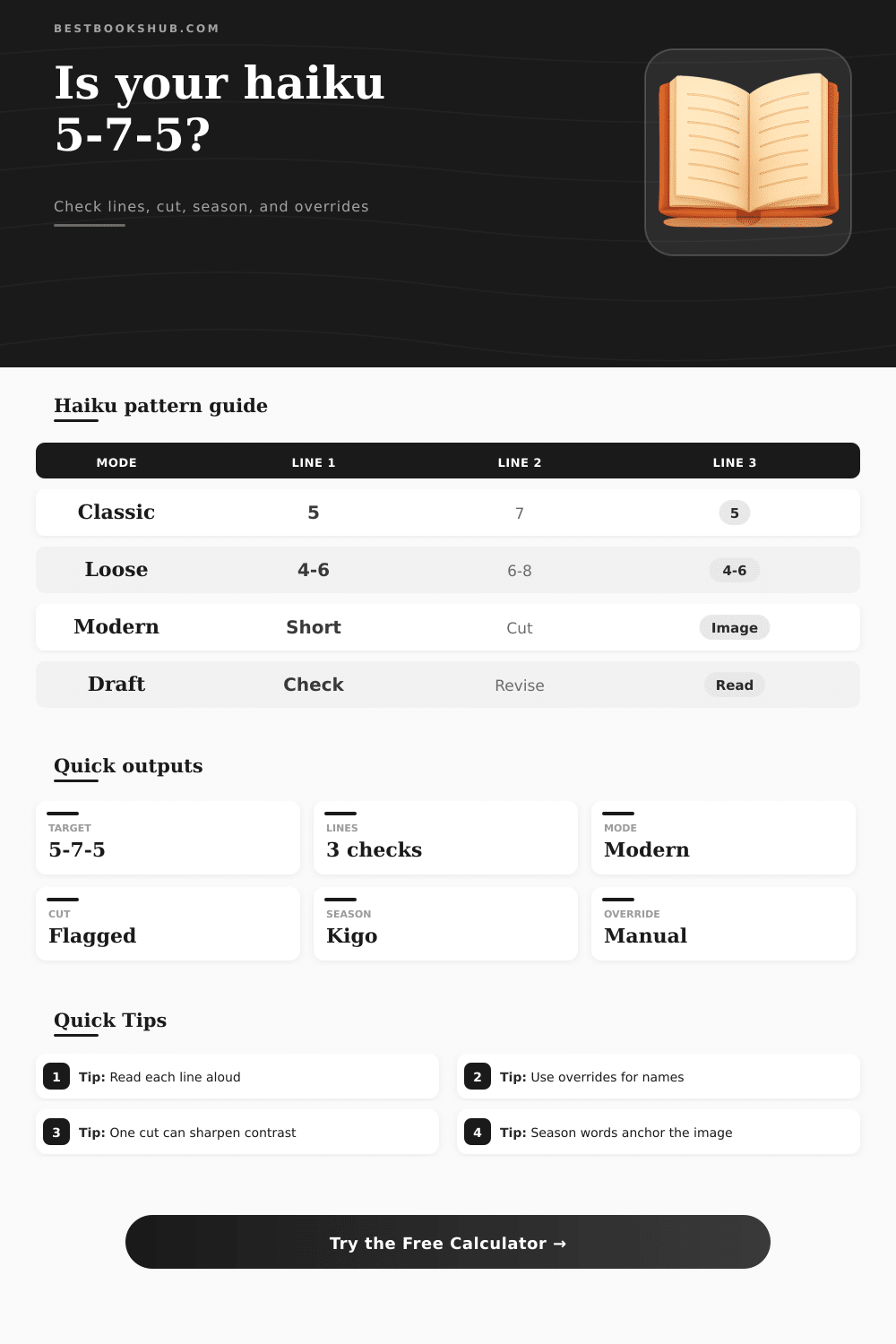
| Validation mode | Line target | Pass rule | Best use |
|---|---|---|---|
| Classic strict | 5, 7, 5 | Exact syllables and three nonblank lines | Assignments, forms, simple drafts |
| Loose 5-7-5 | 4-6, 6-8, 4-6 | Each line can drift by one syllable | Early revisions and oral rhythm checks |
| Modern haiku | Short total, often under 17 | Three lines with compact imagery | Contemporary haiku and free-form drafts |
| Workshop | No fixed pass target | Counts and feature flags only | Exploration, teaching, revision notes |
| Cut marker type | Examples checked | What it signals | Validator note |
|---|---|---|---|
| Punctuation cut | dash, colon, semicolon, ellipsis | A turn, pause, or juxtaposition | Detected when cut mode includes punctuation |
| English cut word | yet, still, ah, listen, behold | A hinge between two images | Detected when cut mode includes words |
| Line break cut | Image turn after line one or two | Structural contrast without punctuation | Use manual judgment for subtle cuts |
| No cut | Single flowing sentence | May read as a tiny lyric | Can pass only if cut is not required |
| Season group | Sample kigo hints | Common image | Draft check |
|---|---|---|---|
| Spring | blossom, thaw, rain, nest | Opening, return, growth | Detector checks broad nature terms |
| Summer | cricket, cicada, heat, firefly | Sound, brightness, fullness | Manual checkbox can confirm local terms |
| Autumn | maple, harvest, dusk, geese | Change, ripeness, leaving | Season set changes which words count |
| Winter | snow, frost, bare, moon | Stillness, cold, distance | Detected terms appear in result chips |
| Override need | Example | Why it matters | Override format |
|---|---|---|---|
| Proper noun | Kyoto, Ana, Reyes | Names vary by speaker and language | Kyoto=3 |
| Dialect shift | fire, poem, again | Regional speech can add or remove a beat | fire=1 |
| Poetic elision | over, evening, heaven | Poems may compress spoken sound | evening=2 |
| Invented word | Moonbright, riverglass | Coinages need author choice | riverglass=3 |
Haiku use three lines to convey a thought or feeling within the poem. Given the limited number of words that can be included in a haiku, syllable counts is often used as a guide for the writer to structure the poem in a haiku fashion. The most common guideline for haiku poetry is the guideline of 5-7-5 syllable for each line of the poem.
This guideline provides structure for the writer for the poem and allows them to see the way that their poem fits into the structure of a haiku poem. One of the main tools that can be used for haiku is an tool that calculates the syllables of the poem after the writer pastes their three lines of text into the tool. The tool can compare the lines of the poem to a mode of haiku that the writer choose; modes can range from the classic forms of haiku to moddern interpretations of the form.
Check Your Haiku: Syllables, Cuts and Season Words
Additionally, the tool will check for the presence of a cut in the poem. A cut is an element that separates the two image that are depicted in the poem. Another function of the tool is to check for the presence of seasonal words within the poem.
Seasonal words are words that help to convey the time of the year in which the haiku takes place; they function as a time stamp for the poem without mentioning the specific time of the year in the poem. Both of these elements are important, as the cut can help to contrast the two images in the poem, and the inclusion of seasonal words can help to ground the poem within a specific time of year. Many writers will use the syllable count as a means of creating their haiku poem.
However, the validator will assist the writer in this process because it can separate the question of the syllable count of the poem from the question of the structure of the poem. The tool can help the writer to decide whether the writer needs to revise the lines of the poem to ensure that they fit within the structure of the haiku poem. Additionally, the tool has an override field for the writer to tell the tool how to interpret the words that are written in the poem; spoken English does not necessarily follow the rules of dictionary English.
The override field allows writers to account for this difference and to ensure that the tool does not force the writer to conform to a single set of rules. The tool will detect seasonal words (kigo) in the same manner in which it will detect syllables in each line of the poem. It can recognize the obvious seasonal words in each poem; however, the writer can check a box to indicate that they have made a conscious decision to use a seasonal word in their poem.
Just as with the cut in the poem, the tool can detect a cut if the writer chooses to use a dash or a word to indicate the cut; however, a cut can exist within the line breaks of the poem alone. The tool will flag these elements in the poem that the tool find, but the writer holds the final judgement of their poem. Worrying about counting syllables in the poem may flatten the musical nature of the poem; however, the use of a syllable counting tool for haiku will often enhance the musical nature of the poem.
The writer can use the tool to focus on the musicality of the poem because the syllables have been accounted for. These adjustments to the haiku may enhance the images within the poem, and the use of the tool makes it easier for the writer to make these adjustments. Additionally, the tool can help the writer during the revision process for the poem.
The writer can write a draft of the poem; use the validator to assess the poem; and then switch modes to assess the same poem. For instance, one mode may ask for shorter lines of haiku with fewer syllables; however, it will still require the presence of a cut and a seasonal word. The alternative mode to the workshop mode for haiku may not include any requirement for the total syllable count to be met.
However, it may ask that the writer review the weight of each line of the poem. Each of these modes will provide the writer with different information regarding the same words that are written in the poem. A writer must be careful with the tool not to treat any of the modes as the final form of the poem.
A poem could meet the requirements of the validator but still have no contrast within the images of the poem. Additionally, a poem might fail the syllable count requirement but have proper weight to its lines when spoken aloud as a haiku poem. The validator helps the writer to focus on the measurable elements of the poem so that the writer can give more consideration to the unmeasurable elements of the poem.
The validator and writer should be considered a conversation rather than the validator making the final judgement on the poem. The writer brings their draft to the validator; the validator presents the writer with the counts of the syllables and the flags for the elements in the poem; and the writer makes the decision as to what adjustments will be made to the poem. The three lines of the poem remain the writers alone, but the syllable count can help the writer to more clearly see their three lines of haiku.