📚 Verse structure lab
Limerick Structure Checker
Paste a five-line comic verse to check line count, AABBA rhyme signals, syllable target bands, rhyme endings, and meter bounce hints in one pass.
Lines: 0 / 5
Run the checker to validate the five-line structure.
A lines: pending
DISCLOSURE: This post may contain affiliate links, meaning when you click the links and make a purchase, I receive a commission. As an Amazon Associate I earn from qualifying purchases.
Lines 1, 2, and 5 should rhyme and sit in the longer band.
B lines: pending
Lines 3 and 4 should rhyme and usually feel shorter.
Endings: pending
Extracted endings appear in the result breakdown.
| Line | Usual job | Syllable target | Rhyme role |
|---|---|---|---|
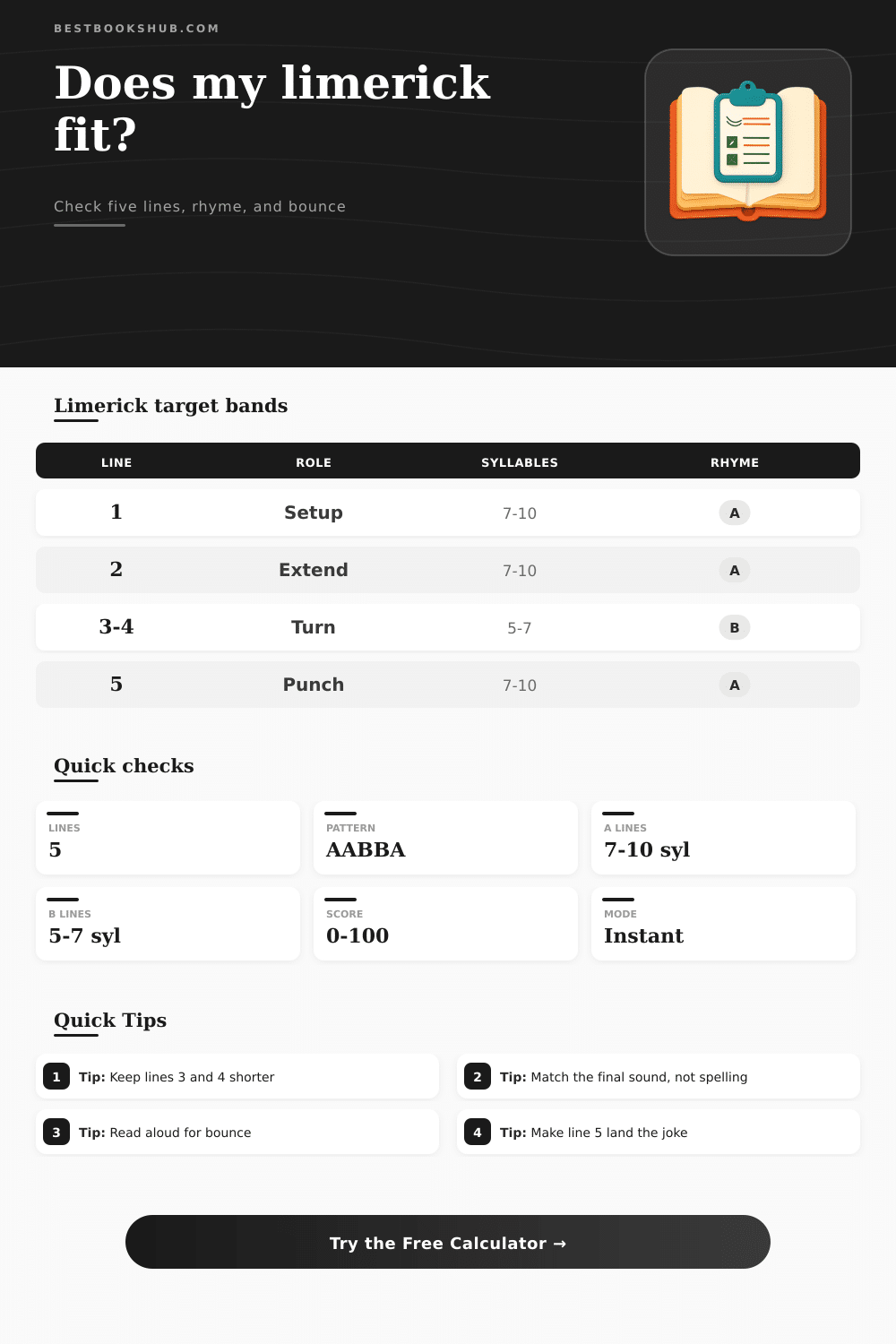
| Line 1 | Introduces person, place, or situation. | A-line band, often 7 to 10. | Sets the A rhyme ending. |
| Line 2 | Extends the setup or adds a complication. | A-line band, close to line 1. | Should match line 1. |
| Line 3 | Turns the thought or speeds the action. | B-line band, often 5 to 7. | Sets the B rhyme ending. |
| Line 4 | Completes the turn or creates tension. | B-line band, close to line 3. | Should match line 3. |
| Line 5 | Punch line, twist, or comic landing. | A-line band, often near lines 1 and 2. | Returns to the A rhyme. |
| Checker signal | What it measures | Strong sign | Weak sign |
|---|---|---|---|
| Line count | Hard structure based on line breaks. | Exactly five nonblank lines. | Four, six, or blank counted lines. |
| Rhyme proxy | Last-word ending similarity. | A endings align and B endings align. | A and B endings collapse into one sound. |
| Syllable band | Estimated spoken beats per line. | A lines longer than B lines. | Middle lines as long as outer lines. |
| Meter hint | Light bounce from length and stress cues. | Outer lines roll, middle lines snap. | Flat or overloaded line movement. |
| Rhyme mode | Ending extraction | Best use | Tradeoff |
|---|---|---|---|
| Loose | Uses the final vowel-tail when possible. | Drafts with slant rhyme or accents. | May accept weak sound matches. |
| Balanced | Combines vowel-tail and a short suffix. | General limerick editing. | Still misses some true sound rhymes. |
| Strict | Requires a longer spelling ending. | Clean rhymes with similar spelling. | Can reject valid sound-only rhymes. |
| Custom depth | Changes how much ending is compared. | Fine-tuning unusual last words. | Needs manual judgment. |
| Issue found | Likely cause | Fast revision | What to recheck |
|---|---|---|---|
| Wrong line count | Wrapped text or missing hard returns. | Put each limerick line on its own row. | Line count card. |
| Weak A rhyme | Line 5 changed the final sound. | Revise the last word or phrase. | A endings list. |
| Heavy B lines | Middle turn has too many modifiers. | Cut one phrase or swap shorter words. | B-line syllable band. |
| Flat bounce | All five lines share similar length. | Shorten lines 3 and 4. | Meter hint card. |
A limerick is a poem that consist of five lines. The line of a limerick follow a specific structural pattern, refered to as AABBA. This means that the first, second, and fifth lines of a limerick must contain word that rhyme with one another, and that the third and fourth lines of the poem must contain words that rhyme with one another.
The lines of a limerick also follow a specific rhythm, which the number of syllables contained within each line create. The fact that a limerick have this specific structural and rhythmic pattern means that the third and fourth lines of a limerick must be shorter than the other lines of the poem. Any poem that dont follow these guidelines will not have the expected “bounce” to its line, and will not function as a properly limerick poem.
How to Use the Limerick Checker
The tool that is present on this page function as a limerick checker. To use the limerick checker, all that is required is for the user to paste the poem that they have written into the tool. After the poet paste their poem into the limerick checker, the tool will automatically count the line that the poet wrote.
Furthermore, the tool will compare the sound of the words at the end of each line of the poem to determine if the AABBA structure is followed. Additionally, the tool will analyze the number of syllables in each line of the poem to determine if the lines follow the specific length that is required for a limerick. Finally, the limerick checker will provide a hint to the user regarding the meter of the poem.
This hint will tell the poet whether the meter of their limerick is smooth or flatly. There are a few different settings for the limerick checker that the user can adjust. For instance, the user can change the rhyme sensitivity settings to either strict rhyme or looser rhymes.
Additionally, the tool also feature an “ending depth” option, which allows for the user to change how many letter of each word are compared by the limerick checker. Furthermore, the syllable style settings can be adjusted to account for the use of contraction in the limerick. One of the most common mistake that occurs when writing a limerick is making the third and fourth lines of the poem too long.
Making the third and fourth lines too long will ruin the rhythm of the limerick. The limerick checker will highlight these long line so that the poet can begin to fix the line by either removing a word from the line or by changing the line to one that employ shorter words. Another of the most common mistake that occur is that the poet fails to use hard line breaks when pasting the poem into the tool.
The reference table that are present on this page help to explain the function of each line of a limerick. Each table explain that line one of a limerick is used to introduce a subject to the reader. Line two of a limerick provide more information regarding that introduced subject.
Lines three and four of a limerick are used to provide a transition between the introduction of the subject to the rest of the lines of the limerick. Finally, line five of a limerick provide a conclusion to the limerick. Additionally, the comparison card also provide a summary of the data that the limerick checker collected.
These comparison cards make clear the structural error, if any, that were made within the limerick that was submitted to the limerick checker. By using the limerick checker tool, the poet can ensure that the structure of their limerick is correct. By ensuring the structure of the limerick is correct, the reader of that poem will be able to understand the humor that was created within the limerick.