📖 Sonnet form studio
Sonnet Structure Checker
Paste a poem to check the 14-line frame, selected rhyme scheme, iambic pentameter syllable target, volta placement, couplet, octave, and sestet structure.
Load a model-style draft, then switch form, target syllables, rhyme strictness, and volta line to compare Shakespearean, Petrarchan, and Spenserian expectations.
DISCLOSURE: This post may contain affiliate links, meaning when you click the links and make a purchase, I receive a commission. As an Amazon Associate I earn from qualifying purchases.
Rhyme and meter are approximations from spelling and syllable counts. Use them as a fast drafting check, then confirm final sound by reading the sonnet aloud.
Dynamic table updates after calculation. Rhyme keys are approximate spelling-based sound groups.
| Line | Expected | Ending | Rhyme key | Syllables | Meter | Turn cue |
|---|---|---|---|---|---|---|
| Paste a sonnet or load a preset to populate line checks. | ||||||
| Form | Expected scheme | Primary units | Typical volta | Closing test |
|---|---|---|---|---|
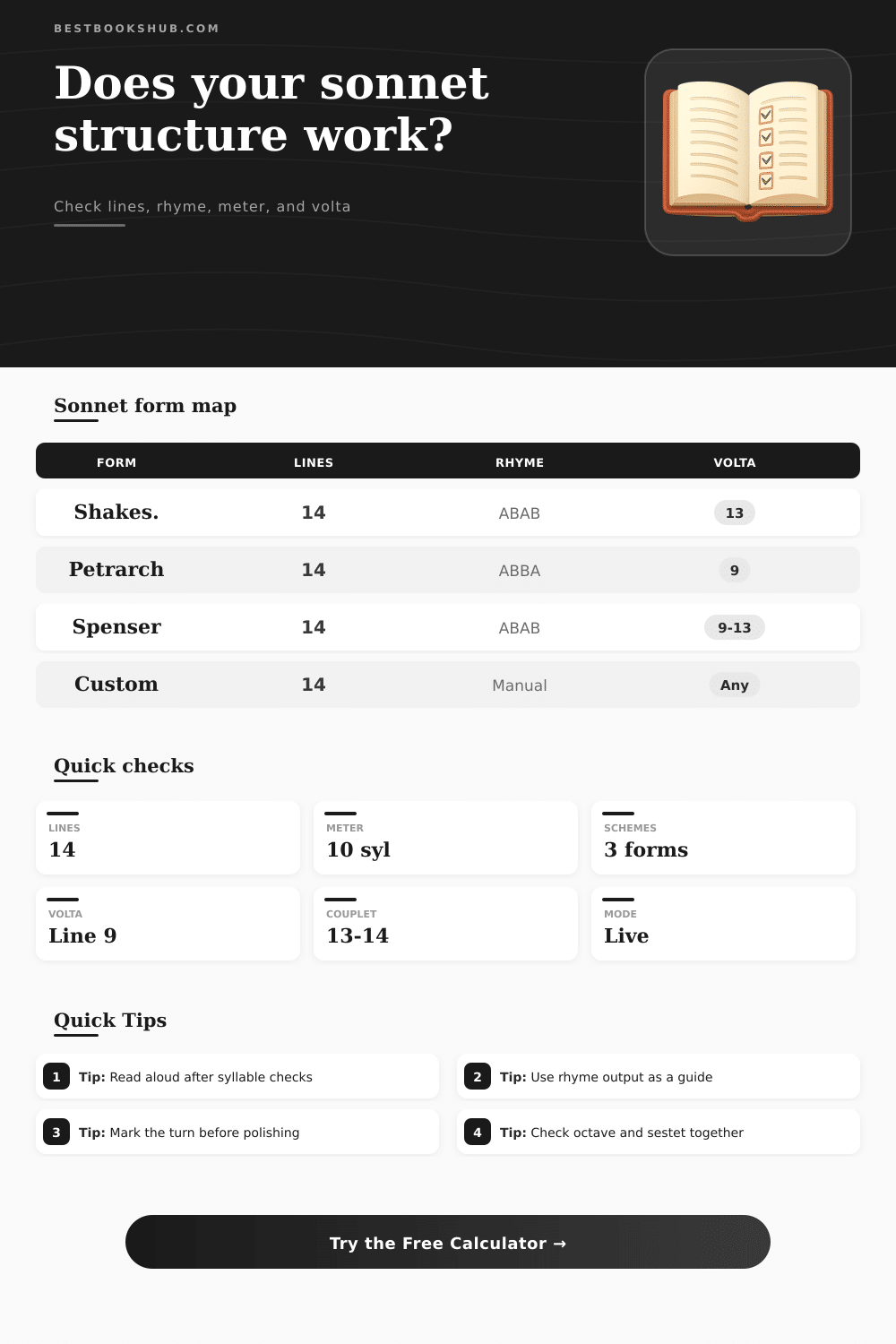
| Shakespearean | ABAB CDCD EFEF GG | 3 quatrains + couplet | Line 13 or 9 | Final GG couplet resolves or overturns. |
| Petrarchan | ABBA ABBA CDE CDE | Octave + sestet | Line 9 | Sestet answers octave tension. |
| Spenserian | ABAB BCBC CDCD EE | Linked quatrains + couplet | Line 9 to 13 | Couplet seals linked argument. |
| Modern sonnet | Often varied | 14-line pressure | Flexible | Structure may bend while retaining turn. |
| Check | Ideal signal | Warning signal | How calculator scores it |
|---|---|---|---|
| 14-line count | Exactly 14 nonblank lines | Fewer or more lines | Line card and score weight. |
| Rhyme scheme | Matching letters share rhyme key | Expected pairs do not match | Pair agreement percentage. |
| Meter target | 10 syllables, or allowed range | Several short or long lines | Percent of lines within tolerance. |
| Volta | Turn near selected line | No hinge near expected line | Position and cue evidence. |
| Segment | Lines | Best use | Structural question |
|---|---|---|---|
| Quatrain 1 | 1-4 | Set image, claim, or problem | Does it open the argument clearly? |
| Quatrain 2 | 5-8 | Develop or complicate | Does it advance rather than repeat? |
| Quatrain 3 | 9-12 | Turn, deepen, or counter | Does line 9 shift pressure? |
| Couplet | 13-14 | Resolve, snap, or reframe | Do the last two lines rhyme and land? |
| Rhyme mode | Compares | Good for | Limitation |
|---|---|---|---|
| Loose | Last vowel cluster and tail | Draft rhymes and slant rhymes | May overmatch spellings. |
| Medium | Final three or four letters | Quick pattern checks | Misses eye-rhyme exceptions. |
| Strict | Exact ending word | Repeated refrain endings | Too strict for real rhyme. |
| Manual review | Your ear and stress | Final poetic judgment | Requires reading aloud. |
A sonnet are a poem that consist of exactly fourteen lines. The requirement of a four line structure force the poet to include a turn or a volta. The turn or volta is a shift in the direction of the poem, or the tone of the poem.
A poem without a turn or volta may read more like a lyric poem or a paragraph then a sonnet. You can use the structure checker to calculate the number of lines in the poem, but you must also decides where the volta should be placed. In most instances, the volta will occur at different places in the poem depending on the types of sonnet that is being written.
How to Check a Sonnet’s Structure
For instance, in Italian sonnets, the volta will occur near line nine. This is because the first eight lines, known as an octave, establish an idea in the poem. In English sonnets, the volta usually occur in the final couplet.
This is because the first twelve lines establishes an idea in the poem, and the final two lines provide a reversal of that idea. In Spenserian sonnets, the rhymes is arranged in an interlocking chain until the final couplet is reached. The placement of the volta is important in that it determines where the reader take a breath in the poem.
Placing the volta too early in the poem may lead to too few line remaining for the sonnet, while placing the volta too late with the final lines of the poem may make it seem flat when it end. The structure checker will catch these type of issues by comparing the rhyme scheme and the line endings in the poem. However, you must read the poem yourself to make sure the rhymes in the poem are accuratey.
The sonnet structure also include an element of meter. The line consist of ten syllables. A ten-syllable line allows for five iambic feet to be formed in the line.
Iambic feet include a short syllable followed by a long syllable. Other lines may include eleven syllables. These lines with eleven syllables are known as lines with a feminine ending because there is an extra unstressed syllable at the end of the line.
The tolerance settings for the structure checker can be adjusted to be either strict or loose regarding the meter for the sonnet. If the meter settings are too strict, you may delete lines in the poem that sound good when read aloud. If the settings are too loose for the meter of the sonnet, the poem may not follow the expected pentameter for the sonnet.
The syllable counts is one way to measure the meter for the poem. However, the stress of each word in each line should also be considered. Reading the poem out loud is the best way to determine whether or not the meter is correct for the poem.
The volta setting in the structure checker ask if you want the software to look for cue words such as but, yet, or however, or if you want the software to look for any visible hinge in the poem. The presence of cue words does not mean that the volta in the poem is successful, but the absence of these words may mean that the poem has not yet develop a volta to change the direction of the poem. Many poets struggle with the volta because they have not yet figured out the direction that they want the poem to take.
The structure checker will help point this out for the poet. Some of the mistake that writers often make when writing a sonnet include treating blank lines or subtitles as part of the fourteen lines in the poem. Considering blank lines as part of the line count will result in an incorrect rhyme scheme for the poem.
Another mistake is using a strict mode for the rhymes in the poem but finding that the structure checker penalize the use of slant rhymes. These types of rhymes are often required to create the music for the poem. Another mistake that is often made is placing the volta at line thirteen in every sonnet that is written.
However, if the argument for the poem change at a later point, this is incorrect. These mistakes can be adjusted after the structure checker alert the writer about these issues. However, it is necessary to understand what each mistake mean to the poem for the poet to make the appropriate adjustment to the poem.
The structure checker is a mirror that will reflect issues with the poem rather than a judge. When using the structure checker, place the sonnet into the appropriate settings according to the type of sonnet that is being written. Make note of the area in which the score is low on the structure checker.
Ask the poem what it require to fix the issues with the structure of the poem. A simple change of a single word may fix the issue with the rhyme in the sonnet. Other issues may require a full rewrite of the poem in order to move the volta to the correct register in the poem.
The structure checker cannot make decisions for the poet as to what the poem should look like. However, the structure checker can reflect on the poem and inform the poet of whether or not the structural skeleton for the sonnet is correct. The structural skeleton of a sonnet include the fourteen lines that make up the poem, the rhyme frame, the meter, and the volta.
These elements of the poem create the architecture for the sonnet to contain a turn or a surprise in the poem. If the structure of the poem hold, the reader will experience the lines of the poem and the change in the poem. If the structure of the poem do not hold, it will feel unfinished.
The structure checker allow the poet to quickly see if there are any issue with the structural elements of the poem. However, the poem must earn the structure of the sonnet.