📚 Verse structure lab
Poem Line Counter
Paste a poem to count total lines, nonblank lines, stanza breaks, average stanza length, numbered lines, and structural fit against common poem form targets.
Load a form-shaped example, then change blank-line and numbering rules to match your draft. These presets focus on line structure, not syllable counting.
Lines: 0
DISCLOSURE: This post may contain affiliate links, meaning when you click the links and make a purchase, I receive a commission. As an Amazon Associate I earn from qualifying purchases.
Run the counter to compare physical rows with counted poem lines.
Stanzas: 0
Blank-line policy controls whether stanza breaks are visible.
Average: 0
Average lines per stanza helps spot short or long sections.
Target: custom
Select a form target to see line-count and pattern fit.
| Form | Typical line count | Stanza pattern | Line-count note |
|---|---|---|---|
| Haiku | 3 lines | Single tercet | This counter checks lines only, not syllables. |
| Tanka | 5 lines | Single 5-line poem | Useful for checking compact draft shape. |
| Limerick | 5 lines | Single 5-line stanza | Line count is exact; rhyme is outside this tool. |
| Sonnet | 14 lines | Usually one block or 4-4-4-2 | Use nonblank lines when checking form length. |
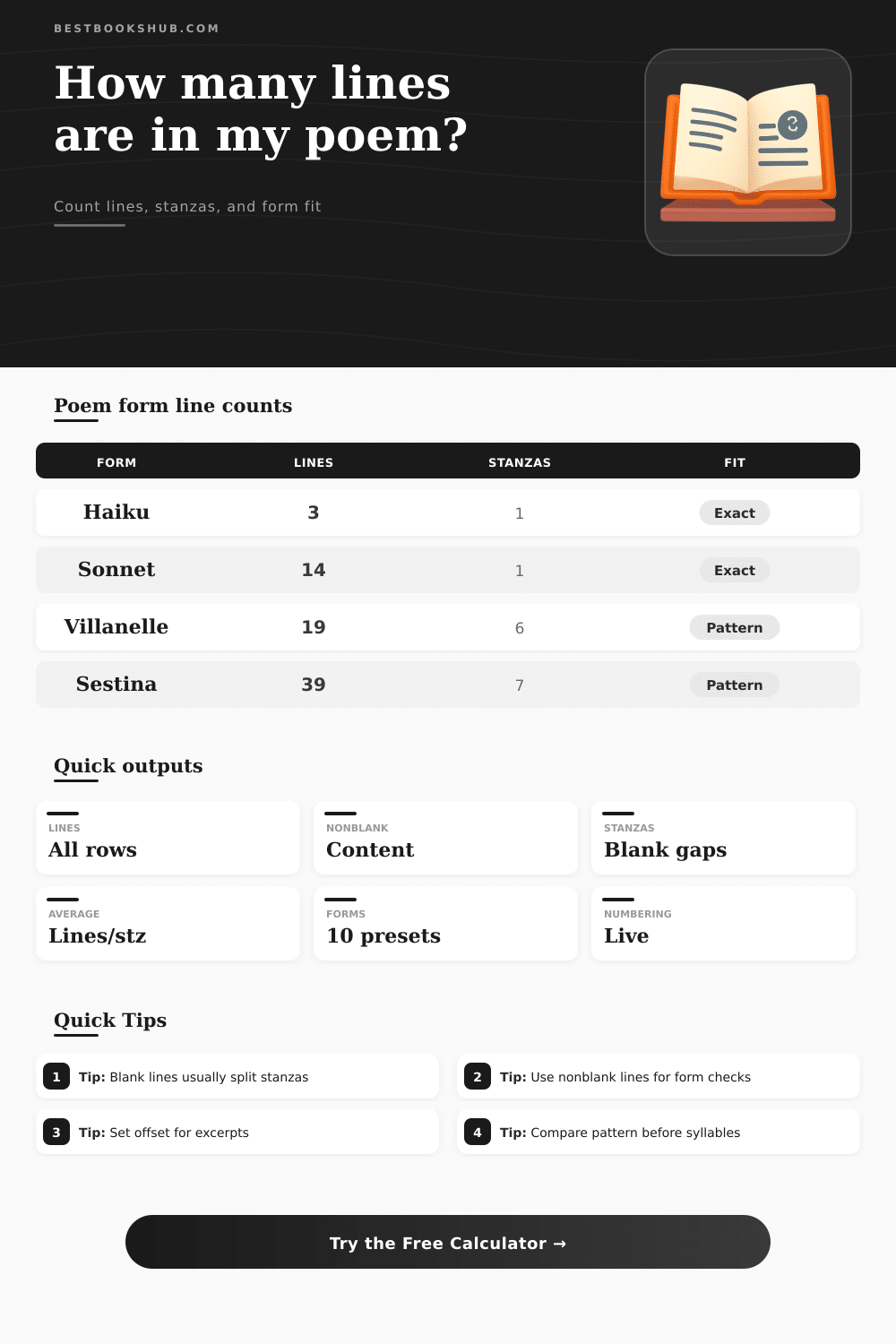
| Villanelle | 19 lines | 3-3-3-3-3-4 | Pattern score checks six stanza groups. |
| Sestina | 39 lines | 6-6-6-6-6-6-3 | Line count checks the six sestets plus envoy. |
| Pattern | Name | Best use | Counter behavior |
|---|---|---|---|
| 2 lines | Couplet | Ghazal, epigram, lyric pair | Checks whether stanza lengths are multiples of two. |
| 3 lines | Tercet | Haiku, villanelle units | Useful for identifying repeated three-line blocks. |
| 4 lines | Quatrain | Ballad, pantoum, hymn stanza | Checks steady four-line stanza construction. |
| 6 lines | Sestet | Sestina body, sonnet turn | Useful when matching six-line stanza groups. |
| Mode | What it counts | Best use | Watch for |
|---|---|---|---|
| Split stanzas | Blank rows separate groups | Most poems and workshop drafts | Extra blank rows can create false gaps. |
| Collapse blanks | Repeated blanks become one break | Copied text from editors or PDFs | Still preserves stanza boundaries. |
| Ignore blanks | Only content rows count | Pure form-line checking | Stanza count may become one block. |
| Count blanks | Blank rows remain physical lines | Layout proofing and page mockups | Do not use for strict form counts. |
| Numbering style | Example | Best use | Result |
|---|---|---|---|
| Every physical line | 1, 2, 3 | Proofreading copied poems | Blank rows keep visible positions. |
| Content only | 1, 2, 3 | Workshop notes and submissions | Blank rows are shown but not numbered. |
| Stanza.line | 2.4 | Form analysis and teaching | Shows the local line inside each stanza. |
| No visible numbers | Plain lines | Clean reading preview | Still calculates counts in the results. |
Poetry is defined by its visible shape and its sounds. The number of line in the poem measure the visible shape of poetry. A sonnet is not merely fourteen line of thought, but a sonnet is fourteen lines of poetry that is arranged so that a reader can take a visual turn at the eighth line and end with a couplet.
A haiku is not comprised of three thought, but a haiku poem is composed of three lines of brevity to show what is not written in the poem. Counting the lines of a poem is a task that many writer neglect, but is actualy one of the first ways that a writer can determine if a poem has the weight that they intended for it to have. When a poet drafts a poem, it is typical for that poem to be drafted in a notebook, a word processor, or even an email.
How to Count Lines in a Poem
Each of these destination for a poet’s thoughts may include breaks between lines, titles above stanzas, or even lines that appear to be fragments that may or may not count as a line of poetry. Each of these line counts may alter the line count of the poem. While the line count calculator can do the math in its head to determine the line count of a poem once a poet decide what lines and breaks count, the poet must make that decision regarding the poem that they have written.
Many poets discover the importance of line counts when attempting to transform a poem written in free verse into another form, such as a villanelle or a sonnet. Within a villanelle, the lines that are repeated may not land as the poet intend that they would land within the poem. In a sestina, the words that are to be repeated at the end of stanzas may appear force if the lines of the stanzas are of the incorrect length.
In these instances, knowing the line count of a poem can reveal to the poet whether the issues with the poem relate to the musicality of the poem or whether the issues with the poem relate to the number of lines within the poem. The ability to adjust the line count rules within the line count calculator can help a poet to recognize whether the stanzas within their poem are drifting due to blank lines within the stanzas, or due to the poem not meeting the requirement of the form in which it is written. Beyond the total lines within a poem, it is often important to also count the number of lines that are not blank lines.
In many instances, a poem may appear to have numerous lines when viewed on a page, but reveal only twelve lines of poetry when those blank lines are remove. There is often a gap between the appearance of the poem and its substance, and comments from poetry workshops often relate to this gap between appearance and substance. The same gap can exist between two poems when comparing them, as well.
For example, many contemporary ghazals include twenty couplets, while classical ghazals may only include five or six couplets. Without being able to establish a method of counting lines within poems, any comparison between poems can become vague and imprecise. The average length of a stanza within a poem can reveal more about the poem than the total number of lines within the poem.
For example, a poem that includes stanzas of only two lines may have a more different impact upon the reader than a poem that includes stanzas of six lines each. Stanzas of only two lines may create a quick poem with a quick impact upon readers, while stanzas of six lines each may allow for the development of the ideas within those poems. The average length of a stanza within a poem may drift from the average length of the other stanzas within the poem, and the poet may not understand the reason for this drift in stanza length.
Identifying this issue will allow the poet to better understand their purpose for the poem. While forms of poetry may appear to be handcuffs to the poets who write within them, they are actualy measuring sticks for the poet. While a poet may not require a poem to contain exactly the same number of lines as that required by a specific form, knowing that number will help the poet manage the poem that they are writing.
For instance, within a villanelle, tercets compose stanzas and end with a quatrain. Each stanza can be inspected to determine which stanzas may need to be trim or expanded, thus allowing the poet to avoid rewriting that section of the poem entirely. Another useful feature within the line count calculator is the ability to preview the lines within the poem.
This is useful for poets to determine if, for instance, the fifth line within the second stanza of the poem has the same function within the poem as the fifth line within the fourth stanza. This type of feature is especially important within poems that use forms of repetition, such as pantoums or ghazals. Although line counts cannot determine the emotional accuracy of a poem, and despite the fact that line counts cannot reveal the freshness of the language within a poem, the line counts for a poem can help to ensure that the architecture of the poem is not fighting against its content.
If the lines of a poem do not appear to contain the number of lines that are required by the poem’s form, the poet may have written a poem that requires a different container for its content. Checking these various numbers within a poem is a habit that can be helpful to any poet. Over time, the poet will begin to notice when a new poem is borrowing elements from an old poem.
As with most things, the numbers will eventually stop being a tool that the poet employs, and will instead become a sense within the poet of where the poem is going. The poem will decide where the poem would like to go, but the line count will tell the poet if the poet has arrive at that destination.