📣 Responsive search ad checker
Google Ads headline length checker
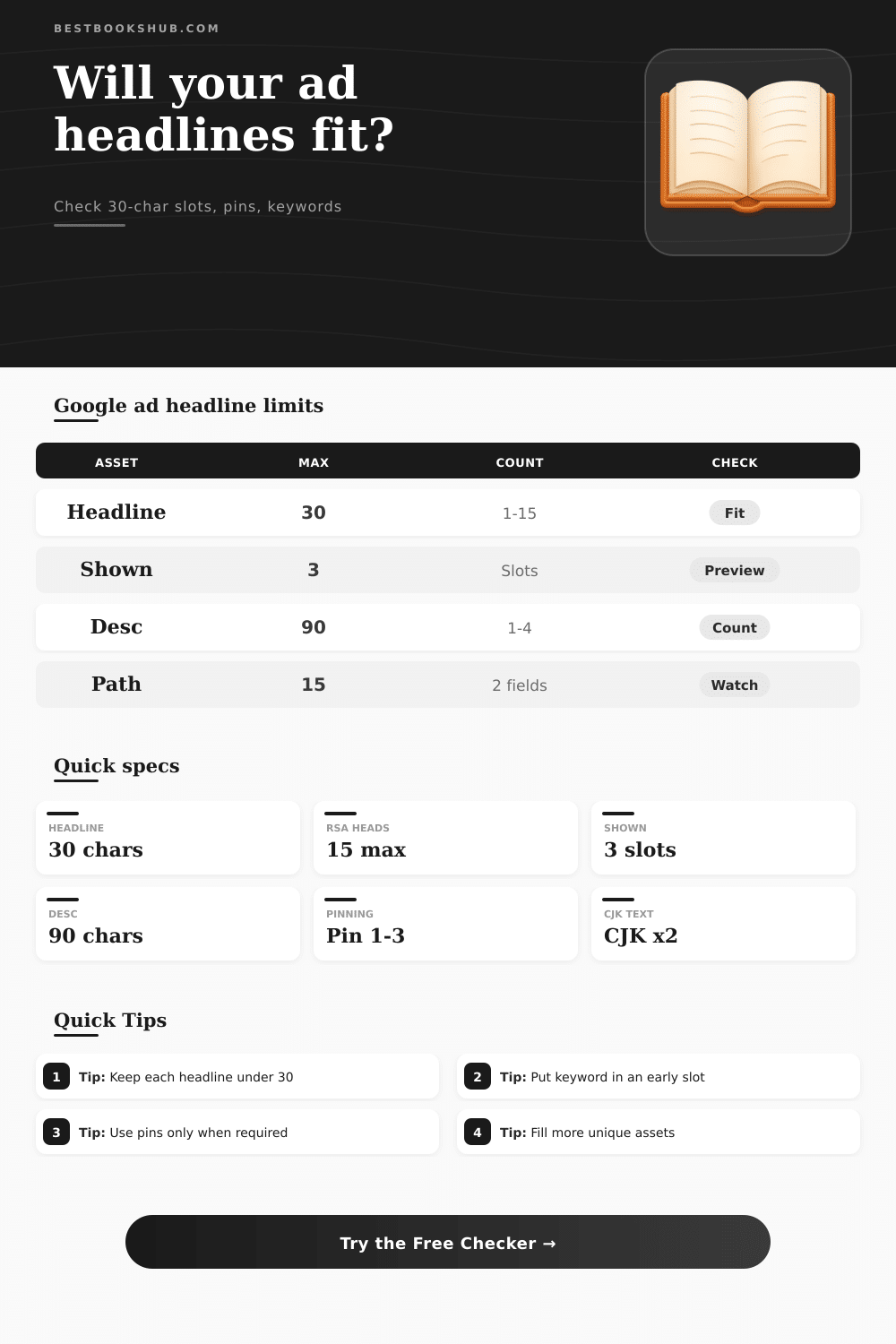
Check up to 15 responsive search ad headlines against the 30-character limit, preview the 3 visible headline slots, flag pinned positions, and measure keyword coverage before publishing.
| Google Ads field | Maximum length | Responsive search ad count | Checker action |
|---|---|---|---|
| Headline | 30 characters each | 1 to 15 headline assets | Flags every headline over 30 |
| Description | 90 characters each | 1 to 4 description assets | Counts selected description assets |
| Path field | 15 characters each | 2 optional path fields | Warns when either path is long |
| Visible headline area | Up to 3 headlines | Chosen by Google Ads | Builds a 3-headline preview |
| Headline slot | Best role | Pinning risk | Keyword note |
|---|---|---|---|
| Position 1 | Main search intent or brand promise | Too many required openers can limit testing | Useful place for the primary keyword |
| Position 2 | Benefit, proof, or offer detail | Repeated offers can feel redundant | Good for secondary keyword context |
| Position 3 | CTA, differentiator, or qualifier | May not always show on all surfaces | Do not rely on it for the only keyword |
| Unpinned | Variation for machine testing | Least control over order | Works best with unique intent angles |
| Valid headline assets | Planning signal | Combination impact | Next action |
|---|---|---|---|
| 1 to 3 | Thin asset set | Very limited headline testing | Add distinct benefit and CTA variants |
| 4 to 7 | Basic coverage | Some useful combinations | Add keyword and audience variants |
| 8 to 11 | Useful RSA draft | Good variation if pins are light | Remove duplicates and long headlines |
| 12 to 15 | Strong asset library | More room for Google Ads testing | Keep each headline unique |
| Headline pattern | Example under 30 | Common failure | Checker signal |
|---|---|---|---|
| Keyword headline | Buy Used Books Online | Keyword appears only in slot 3 | Keyword placement score |
| Benefit headline | Save On Your Next Read | Benefit is too vague | Asset uniqueness count |
| CTA headline | Shop New Book Deals | CTA exceeds 30 characters | Over-limit flag |
| Brand headline | Best Books Hub Picks | Brand term missing when required | Brand coverage row |
DISCLOSURE: This post may contain affiliate links, meaning when you click the links and make a purchase, I receive a commission. As an Amazon Associate I earn from qualifying purchases.
But why does Google Ads have such a character limit? Why are they showing at most three headlines in the classic layout where each headline can have up to 30 characters? Turns out that if you go one character over the maximum, then your ad will either not get triggered properly or else it might show up in an abbreviated state on mobile phones. That has effects regarding keyword placement, offer wording, etc.
A good tip: Responsive search ads works better when you use a wider variety of assets. A couple of headlines aren’t sufficient. Eight to eleven provide some variability. Fifteen, the new limit, allows for true machine learning. It takes self-control to cram a lot of concepts within 30 character field. Know what verbs sell, know what adjectives don’t matter.
How to Write Better Headlines
Many advertisers undervalue the power of pins. A pinned asset will appear in the first spot regardless of what combination the system generate. You may need this to fulfill some kind of requirement (e.g., legal) or protect your trademark. But each pin that you add cuts down on the possible combinations the system can generates. Too many pins and your responsive ad becomes static. In general, pinning should of be reserved for critical items, letting the system create combinations with the rest.
Click-through rate varies by keyword position: The closer a searcher sees her question at the start of the headline, the better. Placing the precise search phrase within all assets make the ad seem robotic. Instead, aim one set of headlines for benefits; use another that includes the keyword but only in a way that shows Google it is relevant. High-engagement campaigns tend to split between naturaly sounding phrases and explicit keyword mentions.
Don’t ignore descriptions, even though they matter more than most admit. There’s room for four of them with a limit of 90 characters per description. If you can tie your headline and descriptions together Google can shuffle them around but your ad still makes sense.
The path fields on the display URL have a limit of 15 characters apiece. That doesn’t count toward your character limits on the headline, so it adds context without gobbling up headline space. Choose wisely what goes into the path field; it should reinforce the offer.
There is a pattern among many accounts. The 30 character maximum isn’t treated as a maximum. Instead of exploring different copy, the same promise are repeated from asset to asset. Characters that take up double width (such as those used in Asian languages) are counted twice. Pinning can become aggressive and result in flat performance. These errors show up when you measure results.
Good advertisers think about headlines as if they’re managing an inventory. It is a mixture of calls to action, offers, benefits, social proof, and hooks. Different types of hooks aims at different kinds of searchers. Testing a variety. Weak performers retire thanks to data. It’s not about making each line hit the exact number of characters. It’s about building up a flexible library that lets Google show relevant messages.
If done right these restrictions make ads better. Advertisers who respect the character limit perform better. These rules help it work for you.