📖 Torah portion timing desk
Torah Portion Reading Time Calculator
Estimate the time for a full parashah, selected aliyot, maftir, Hebrew reading, English translation, chanting practice, study notes, and a weekly preparation schedule.
Preset word and verse counts are planning references. If your chumash, tikkun, or community assignment differs, switch to custom values and enter the exact assignment.
| Portion | Reference verses | Hebrew words | Planning use |
|---|---|---|---|
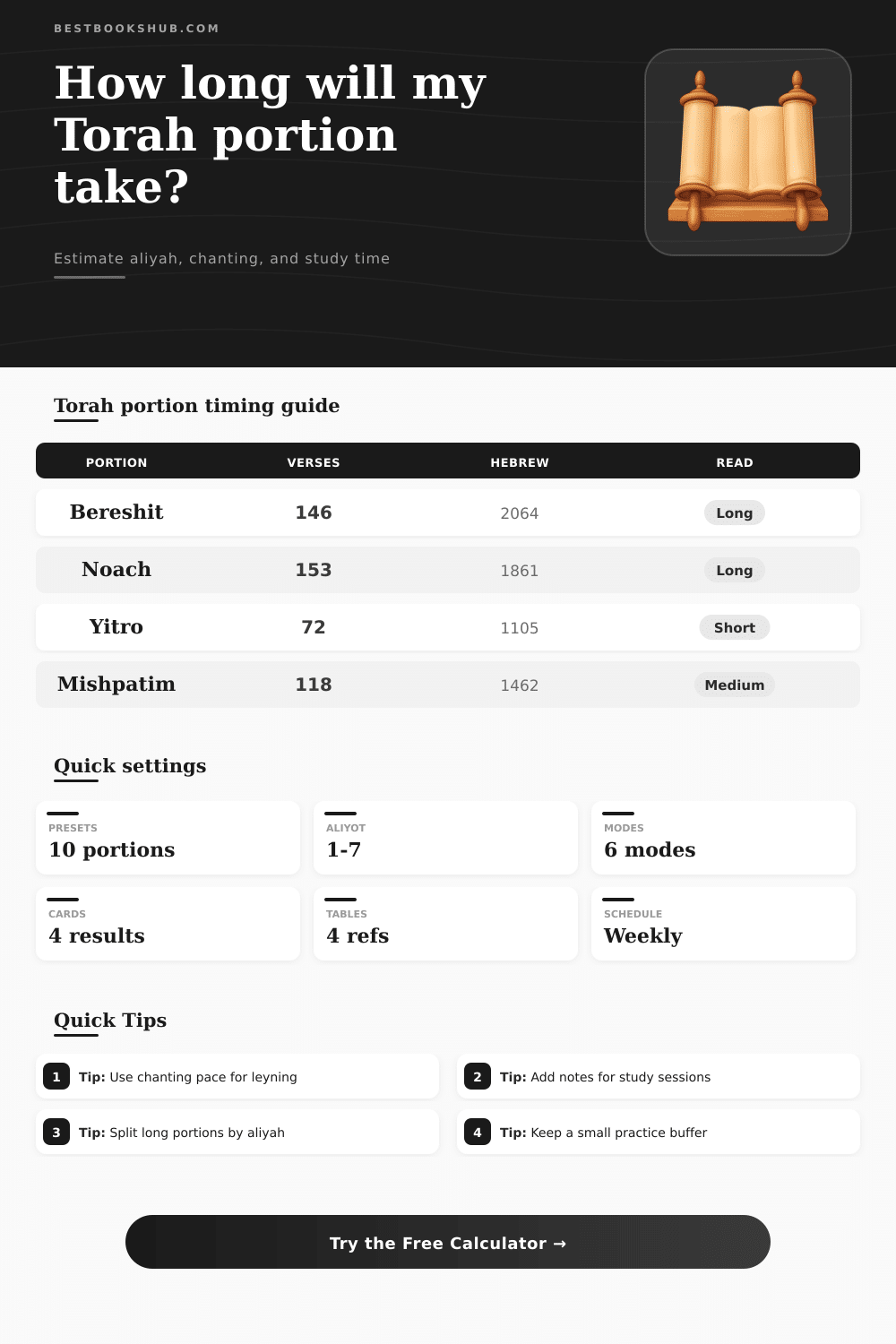
| Bereshit | 146 verses | About 2,064 words | Long opening portion with narrative flow and many short clauses. |
| Noach | 153 verses | About 1,861 words | Long portion; schedule extra review for repeated names and sections. |
| Lech-Lecha | 126 verses | About 1,686 words | Medium-long assignment with travel narrative and covenant passages. |
| Vayera | 147 verses | About 2,085 words | Long narrative portion; useful for multi-day chanting practice. |
| Chayei Sarah | 105 verses | About 1,402 words | Moderate portion with repeated dialogue sections. |
| Vayigash | 106 verses | About 1,480 words | Moderate narrative reading with emotional speeches. |
| Beshalach | 116 verses | About 1,681 words | Includes Shirat HaYam; chanting practice may need extra time. |
| Yitro | 72 verses | About 1,105 words | Shorter portion, but formal passages can slow careful reading. |
| Mishpatim | 118 verses | About 1,462 words | Law-heavy portion; study notes can add meaningful time. |
| Nitzavim | 40 verses | About 553 words | Short portion, often easy to schedule in fewer sessions. |
| Mode | Typical planning pace | What changes time | Calculator control |
|---|---|---|---|
| Hebrew oral reading | 80 to 110 Hebrew words per minute | Fluency, vowels, punctuation, and familiarity with the passage. | Hebrew reading pace |
| English translation | 150 to 210 English words per minute | Edition style, reader speed, and whether footnotes are included. | English reading pace |
| Chanting or leyning | 35 to 60 Hebrew words per minute | Trope, repeated practice, musical phrasing, and confidence. | Chanting pace and practice passes |
| Study with notes | Reading time plus note minutes | Depth of commentary, cross-references, and written summaries. | Study-note time per verse |
| Segment choice | Length rule used | Best for | Planning caution |
|---|---|---|---|
| Whole weekly portion | Uses full preset or custom counts | Full parashah review, translation reading, or weekly study. | Long portions may need several sessions. |
| Selected aliyot | Uses aliyot covered divided by seven | One reader assigned multiple aliyot or a class portion split. | Actual aliyot are not always equal length. |
| One average aliyah | Uses one seventh of the portion | Quick planning when exact aliyah boundaries are not entered. | Check the exact verses for public reading practice. |
| Maftir or short reading | Uses a short portion share or entered verses | Short chanting assignments and concise review blocks. | Holiday maftir readings can differ from the weekly preset. |
| Custom verses or pages | Uses the manual verse or page fields | Exact class assignments, tikkun pages, or edition-specific work. | Enter the actual word count if available. |
| Practice days | Short assignment | Medium assignment | Long assignment |
|---|---|---|---|
| 2 days | Two focused review blocks | Longer sessions, good for confident readers | Can feel compressed for chanting practice |
| 3 days | Read, refine, final review | Balanced for many aliyah assignments | Use a buffer for difficult phrases |
| 5 days | Short daily practice | Steady study-note schedule | Good for full portions or repeated chanting passes |
| 7 days | Small daily touchpoints | Best for spaced repetition | Use gentle daily targets rather than rushing |
DISCLOSURE: This post may contain affiliate links, meaning when you click the links and make a purchase, I receive a commission. As an Amazon Associate I earn from qualifying purchases.
That’s why you are using this Torah portion reading time calculator: Because no two preparations ever go quite like they’re supposed to. You settle down with your chumash, determined to read through the week’s parashah in one concentrated evening session. But between the Rashi notes, the English review, and the chanting practice, before you know it, the entire afternoon is gone. Knowing just how long each part take is what makes all the difference between feeling rushed versus feeling ready.
Chanting in trope feels different than reading Hebrew aloud. When you read at your comfortable conversational rate, you may find yourself getting through 90 words a minute with relative ease. When you switch into leyning mode, you slow down to about half the speed. This happens because of the pause for each phrase, the tune of the notes, and the naturaly desire to slow down and double-check. This difference, I think, is what makes the same passage seem like it’s dragging during a Shabbat morning service but seems snappy during your own study time. The tool takes this into account by allowing you to select a mode that matches what you are going to be doing.
Why Use the Torah Reading Calculator
Then there’s English translation. While a richly detailed commentary may move slowly, a sleek moddern translation races through, as do most of us, even if we slow down momentarily to understand what is happening. And then there are the study notes, which further stall time. Depending on the verse, it can take as little as half a minute for your mind to process its footnotes. However, in heavy legal chapters like this one, Mishpatim, a single verse can take up two minutes or more, especially when you begin cross-referencing. Multiply these choices over multiple verses and you’ve got yourself a time consuming segment.
The Aliyot do make a difference, and I don’t think we realize how much. They’re about a seventh of the total, that’s fine for planning purposes, but each is not really equivalent. A long stretch of narrative feels endless; a shorter maftir are done in minutes. Doing it over multiple evenings doesn’t create panic at the last minute. Often three solid sessions will be easier to sustain than a single heroic effort the night before especially with a little padding for the sure-to-happen rereads.
The details reveal common errors. Newbies underestimate the time it takes to transition between aliyot. Remember that each one includes a moment of repositioning or a blessing. Others overburden themselves with too many things at once. They try to use English, Hebrew, notes, and chanting all together, but it is impossible to do all of that. It is a dumb idea. A better strategy is to figure out exactly what this week demands. If you’re learning in public, focus on the chanting passes; if you’re teaching a class, make sure to have the study notes handy; if you’re prepping for yourself, keep it simple with just Hebrew and English.
The starting point is how long the portion is. Some parashiot open with a wide sweep of narrative and a repetition of names that pays off when practiced slowly and on purpose, like Bereshit. Others are shorter, like Nitzavim, where you have time to dwell on every thought without getting worn out. Even the number of printed pages in your specific Chumash or tikkun may not be the norm, so we provide custom input options. Because you’re holding a physical object in your hands, real prep honors it.
In sum: The calculator doesn’t deliver magic answers; it delivers trade-offs. If I drop the English layer, for example, or make two practice passes instead of four then that’s an hour I free up. And that’s enough to show up prepared and yet also protect my time. You should of seen how much better it feels.
The portion comes every week like clockwork. You get to decide how much of your week it will take, one informed choice at a time.