🎬 Script timing lab
Screenplay Page-to-Minute Calculator
Estimate screen runtime from screenplay pages, format type, dialogue and action density, montage or set-piece pacing, scene count, transition drag, target runtime, and page-per-minute range.
Use a preset as a realistic starting point, then adjust pages, density, format, scene count, and page-per-minute limits to match the actual script draft.
DISCLOSURE: This post may contain affiliate links, meaning when you click the links and make a purchase, I receive a commission. As an Amazon Associate I earn from qualifying purchases.
These tables are planning references. Final timing should be checked with a table read, animatic, or edited cut when precision matters.
| Format type | Baseline pages/min | Typical runtime target | Timing note |
|---|---|---|---|
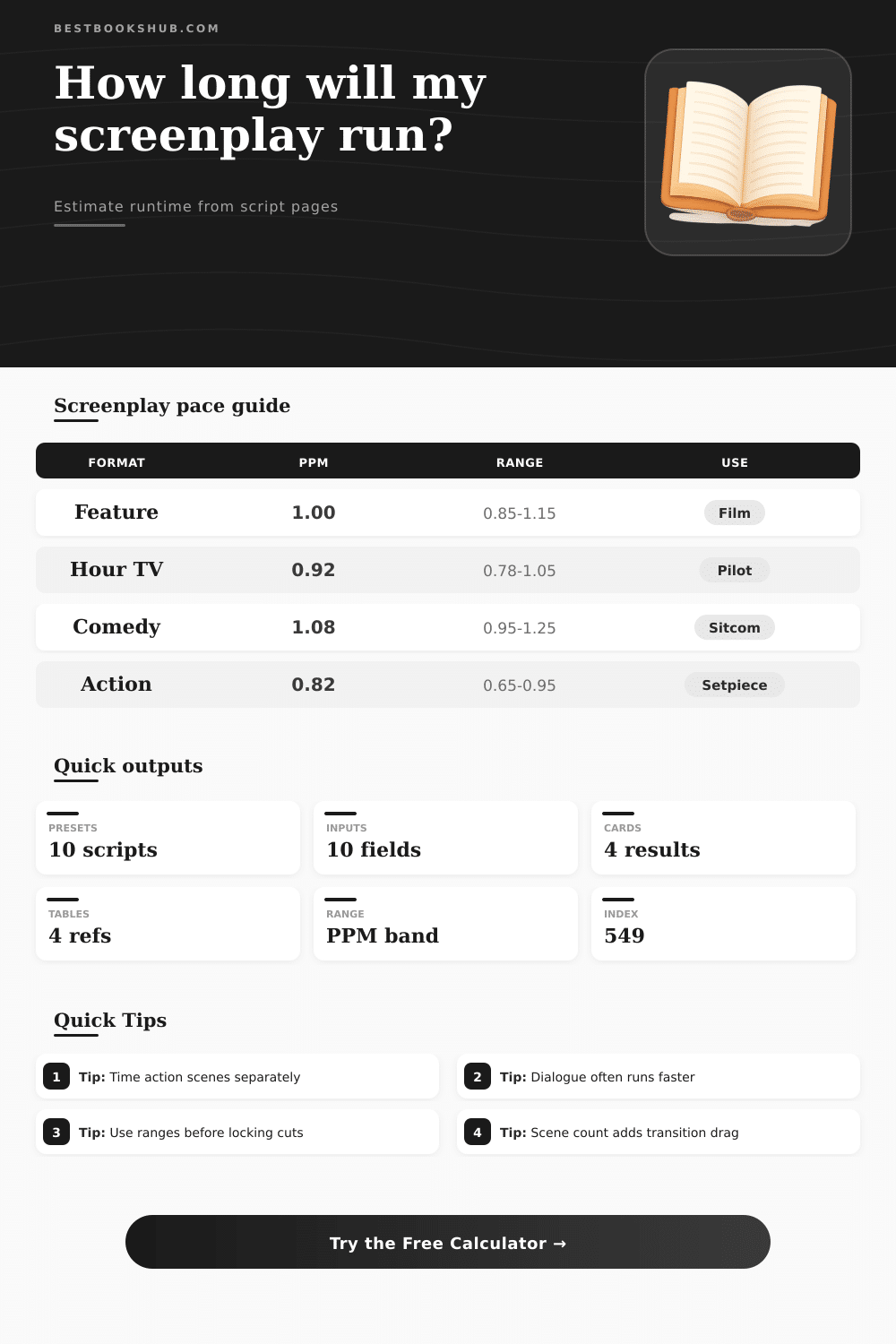
| Feature screenplay | 1.00 | 90-120 minutes | Good baseline for standard screenplay format with mixed dialogue and action. |
| Hour drama pilot | 0.92 | 45-62 minutes | Act structure, teasers, and dense plot movement often slow the page pace. |
| Half-hour single-camera | 1.04 | 22-35 minutes | Shorter scenes and brisk dialogue can push more pages into each minute. |
| Multi-camera sitcom | 1.12 | 20-30 minutes | Dialogue pages can run fast, but audience response or pauses can widen the range. |
| Animation script | 0.86 | 7-30 minutes | Visual business, gags, and storyboard timing can add screen time beyond page count. |
| Density setting | Factor | Usually changes pace by | When to use it |
|---|---|---|---|
| Dialogue-heavy quick exchanges | 1.14x | More pages per minute | Use for banter, interrogation, rapid comic scenes, and overlapping verbal beats. |
| Balanced dialogue and action | 1.00x | Neutral | Use for standard scene work with action lines, dialogue, and normal blocking. |
| Lean visual action | 0.93x | Fewer pages per minute | Use when short action lines describe moments that need screen time. |
| Dense action description | 0.78x | Much fewer pages per minute | Use for chases, fights, horror suspense, or detailed action paragraphs. |
| Sparse beats with silence | 0.84x | Fewer pages per minute | Use when the page is light but performance, pauses, and image duration matter. |
| Sequence type | Calculator factor | Manual adjustment idea | Timing cue |
|---|---|---|---|
| No special adjustment | 1.00x | 0 minutes | The page estimate is enough for ordinary scene timing. |
| Fast montage or quick cuts | 1.16x | -1 to -6 minutes | Many written beats may compress into short screen time. |
| Long action set pieces | 0.78x | +2 to +15 minutes | A few pages of combat, chase, or suspense can occupy a large sequence. |
| Quiet visual passages | 0.74x | +1 to +10 minutes | Silence, landscape, reaction, or dread can make pages run long. |
| Song or performance beat | 0.80x | Use song length | Lyrics, choreography, and performance time should be timed directly. |
| Page count | Fast dialogue estimate | Balanced estimate | Action-heavy estimate | Planning use |
|---|---|---|---|---|
| 10 pages | 8-10 min | 10-12 min | 12-16 min | Short sequence, teaser, or extended scene block. |
| 30 pages | 24-30 min | 30-35 min | 36-46 min | Half-hour draft or first act planning band. |
| 60 pages | 48-58 min | 58-68 min | 72-92 min | Hour pilot, contained feature, or long act stack. |
| 90 pages | 72-86 min | 86-102 min | 108-138 min | Lean feature or visual draft sanity check. |
| 120 pages | 96-115 min | 115-136 min | 144-184 min | Long feature draft with high timing risk. |
To predict duration from pages, use this screenplay page-to-minute calculator. It look at how much dialogue is used, the number of actions, number of scenes, the formatting, the timing range, the target gap, and more. Now you’ve typed “fade out” on page 112 and the actual question arises. How long does this thing run on screen?
The old industry shorthand was one page per minute. But that rule collapse when your script tilts toward long silent beats or dense action. A flabby 118 can mean your project sits on a shelf; a tight 95-minute cut can get it financed. Timing a screenplay is as much an art as it is math.
Why Script Pages Do Not Equal Minutes
Forty seconds can pass in the blink of an eye if actors overlap their dialogue and pace is brisk. Seven minutes can be eaten up when meticulous action descriptions begin to add up and sound design and stunts comes into play. And veteran producers are hesitant to take the raw page count at face value. Each scene’s rhythm and texture will impact its unique weight.
That’s where this calculator comes in: By allowing you to factor in a handful of real world variables, it’ll do all that for you. For example, dialogue; dense, rapid-fire exchanges will compress time; sparse, atmospheric beats will stretch it out. A montage written as a bullet list on the page may collapse to thirty seconds when editor pairs it with the appropriate music. Conversely, long action set pieces requires breathing room, which is something no simple formula can predict.
And then there’s the hidden tax that scene count plays. Each cut, each location shift cost a few seconds which add up over the course of a complete script. If you overlook that slowdown, what looked so beautiful on paper; say, 105 minutes, now feel rushed in the edit bay. And that’s what the tool shows you: The difference between intent and execution.
Maybe it turns out you’ve got a twelve-minute-over-the-target thriller once you time the set pieces for real. And that changes everything. It stops you from fighting over pages trimmed for no good reason. Instead, it makes you ask smarter questions: Where can silence do the work of exposition? What sequence really earns its running time? When does compression actualy help the story rather than hurt it?
As veteran writers discover, there’s no such thing as absolute when it comes to outlines. So much changes once actors are cast and take up residence in your work that early drafts needs wide ranges. The table read narrows the margin considerably. A revised production draft brings things closer still, but not all the way. Movies are organic. In rehearsal, they draw breath. In the edit, they firm. And occasionally at score, they catch us all off guard.
There are common missteps whenever anyone takes the one-page-per-minute rule as gospel. Writers who specialize in comedy routinely under-estimate the amount of onscreen space occupied by both physical business and audience laughter. Action writers over-estimate the number of words it takes for someone to go from sitting still at a computer to leaping through a window. And both fail to take into account that the math shifts based off format alone.
The structural demands of an hour-long drama pilot differ than those of a feature. Those structural demands shift perceived pace long before a frame gets shot. Here’s the good part: The estimate is merely a diagnosis, not a judgment. If the numbers return and indicate your script exceed its limit, then you’ll know which aspects is dragging it down. You won’t have to panic-cut on deadline, sacrificing your story logic for the sake of time. You would of been able to choose with purpose; based on something greater than an educated guess.
In the end, all scripts are written twice: once as they appear on page and again as viewers see them in the darkness. That’s where the craft becomes the art. Getting to the start line is only half the battle. Whether a project succeeds depend on how you use the information once you know how long it will take.