🎙 Episode timing lab
Podcast Script Length Calculator
Estimate podcast runtime from script words, speaking pace, host count, ad breaks, intro and outro time, interview spontaneity, target length, and a segment-by-segment plan.
Choose a preset to load realistic pacing, host, ad, intro, outro, and segment-plan assumptions. You can edit every field after applying a preset.
DISCLOSURE: This post may contain affiliate links, meaning when you click the links and make a purchase, I receive a commission. As an Amazon Associate I earn from qualifying purchases.
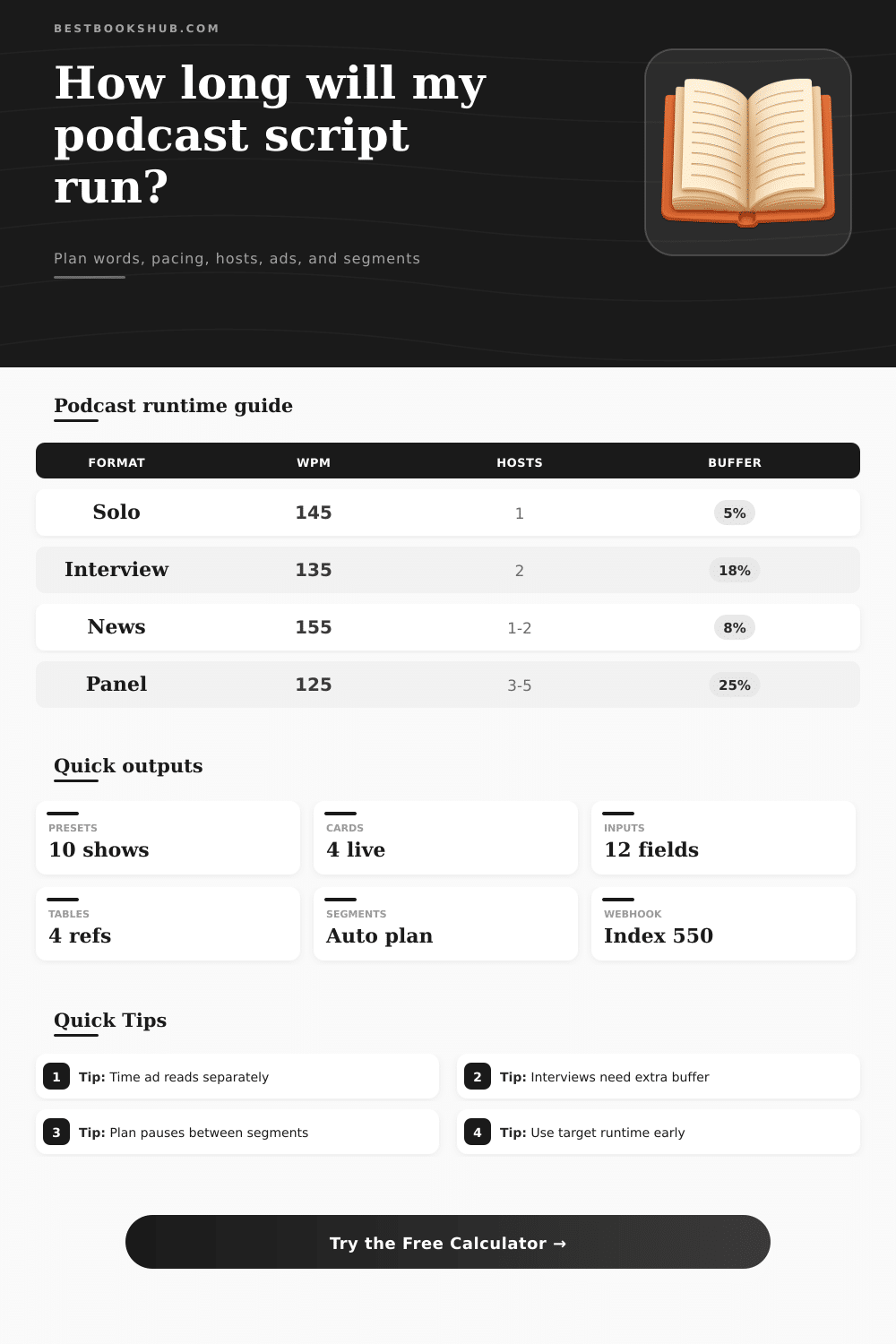
Use these reference bands to sanity-check the live estimate. Actual recording time can shift with delivery, edits, laughter, room tone, and unscripted follow-ups.
| Podcast format | Typical WPM | Host count | Runtime buffer |
|---|---|---|---|
| Solo essay or commentary | 140-160 WPM | 1 host | 3-8% for breath, emphasis, and minor edits. |
| Co-host conversation | 130-150 WPM | 2 hosts | 8-16% for handoffs, reactions, and short tangents. |
| Interview episode | 125-145 WPM | Host plus guest | 15-30% for answers, clarifying questions, and overlap. |
| Roundtable panel | 115-135 WPM | 3-5 voices | 20-35% for turn-taking and moderation. |
| News briefing | 150-170 WPM | 1-2 voices | 4-10% when scripts are tight and transitions are short. |
| Script word count | At 130 WPM | At 145 WPM | At 160 WPM |
|---|---|---|---|
| 1,000 words | 7:42 | 6:54 | 6:15 |
| 2,500 words | 19:14 | 17:14 | 15:38 |
| 4,000 words | 30:46 | 27:35 | 25:00 |
| 6,000 words | 46:09 | 41:23 | 37:30 |
| 8,000 words | 61:32 | 55:10 | 50:00 |
| Episode block | Common length | Calculator field | Planning note |
|---|---|---|---|
| Intro music and setup | 20-75 sec | Intro length | Count the produced intro separately from spoken script words. |
| Midroll ad read | 30-90 sec | Ad breaks and seconds | Use the finished ad slot length, not only the written ad copy. |
| Segment transition | 3-15 sec | Transition pause | Small pauses add up across multi-segment episodes. |
| Interview tangent room | 10-40% | Spontaneity factor | Apply more when questions are prompts, not fully scripted answers. |
| Outro and call to action | 20-90 sec | Outro length | Keep recurring outro time consistent across episodes. |
| Segment type | Best input style | Timing risk | Useful check |
|---|---|---|---|
| Segment plan rows | Words or minutes | Waiting for input | Run the calculator |
This podcast script length calculator will help you plan your next episode. It estimates run time based off the word count, speaking speed, number of guests, ad breaks, intro/outro, amount of spontaneity, desired length, and how much thought you’ve put into structuring segments.
All too frequently you’ll be sitting in front of what feels like a great script… And then end up producing an episode eight minutes past the mark. What was meant to be a quick tangent from a guest ends up eating four minutes. That ad read you timed for forty-five seconds now becomes a minute fifteen when music are added.
How to Plan Your Podcast Time
Why? Because spoken doesn’t always equate to written. Everything that happens when we get out of the writing phase and let our voices take over add to the real run time. The secret is that speaking pace is at the heart of calculation. In theory, one voice; like a narrator reading tight copy, can gets through 145-160 words per minute. But bring in a couple co-hosts and it comes down fast. They’re repeating ideas, they’re reacting to what’s been said, they’re laughing, they’re passing around microphone. All the natural rhythms take time on tape.
Then put in interviews. Guests will have stories to tell and moments to think about. They will also has ways to work things out. All of this takes additional airtime. The calculator factors these difference in so you won’t be surprised that your half-hour target turns into a forty-two-minute file.
Writers frequently overlook fixed production elements which use up time in the rough cut. A welcome message and intro sting may only be 45 seconds on paper but can stretches to 70 seconds with music. The sponsor copy isn’t all there is to ad breaks. There’s a read, a disclaimer, transition music, reintroduction… Time these as completed segments not simply by word count. Segments within each other add time too. A couple of eight second gaps between subjects don’t sound much till multiplied by six and then factored for an edit cushion to protect against awkward cuts.
Before you open the microphone, segment planning demands that you get clear. When you break your episode down into named blocks of fixed minutes or word targets, any imbalances shows up instantly. If a four-minute listener story and a twenty-minute teaching block are placed next to each other, you may need to split the teaching block. Try different distributions in tool until it feels right. For some, this means writing out every word; for others, outlining loosely and speaking off bullet points. If you know how much you can wing it without breaking the runtime, both will do.
Actualy, it’s better than guessing. I see certain common errors made by novice and veteran podcasters alike. One error is failing to tell the difference between what you say and what has been produced, meaning, counting every single word in an episode rather than each element separately. Second, people do not realize that time spent laughing, clapping, or thinking thoughtful also adds up. Three, people establish a goal but do not work backward to find the number of words needed once they have accounted for padding and breathing room. Mastering these requires reverse engineering the balance; then editing becomes light polishing rather than crisis management.
Best shows respects the conversation and the timing. They get you your money’s worth, but don’t rush or ramble along in ways that make you wish for a delete button. The math of talk time becomes your friend; knowing how long each of your ideas really takes gives you reason to pare back what doesn’t matter, and preserve what does. Knowing how long things should of last makes you a sculptor instead of a scrapper with the recording. It can be a moddern way to work.