🕯 Memorial timing worksheet
Eulogy Length Calculator
Estimate eulogy word count, speaking pace, pause and emotion buffer, service slot fit, story transitions, printed pages, and a practical rehearsal target.
Choose a practical service scenario, then adjust the draft word count, pace, buffer, story count, and printed page assumptions.
DISCLOSURE: This post may contain affiliate links, meaning when you click the links and make a purchase, I receive a commission. As an Amazon Associate I earn from qualifying purchases.
The draft word count is timed against the service slot. Story transitions, opening and closing lines, and pause buffer are calculated separately so the estimate leaves room for real delivery.
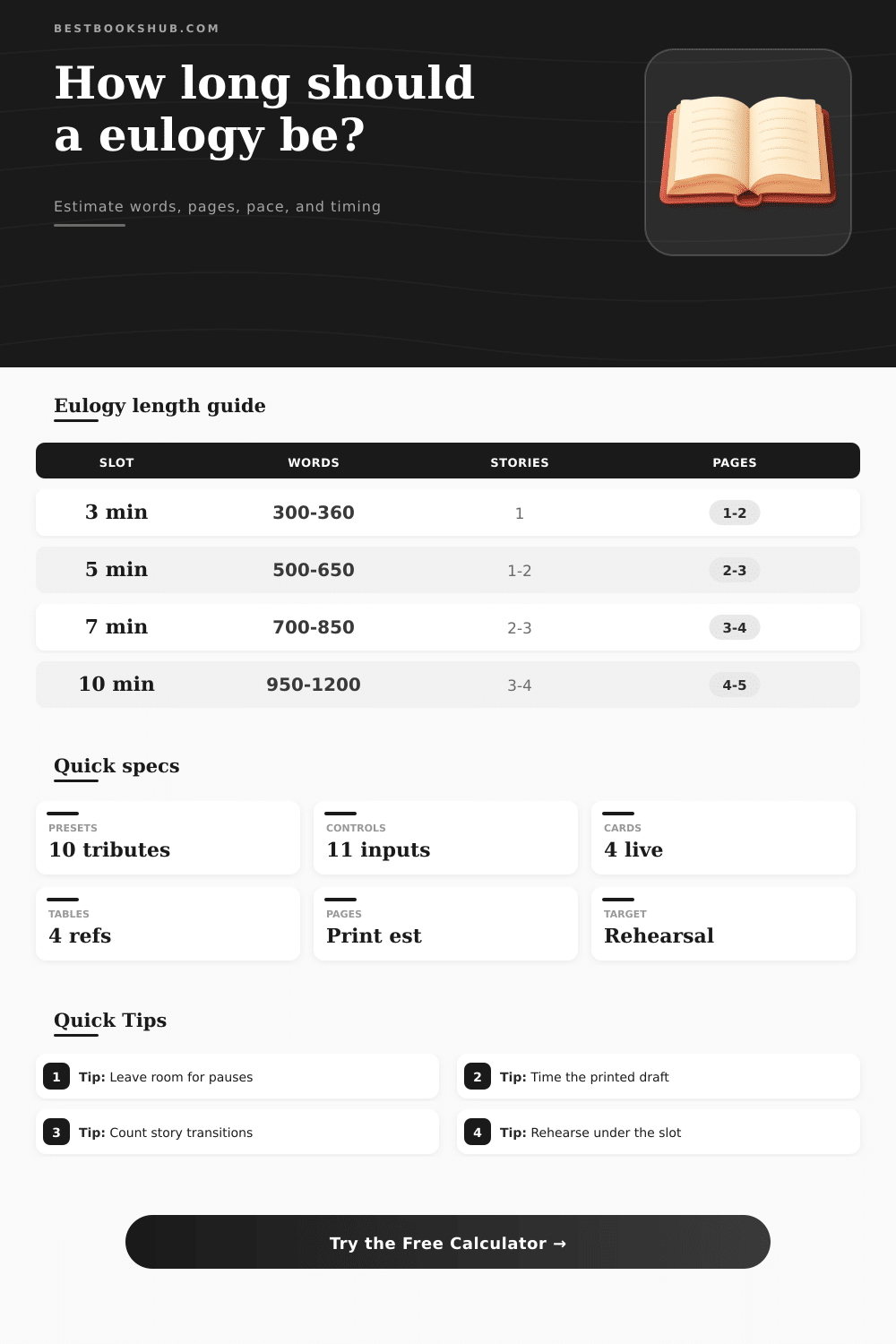
These bands are planning references. The live calculator above uses your exact word count, pace, pause buffer, story transitions, and service slot.
| Speaking pace | Words per minute | Timing effect | When to use it |
|---|---|---|---|
| Very measured | About 105 WPM | Longest delivery time for the same draft. | Use for careful reading, strong emotion, or large rooms. |
| Gentle | About 115 WPM | Practical middle pace for a memorial reading. | Use when the speaker wants calm pacing without rushing. |
| Steady | About 125 WPM | Shorter delivery while still controlled. | Use when the speaker is comfortable reading aloud. |
| Conversational | About 135 WPM | Fits more words into the same slot. | Use only if rehearsal confirms the pace still feels clear. |
| Service slot | Practical target words | Story count | Printed pages at 220 WPP |
|---|---|---|---|
| 3 minutes | 300 to 360 words | One compact story or memory | About 1.4 to 1.7 pages |
| 5 minutes | 500 to 650 words | One to two brief stories | About 2.3 to 3.0 pages |
| 7 minutes | 700 to 850 words | Two to three focused stories | About 3.2 to 3.9 pages |
| 10 minutes | 950 to 1200 words | Three to four carefully timed stories | About 4.3 to 5.5 pages |
| Pause buffer | What it adds | Effect on target words | Calculation use |
|---|---|---|---|
| 0 to 10 percent | Minimal silence between lines. | Highest word target. | Use only after a calm timed rehearsal. |
| 15 to 20 percent | Natural pauses and small resets. | Moderately lowers the word target. | Good default for most drafted eulogies. |
| 25 to 35 percent | More room around personal moments. | Noticeably lowers the word target. | Use when the speaker wants more margin. |
| 40 percent or more | Large delivery cushion. | Shorter draft recommended. | Use when timing must stay safely under the slot. |
| Printed format | Words per page | Page estimate | Practical use |
|---|---|---|---|
| Large print notes | About 180 WPP | More pages to hold. | Use for bigger type, wider spacing, or lectern reading. |
| Readable notes | About 220 WPP | Balanced printed length. | Good default for marked pauses and paragraph breaks. |
| Double-spaced standard | About 250 WPP | Slightly fewer pages. | Works when the speaker tracks lines comfortably. |
| Compact notes | About 300 WPP | Fewest pages. | Use for backup copies, not hard-to-read podium text. |
How long should a eulogy be? How many words does that require? What about pausing for breath? Or telling a story? Or how long will I actualy take to say all those words? You learn (usually the hard way) that standing up there with papers in hand, without time, grief expands time in weird ways. Four even minutes on the page may turn out to be six (or more!) after your voice shake and the silence settles over you and everyone else in the room.
This is precisely why the issue of length arise. If a eulogy is too short, it leaves an awkward gap. Too long, and it throws off the whole service. There’s a sweet spot, sure… and it needs more than guessing to find it.
Why Eulogy Length Is Important
Second: speed of speech are variable. When you’re showing emotion, you automaticly speak more slowly. You want to build up to the punch line when telling one of Dad’s awful jokes. You also pause slightly between stories so people can catch their breath during the transition.
None of these pauses is dead air. They’re the space where people make contact, and those moments are what you should of plan for. Don’t think of a pause as something that just happened. Think of it as time you’ve allotted. The same goes for transitions among memories: each change of subject deserve mental breathing room for speaker and listener alike. If you don’t allow for this time, even an otherwise reasonable word count will be too much to deliver.
One thing that’s different than what many people think is that service slots don’t follow a strict timetable. Some are military-tight, while others bend generously. When it comes to rehearsal goals, this can be a good area to adjust. If your slot is five minutes, for example, you may find when the celebrant says their piece that in reality, you only has about four.
Rehearse to an end goal of 95% of your allocated time: that way if waves of genuine emotion rise unexpectedly, you’ll still have some breathing space. It’s such a simple tweak but one which stops so many writer falling into the trap of crafting something exactly right…only to find it no longer fits.
But then there’s the printed version, and printed versions has their own tale to tell: What seemed reasonable-looking on the laptop screen becomes unwieldy in real life, held by people with somewhat trembling hands, standing beneath the lights. Making the type bigger helps; it also empties out a book rapidly, and makes it harder to find your place again when you look up at the grieving throng. That practical thought doesn’t occur to you till time comes.
There’s also the human element: the finest eulogies strikes a balance between structure and room for being real. Too much, and it feels like a check list; too little and it sounds sparse. How to choose which stories to share? Choose stories that show who your grandmother was without listing everything she did or achieved. One good story about how she bargained with the neighborhood squirrels might tell you more then an entire resume of her professional life.
People tend to compose as if they’re going to deliver their piece at the pace of a podcast and not with the gravity of the moment in mind, which is why predictable common errors emerge. On the other hand, some people over-rehearse every word and ruin any emotional connection. This means you must write deeply and edit strictly, but leave the most emotional parts alone. Read it out loud early and often; see when your own throat constricts. That’s when it’ll want a bit longer.
Because at its core, a eulogy isn’t a timepiece of a TED talk: It’s your last public offering to someone who will never get the chance to hear you again. Respecting that person, and the community that has come together, is shown by getting the length correct. If the words are placed into the right-sized box, there’s something that clicks, allowing those stories to breathe and the silence to say what it needs to say.
For a few short moments, the gap between them… Living and dead, narrows just a bit.