📅 Reading schedule tool
Estimated finish date calculator
Forecast when a book, manuscript, chapter plan, or study packet will be complete using real progress, pace, skipped days, sessions, buffer, and weekday availability.
| Material type | Typical pace | Good buffer | Planning note |
|---|---|---|---|
| Light novel | 25-45 pages/hour | 5-10% | Fastest when chapters are short |
| Literary classic | 15-30 pages/hour | 10-15% | Allow rereading and notes |
| Textbook | 8-20 pages/hour | 15-25% | Exercises and diagrams slow pace |
| Draft review | 2k-5k words/session | 10-20% | Comments add review drag |
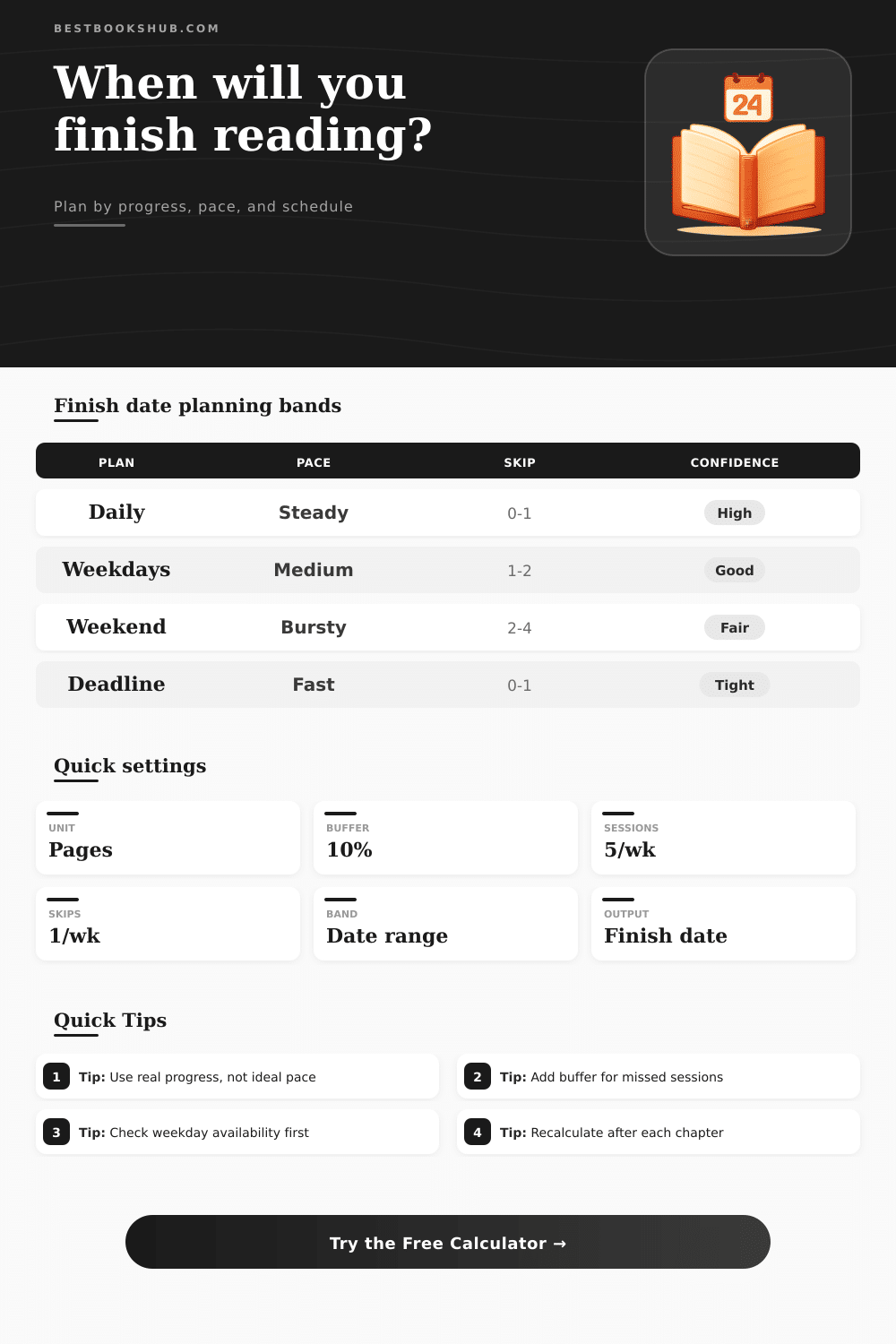
| Schedule shape | Active days | Skipped days | Confidence cue |
|---|---|---|---|
| Daily habit | 6-7/week | 0-1/week | Usually high confidence |
| Weeknight plan | 4-5/week | 1-2/week | Good for steady readers |
| Weekend plan | 1-2/week | 2-4/week | Band should be wider |
| Deadline sprint | 5-7/week | 0-1/week | Fast but fragile |
| Buffer choice | Use for | Effect | Risk covered |
|---|---|---|---|
| 0% | Short, easy book | Fastest date | No interruption margin |
| 5% | Light reading | Small cushion | One short missed session |
| 10-15% | Normal plans | Balanced date | Minor delays and rereads |
| 20-25% | Dense study | Safest date | Notes, breaks, hard chapters |
| Preset scenario | Unit | Schedule | Best comparison |
|---|---|---|---|
| Novel weeknights | Pages | Mon-Fri | Balanced fiction pace |
| Audiobook commute | Chapters | Weekdays | Session-limited progress |
| Research packet | Words | Tue-Thu | Dense annotation load |
| Deadline sprint | Pages | Daily | Fast finish with narrow misses |
DISCLOSURE: This post may contain affiliate links, meaning when you click the links and make a purchase, I receive a commission. As an Amazon Associate I earn from qualifying purchases.
Enter your plan (sessions per day, buffer, etc.) into this estimated finish date calculator to predict when you’ll be done based off pace, progress, weekdays, skipped days, and more. Recalculate whenever your plan shifts.
When we’re starting a new book or working on revising our own manuscript, we intend to finish it, only for life to get in the way. You hit a tough chapter, your work day drags long, you need a brain break and suddenly the finish line recedes farther from reach. It’s frustrating: few things frustrate us more then realizing that our reading plans don’t map onto real life. But if you can take your actual habits and translate them into math without pretending you are some kind of machine, that is the difference between the wishful thinking of “I want to finish this by __” and the real question, “when will I finish?
How to Use the Finish Date Calculator
Second, take your schedule just as seriously as content itself. People obsess over their daily pace but they forget that they don’t really have a certain number of days. Are you reading during weekday hours only? That halves your calendar week. Throw in an errand or an extra tired evening and your effective reading time gets chopped down even more. When you mark which days are available (and what you expect to skip), the calculator will handle all those changes for you. It’ll force you to plan based off an idealized version of yourself rather than an idealized version of yourself.
What also makes all the difference is how big your buffer percentage is. A 10% buffer might not sound like a lot, but it can add an entire week to your completion timeline on a lengthy book. It represents the nights when focus just doesn’t click into place, the chapters that require rereading, the last-minute social engagements that eat up your reading time. The correct buffer isn’t pessimistic; it’s protective of your flow. Too-small and even the tiniest bump feels like a setback. Too-big, and the deadline seems far enough away that you lose motivation.
This one is about your consistency setting. Most people don’t realize how much this matter. You get a tighter confidence band if you’re a steady reader who reads at the same speed every time you open a book. But you need wide margins if you are someone who alternates between long periods of intense work and long periods of quiet reflection (your output level fluctuates). That’s why the tool converts your human inconsistency into an early-to-late range: it prevents you from clinging to any one finish date as sacred. Seeing the spread lets you set expectations for yourself, your book club, or your deadline. But it stays grounded in real progress tracking.
You don’t have to plan as if you’re at the starting line. That is a common pitfall. Instead, enter how many chapters or pages you’ve actualy read or completed. This makes all the difference between measuring reality and guessing optimistically. Your estimated finish date can move weeks based off this. So update these numbers with each significant section to maintain an accurate picture rather than allowing early assumptions to build up.
There’s no calculator for everything. Some books require more thinking then others. Best-laid plans gets derailed by unexpected family emergencies and last-minute work deadlines. That said, a livivng estimate is better than shooting from the hip. Vague hope becomes an adaptable roadmap that guides us toward our goal while allowing room to shift direction. But that’s where the value is.
Run it several times. Make a weekend only preset and compare it with a weekday evening preset. You’ll see the finish date shift back and forth. Then add some extra time. Speed things up. See what really impacts the result. What makes the biggest difference? That’s when those experiments shows you what routines give the biggest returns.
You can’t write or finish anything meaningful if you don’t know yourself first. Knowing what you’re capable of requires patience and time. You must know how far you can push before you hit the wall. You must know where that line in the sand is, so you can respect it, nurture it and let it become stronger.
The key is knowing when you will actualy finish reading or writing, not just guessing at it. Guessing doesn’t make the work go away; it only takes away the fantasy that you’re working without a clock. You should of known this. Knowing approximately when that final sentence will land allows each writing session to be seen as part of a bigger picture. Not a lonely goal unto itself. That’s when the final chapter becomes much easier to recieve.