📚 Reading schedule lab
Chapters Per Week Calculator
Plan how many chapters to read each week from your total chapters, current chapter, weeks available, uneven chapter length, catch-up days, reading days, session capacity, and pacing style.
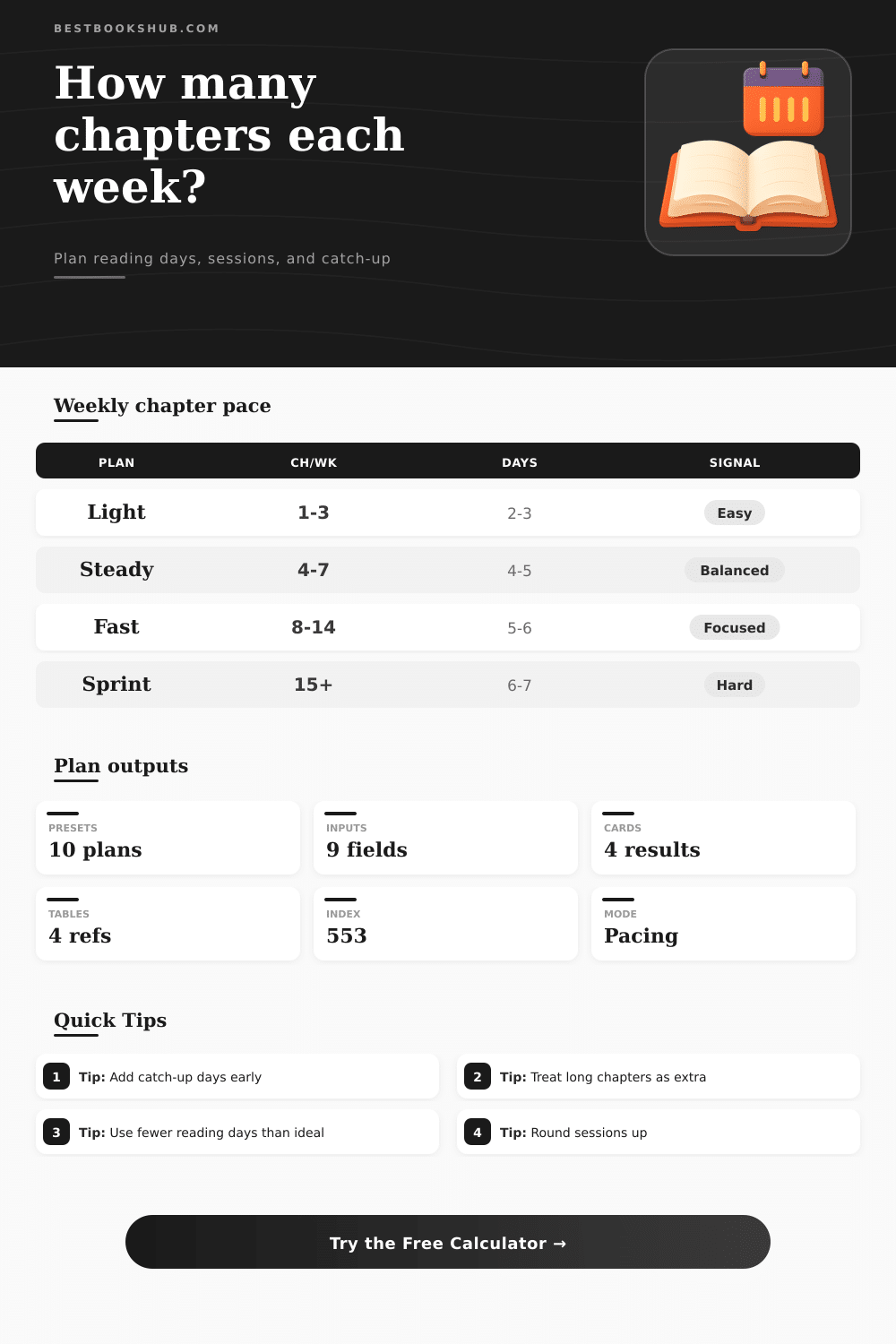
Use these references to sanity-check the calculator output against common reading loads, uneven chapters, catch-up reserves, and session planning.
| Weekly chapter load | Typical use | Reading days | Session pattern | Planning signal |
|---|---|---|---|---|
| 1-3 chapters/week | Dense nonfiction, study notes, shared read | 2-3 days | Short sessions with review | Low pressure if chapters are long |
| 4-7 chapters/week | Book club novel, school reading, balanced plan | 4-5 days | One chapter most days | Steady and easy to recover |
| 8-14 chapters/week | Series catch-up, light fiction, manga volumes | 5-6 days | One to three chapters per session | Needs protected reading windows |
| 15+ chapters/week | Readathon, short chapters, deadline sprint | 6-7 days | Multiple sessions or long blocks | High risk without catch-up days |
| Uneven length factor | Use when chapters are | What it does | Best paired with |
|---|---|---|---|
| 1.00x | Similar in length and difficulty | Uses raw remaining chapter count | Steady pacing |
| 1.08x | Mostly even with a few long chapters | Adds light slack to weekly pace | Book club and novels |
| 1.18x | Mixed short scenes and longer sections | Raises workload for planning safety | Fantasy and nonfiction |
| 1.32x | Highly uneven or note-heavy | Builds extra room for hard chapters | Research reading |
| 1.50x | Textbook-like, problem-heavy, dense | Treats each chapter as much heavier | Study and exam plans |
| Reading days/week | Calendar style | Catch-up reserve | Works well for | Watch out for |
|---|---|---|---|---|
| 2 days | Weekend or block reading | 1-2 days per month | Short books, busy weeks | Missed blocks are hard to replace |
| 3 days | Light weekday rhythm | 2-3 days per month | Book club and casual plans | One lost day shifts a lot of work |
| 5 days | Most weekdays | 3-5 days per plan | School, study, and steady fiction | Burnout if every day is packed |
| 7 days | Daily habit | Still reserve 1 rest day | Deadlines and readathons | No margin unless sessions are small |
| Catch-up days | Plan length | Good reserve | How to use them | Calculator effect |
|---|---|---|---|---|
| 0-1 days | 1-2 weeks | Only for very short plans | Use after a missed session | Lowest weekly target, least margin |
| 2-4 days | 3-6 weeks | Enough for a missed weeknight | Keep them unassigned | Raises normal pace slightly |
| 5-8 days | 7-12 weeks | Healthy long-plan buffer | Place near busy weeks | Creates realistic pressure |
| 9+ days | Semester or long project | Useful for exams or travel | Audit progress every month | Requires earlier weekly work |
DISCLOSURE: This post may contain affiliate links, meaning when you click the links and make a purchase, I receive a commission. As an Amazon Associate I earn from qualifying purchases.
Decide how many chapters to read per week by planning your week, uneven chapter length, session load, catch up reserve, reading days and remaining chapters. The weeks seem shorter then yesterday; a dense textbook sits before you or a thick novel. Quiet panic seeps in, how much should I read each week? The number of unread pages stares back at you, and you want to finish on time without burning out or falling behind.
People rarely take the time to calculate this right; that one question fuels most reading plans. You guess, life interferes, and then you scramble. A good plan starts by treating the remaining chapters as a workload spread across real days, real energy levels, and real interruptions. How honestaly you count what’s left makes all the difference between a frantic approach and a relaxed one.
How to Plan Your Weekly Reading
Subtracting the ones you’ve already read makes the number look smaller, but it seldom tells the whole story: Some chapters fly past in twenty minutes, others require an hour and a half plus discussion prep or note-taking. That is why it is important to adjust for uneven chapter length. Adding a small multiplier to those deeper, denser ones provides breathing room before the plan even starts. A little buffer on the weeks that your focus fades guarantees you have a schedule that survives real life rather than collapses beneath it.
The trick to catching up is to treat these days like insurance: you’re reserving them for the inevitable lost session or two that life is going to take away. If you have a bad week, it won’t derail everything else that comes after, since you set aside some catch-up day earlier in the timeline. You use them if you need to, but they stay in the background, never taking the place of your normal weekly target. That’s what makes it feel less punishing.
Everything else falls out from the number of days a week you choose to read. When you commit to five solid workdays, they feels like a lot. But when you find half of those dissapears into meetings or exhaustion, switching to fewer but more guarded days can yield faster total results due to the compounding effect of consistency.
That’s where the calculator comes in: feed it your constraints and it will show you what happens when your daily target meets session capacity against the load. There’s also pacing style, which most of us overlook till we feel the burnout. If you’re doing a book club, a nice steady pace lets everyone keep up (and you have an easier landing at exam-time/travel-time if you front-load it). If you have a busy weekend schedule, you might prefer others who are busy during the week instead; the number of chapters stays the same, but the workload shifts to match your life. Knowing what pace works with your real-life calendar will help avoid slow-dread that results from misaligning your plan.
The pitfalls are plentiful. Treating all chapters equally seems reasonable enough, until the writing for chapter three goes twice as fast as chapter seventeen; then that schedule falls out of the window. You want to be conservative by rounding sessions up, but it saves you if one session simply isn’t cooperating. It’s tempting to begin counting from page one, which creates false guilt (you’ve got more pages to go!) and inflates the goal.
And here’s where it gets good: You see what it will take to get there, without committing yet. If you plan for 80% of what you realistically have available, you leave margin for livig, and if you plan for 110%, then when you come up short (as you always do), it’ll be disappointing. But if you are realistic about the actualy load, small changes like switching styles or catching up one more time can turn a scary goal into one you can reach.
After all, the chapters don’t give a shit about your schedule; your reading schedule only works if it respects the reader and the book. Create a schedule that honestly accounts for what’s in front of you and what you have available in terms of energy and time. Watch as the weeks flow by with momentum rather than panic, reaching that last page at the moment you intended to.