Book club planner
Book Club Deadline Pace Calculator
Turn your meeting date, remaining pages, chapters, reading days, prep time, and missed-day buffer into a practical daily pace with weekly checkpoints.
Choose a scenario to load realistic book club timing, then adjust any field for your exact book and meeting schedule.
| Milestone | Target date | Pages completed | Chapters completed | Checkpoint |
|---|
| Band | Daily pages | Typical fit | What to watch |
|---|---|---|---|
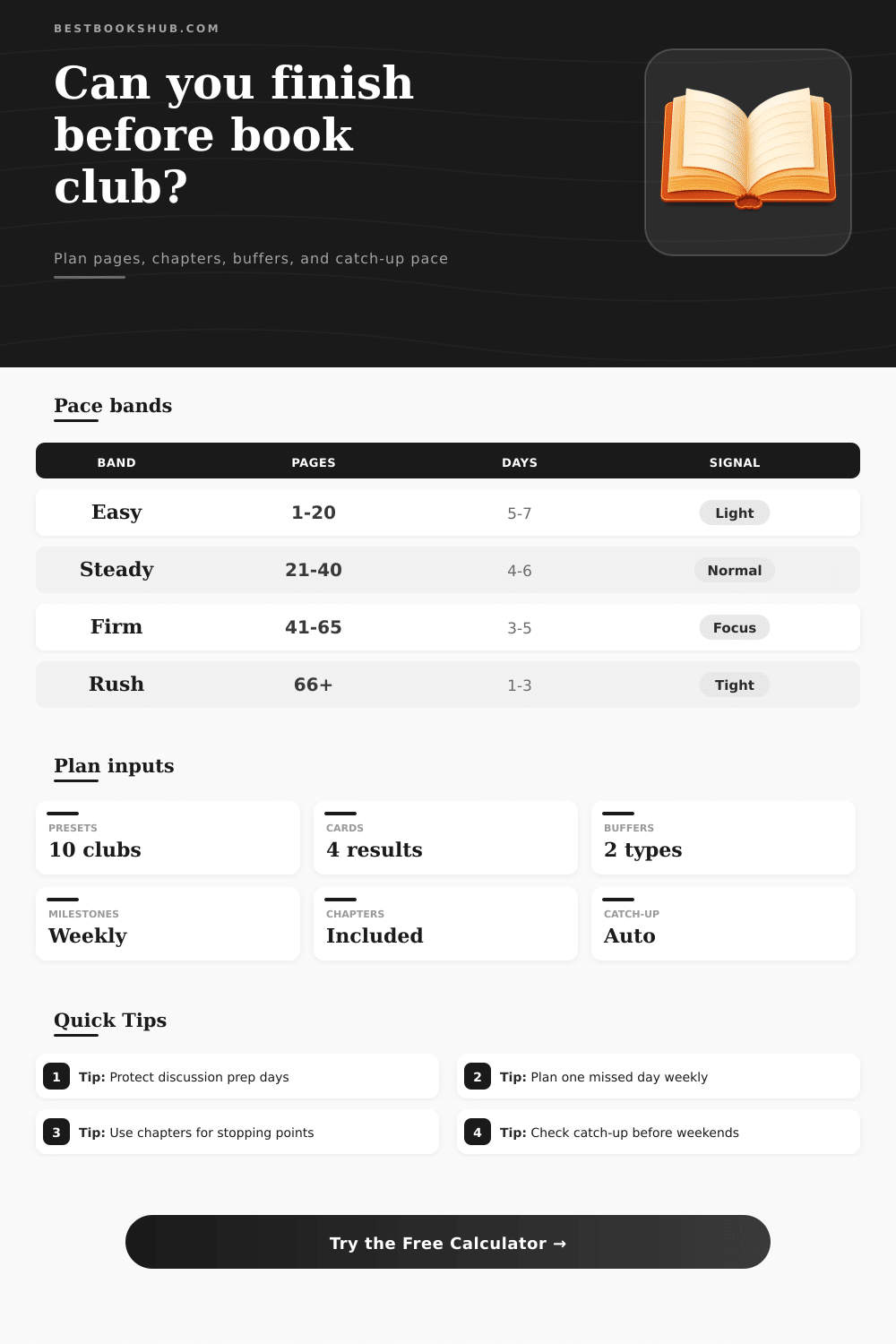
| Easy | 1-20 pages | Casual monthly club | Do not spend the buffer too early. |
| Steady | 21-40 pages | Most novels and memoirs | Keep chapters aligned with stopping points. |
| Firm | 41-65 pages | Late start or longer book | Use fixed sessions instead of vague goals. |
| Rush | 66+ pages | Deadline pressure | Reduce prep buffer only if discussion notes are simple. |
| Schedule style | Reading days/week | Suggested missed buffer | Best for |
|---|---|---|---|
| Daily light reading | 6-7 days | 1-2 days | Readers who like small, steady sessions. |
| Weekday plan | 5 days | 2-4 days | Readers protecting weekends or commute time. |
| Focused blocks | 3-4 days | 3-5 days | Longer sessions with more recovery space. |
| Weekend only | 1-2 days | 4-7 days | Readers who need bigger catch-up cushions. |
| Prep buffer | Use when | Includes | Tradeoff |
|---|---|---|---|
| 0 days | Informal chat | Reading up to meeting day | Little time to collect ideas. |
| 1 day | Light notes | Quotes, tabs, quick reactions | Works best for shorter books. |
| 2-3 days | Standard club | Questions, themes, recap | Slightly raises daily pace. |
| 5 days | Hosting or leading | Prompts, passages, summaries | Requires earlier finish target. |
DISCLOSURE: This post may contain affiliate links, meaning when you click the links and make a purchase, I receive a commission. As an Amazon Associate I earn from qualifying purchases.
You have a book club meeting scheduled, and every time you glance at that pile of unturned pages, you’re convinced you won’t read them all. Here’s the issue: There’s a pace calculator for deadlines. This thing use realistic variables like how many days are left until your meeting, how many pages is left, how many days you can actualy set aside to read, and how much buffer time you want. It then develops an achievable reading strategy.
Buffers are hugely undervalued by most of us. A few extra days is needed to reread chapters, mark passages, write down questions, etc., before your book club meeting, without panicking. Traveling, work deadlines, getting sick, life can steal days you don’t expect. The closer you get to test day, the smaller your safe reading window become. So your daily target needs to be realistic. The calculator factors in this reality, which is why twenty-five pages a day is more steady then thirty-five (add two days as a buffer, plus another two days as a cushion).
How to Use a Reading Pace Calculator
It is more important to consider how fast you read. Most people underestimates their reading speed. You might crawl along at twenty pages an hour with a dense novel, but you could fly through a thriller at forty-five. You tell it what your realistic speed is for this particular book, and it tells you whether you have enough time to reach your goal. It’s one thing to schedule an hour without knowing if you’ll actualy have an hour; it’s another thing to know you’ve got just twenty-five minutes on the train.
Page count is occasionaly an imperfect guide to where you are in a book, but chapters naturaly serve as stop points. Halting in middle of a chapter is awkward and undermines momentum. By using both measures, you can focus on finishing complete chapters during some sessions yet still track your cumulative progress. This synchronizes plan with reality. These are the milestones.
Milestones make abstract deadline concrete. When you see “At the end of week two, you should be at page 180,” it’s easier to grasp what your work looks like. It also allow you to see if you’re off-track. You get to course-correct before it gets difficult to catch up. When you’ve missed a few days, suddenly the next day’s required amount can skyrocket. The tool let you know just how much. This helps avoid getting surprised on a Sunday night.
The usual advice is don’t show up empty handed. Finish line first, and that includes finishing the prep buffer. It’s not optional; it’s a necessity. And if you skim here, you’ll have stories, but scattered thinking. Show up with some real questions and you’re going to have one helluva discussion.
This is also true with the pace band you select. There are some months when 15 pages seems like a comfortablely pace. At other times, it feel like you need more of a nudge in the ribs. Use reference bands as a guide to know what each asks. Select a band based off your time and how much pressure you are willing to bear.
And finally, the calculator doesn’t actualy do your reading for you. But it does take away some of the guesswork that leads to last-minute cramming or quiet guilt when you arrive unprepared. After you’ve done the math, then comes the fun: sinking into the book confident that you’re going to make it all the way through in time to enjoy the party, not rush towards it. Maybe that should of been the best thing of all.