📖 Three word phrase analysis
Trigram frequency counter
Count unique three-word phrases, compare overlap rules, handle stopwords, and measure repeated phrase density per 1,000 words.
This tool is fixed at n=3. It counts three-word phrases only, so it stays focused on phrase cadence instead of duplicating a bigram finder.
DISCLOSURE: This post may contain affiliate links, meaning when you click the links and make a purchase, I receive a commission. As an Amazon Associate I earn from qualifying purchases.
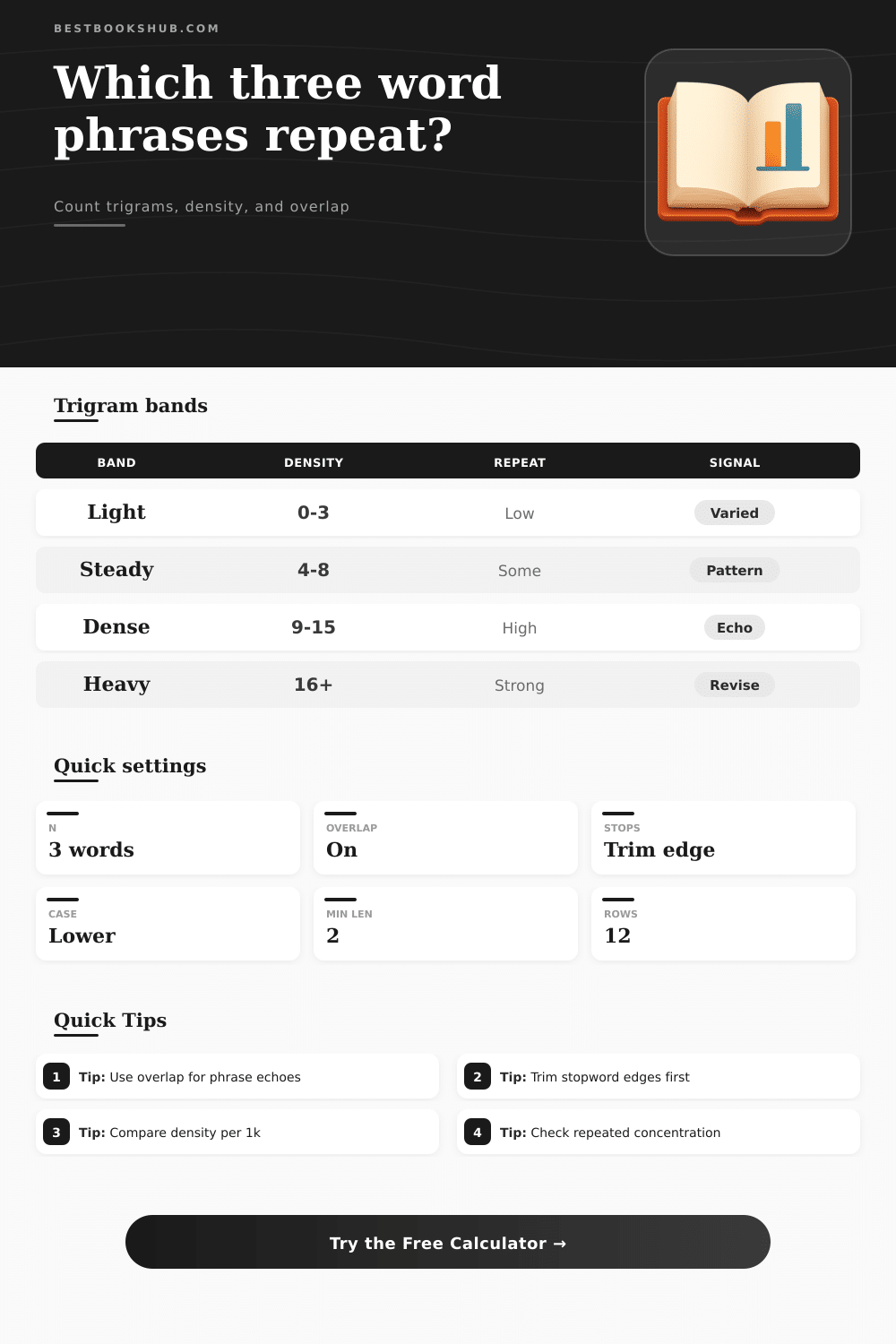
Top trigrams are calculated from the current text. Reference tables below explain density, stopword, and overlap settings.
| Rank | Three-word phrase | Count | Density / 1k | First seen | Signal |
|---|---|---|---|---|---|
| Load a preset or paste text to see top trigrams. | |||||
| Repeated phrase | Uses | Share | Extra repeats | Review note |
|---|---|---|---|---|
| Repeated trigrams will appear here. | ||||
| Density band | Repeated uses / 1k | Concentration | Editorial read |
|---|---|---|---|
| Light | 0-3 | 0-4% | Varied phrasing |
| Steady | 4-8 | 5-9% | Noticeable pattern |
| Dense | 9-15 | 10-17% | Phrase echo risk |
| Heavy | 16+ | 18%+ | Strong repetition |
| Stopword option | What changes | Best use | Caution |
|---|---|---|---|
| Keep stopwords | Counts raw phrasing | Style and rhythm | More filler phrases |
| Remove before count | Builds content trigrams | Topic signal | Syntax is compressed |
| Drop edge stops | Trims weak starts | Balanced review | Middle stops remain |
| Drop any stop | Strict content only | Keyword audit | May hide real echoes |
For example, plug in your study text, review, or chapter you’re editing and then run it through this trigram frequency counter. This will show you the most frequent three-word combination so you can see what is concentrated and what might need revision. It will also tell you how dense phrases are compared to each other and if there is any overlap in your choice of words.
You have just finished a draft and something feels off. You wrote a draft and it doesn’t feel right. The words seem okay on paper, but there’s some sort of weird echo on the page which usually shows up as these three word chunks repeated more frequent than you notice when reading normally. When you find trigrams, they help bring out the underlying rhythm of your work. Once it’s there in plain sight, you know exactly how to write tighter: You’ll be able to see clearly where your words loop around on themself. But knowing what those recurring groups say can be powerful.
How to Fix Repetitive Words in Your Writing
Twice in one paragraph? It could be deliberate: the writer has emphasized something. Five times? That’s beginning to sound like a crutch; repetition doesn’t have as much punch now. Writers of instructional materials and narrative nonfiction face this problem all the time. Phrases like “evidence in the passage” and “track the central” start creeping on the page because they’re efficient. Efficient up to the point where you realize your reader is becoming numb to them, so keep an ear out for these small repetition.
Settings for overlap do more than most people would guess. Count from left to right, moving forward one word at a time. If you let your calculator find the number of distinct three-word windows, you get subtle echoes that lie just beside each other. On the other hand if you step over each word and only check the ones on either side, you treat the text as separate blocks. Both approaches are valid. The first way is good for catching the kind of echoes that reward paying attention to rhythm. The second way is better for catalog entries or transcriptions of spoken words where you are looking for a clearer separation. It’s a question of hunting redundancy versus hunting music.
The other silent lever is how to handle stopwords. Stopwords are those boring common words that hold a sentence together (“the”, “and”, “that”), but also dilute topic signals by adding meaningless noise within each count. Removing them before generating trigrams shifts the focus to phrase-level content. In contrast, keeping only stop-words at the edges retains a more natural flow since people naturaly start and end sentences with words like “the,” while still getting rid of weak beginnings and ends. Remember, though: each decision involves a little bit of noise in exchange for a little bit of clarity. The trick is just remembering there’s a trade-off in the first place.
You can compare a twenty-page chapter to a two-page scene on an even playing field; density readings scaled per thousand words. If your writing stays out of the heavy band, there’s a sense of variety in the phrasing that keeps reader alert. If it moves into the heavy band, the repetition is too strong to go unnoticed. You are probably relying on some favorite constructions without realizing it. That doesn’t mean all repetitions should dissapear. You may be echoing things deliberately. Some forms of spoken-word transcript or poetry lean into this sort of thing for effect. But at least then the decision is made consciously rather than accidentally.
Heavy concentration pretty much always pays off when revised, though. The errors crop early on. They drop a full manuscript onto the page; leave all defaults alone; get swamped when they see how much output there is. But when you start with just a single page or perhaps a single chapter, your eyes learn quicker and can more easily grasp results.
The second common mistake is thinking that what appears in paragraph two (and maybe again in paragraph thirty) is somehow different than what clumps at the end of the book. The tool measures the pressure; you provide the why. Context counts. This is particularly true for editors working with lesson plans and study guides. Repeating information is necessary to drive home points, but overdoing that repetition sound condescending: as though the reader shouldn’t of have to put in any more effort. It’s a fine line, and we’ve found that running the text through multiple stopword filters highlights the parts that pertain to the topic while showing what parts are written in the editor’s voice. In fact, that distinction alone can save hours of line editing.
The idea isn’t that we don’t repeat anything; in fact, if no two trigrams ever appeared together then language would be robotic sounding. Instead, it’s about making conscious repetitions and learning to stop guessing at what needs to go when you revise. The range goes from “this feels repetitive” to “here’s why these four trigrams make up eighteen percent of my phrase concentration.” Your edits gets focused. Next time a draft picks at your brain, run it through the analyzer. See how its best bits line up on top; see what connects and what needs to seek new friends. Even though nobody will know what a trigram is they’ll notice a smoother text that keeps their attention better.