📖 Text balance analyzer
Stopword percentage calculator
Measure how much of a passage is made of stopwords, compare built-in or custom stopword lists, find sentence-level density spikes, and rank the top stopwords.
Load a realistic passage, then change the stopword list, custom words, token rules, and target band to see how the balance shifts.
DISCLOSURE: This post may contain affiliate links, meaning when you click the links and make a purchase, I receive a commission. As an Amazon Associate I earn from qualifying purchases.
The dynamic tables separate whole-passage stopword share from sentence-level density so you can see whether the issue is global balance or local spikes.
| Rank | Stopword | Count | Share of stopwords | Share of all words | List source |
|---|---|---|---|---|---|
| Top stopwords will appear after analysis. | |||||
| Segment | Words | Stopwords | Stopword share | Band | Preview |
|---|---|---|---|---|---|
| Sentence-level density will appear after analysis. | |||||
| Band | Stopword share | Typical balance | Best read as |
|---|---|---|---|
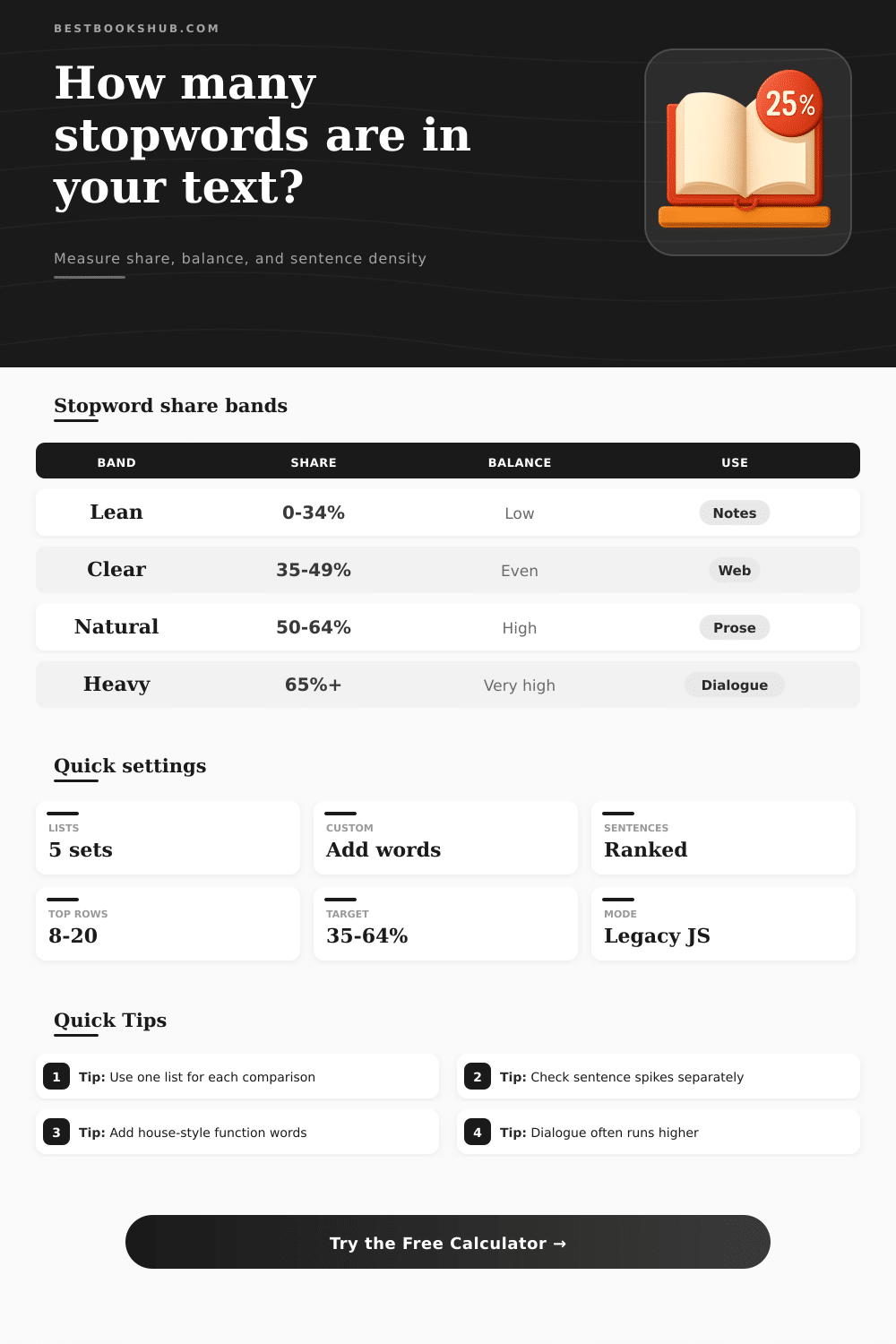
| Lean | 0-34% | Low function-word support | Notes, lists, metadata, compressed copy. |
| Clear | 35-49% | Balanced with direct phrasing | Web copy, summaries, instructions. |
| Natural | 50-64% | Flowing prose structure | Fiction, essays, reviews, discussion. |
| Heavy | 65%+ | Many small linking words | Dialogue, informal drafts, winding sentences. |
| List option | What it counts | Best use | Caution |
|---|---|---|---|
| Common English | Core function words | General drafts and quick checks. | May miss domain-specific filler. |
| Strict prose | Core plus extra helpers | Editing repeated connective language. | Can classify useful phrasing as stopwords. |
| Academic | Formal transition words | Abstracts, papers, study writing. | Compare only against academic passages. |
| Fiction | Dialogue and narrative helpers | Scenes, reviews, commentary. | Dialogue may naturally score high. |
| Web copy | CTA and instruction helpers | Pages, blurbs, microcopy. | Custom brand terms may be needed. |
This stopword percentage calculator measure the proportion of stopwords that appear in your text. It lets you see which function words is used most frequently, and you can check sentence level stopword density, too. Paste in your own text for accurate analysis.
Most people don’t pay much attention to stopwords. Words like ‘the’ and ‘and’ are articles, which is little helpers that keep sentences moving but don’t weigh them down. But they do shape both clarity and rhythm. They impact conversational vs. More formal writing as well. A choppiness can come from not enough stopwords. Too many stopwords creates an overly casual or padded feel. That balance is what distinguishes a web page from a meandering novel.
How to Use Stopword Calculators for Better Writing
It’s something writers pick up on intuitively, but don’t articulate. In conversation, we say “then” and “just,” and the dialogue feels right. But academic writing piles transitions on top of each other, and before long you’re reading a bunch of function words. Leave it to the calculator. Let it point out the trend so you don’t have to guess.
It shows you how one sentence spikes higher than any other. It shows how a single paragraph can be weighed down while whole piece reads just fine. Genres vary in their tolerance for loading up. Dialogue and fiction is often heavier, and so are speech patterns with repetition and fillers. Web copy is better off remaining leaner: Readers want to get through it fast. Academic writing falls somewhere in between, using precise linking terms that does not drown out the argument.
These categories of heavy, natural, clear, and lean reflect how readers actualy experience text. Lean passages read as stripped down or urgent, depending on context. Heavy ones may signal intimacy in narrative or sloppy drafting in an essay.
Custom lists make all the difference. In some areas of writing, such as house style, there is verbs or even nouns that may work for you but not on a general English list. By adding them to the mix, tool will reflect your real voice instead of a generic use of English. Token options also contribute. Maintaining their hyphen or apostrophe ensures that compound words and contractions don’t get split in odd ways. These little choices keep count close to how you see it with your own eyeballs on the screen.
And there you go: There’s your problem areas. A good number per sentence is just an average. It could mask some bloated sentences that kill reading experience. Finding those spikes early means no more painful rewrites later. The list of most common stopwords fine-tunes it even more. It’s possible to see “the” and “and” dominating which is normal. But when you see an unexplained spike of “however” or “really,” you’ll know you have a tic that needs to be edited.
As most writers find, a first draft tends to be too heavy (and then you figure it out and rewrite for tighter phrasing and better flow). On the flip side, writers in technical fields tend to remove so much help that they makes it difficult to follow. More than the precise amount, its about balance. It’s about control with awareness, not targets.
The best instance is dialogue. It’s rare for real speech to sound natural with fewer than 50% stop words. But this level in straight narrative can be repetitive. The ideal always shifts by context. Marketing copy struggles to keep it low (and persuasive). Simple book structures pushes it higher early on.
At the end of the day, though, the percent isn’t so much a grade as a diagnosis. A way to say: here’s where your language is exerting effort. Here’s where your language is coasting and where it’s working hard. From there, edits jump out at you. You notice the words they’re doing the heavy lifting for. They start to shape up your control of pace and tone. And this little bit of awareness is what separates writing that just works from writing that feels just right.