📖 Shannon distribution analyzer
Word entropy calculator
Measure how evenly words are distributed with Shannon entropy, normalized entropy, effective vocabulary, top-word dominance, stopword toggles, and paragraph-level entropy.
Load a realistic text sample, then adjust token rules and stopword handling to compare distribution shape rather than simple word frequency.
| Rank | Token | Count | Probability | Entropy contribution | Dominance |
|---|---|---|---|---|---|
| Run the calculator to see token probabilities. | |||||
| Paragraph | Tokens | Vocabulary | Entropy | Normalized | Top token |
|---|---|---|---|---|---|
| Paragraph entropy appears after calculation. | |||||
| Normalized entropy | Distribution shape | Top-word signal | Editing interpretation |
|---|---|---|---|
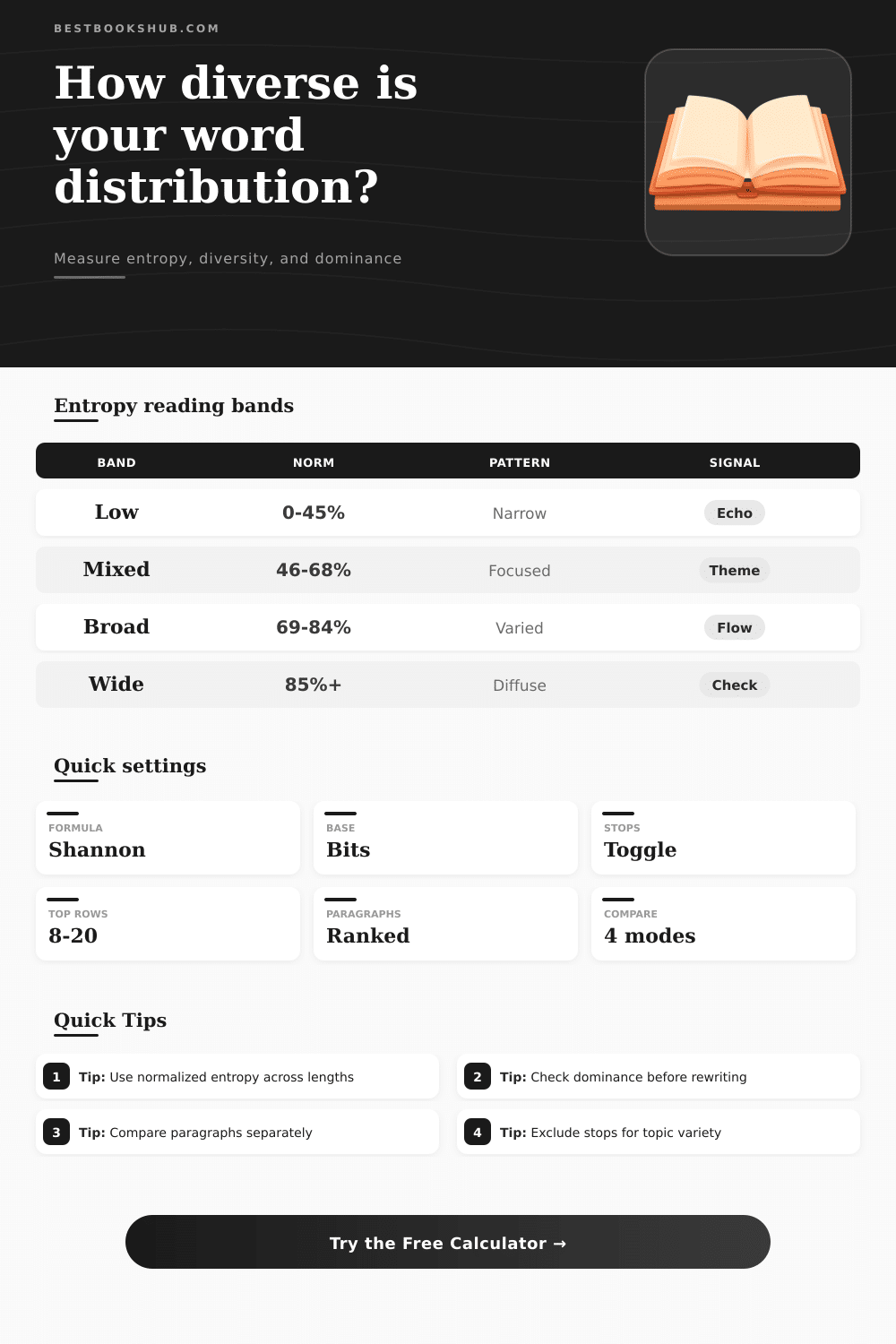
| 0-45% | Narrow and repetitive | One term dominates | Check for accidental echo or keyword stuffing. |
| 46-68% | Focused but varied | Theme words stand out | Often useful for notes, summaries, and tightly scoped copy. |
| 69-84% | Balanced distribution | No single extreme word | Common for polished prose with clear subject variety. |
| 85%+ | Very broad or diffuse | Flat distribution | Review if the passage feels unfocused or list-like. |
| Mode | What changes | Best for | Expected entropy effect |
|---|---|---|---|
| Include stopwords | Keeps function words | Flow and style balance | Often lowers dominance but may mask topic words. |
| Exclude common | Removes high-frequency helpers | Topic distribution | Often reveals stronger content-word dominance. |
| Exclude bookish | Removes text-analysis terms | Reviews and notes | Helps keep book, chapter, and reader from skewing results. |
| Custom or combined | Uses your house list | Project-specific comparisons | Best when comparing drafts with repeated required terms. |
DISCLOSURE: This post may contain affiliate links, meaning when you click the links and make a purchase, I receive a commission. As an Amazon Associate I earn from qualifying purchases.
Before you edit, paste some text into this word entropy calculator to see a chart of paragraph-level distribution patterns, stopword effects, effective vocabulary, top-word dominance, normalized diversity, and Shannon entropy. These gives you an idea of how your text is structured. Track them over time.
Even though the name might sound technical, everything you write has word entropy: when you’re drafting something, every word you type establishes a pattern of surprise and repetition. Too much repetition makes things feel flat; too much variety make things feel scattered. Word entropy will help you strike this balance.
How Word Entropy Helps You Write Better
Based off information theory, entropy is a way to measure uncertainty using Shannon entropy. In other words, it tell you how predictable the next word is likely to be. If sentences repeat the same words over and over again, the reader can predict what’s coming up, keeping the score low. When vocabulary are spread out fairly evenly over multiple words, there’s more surprise with each new token (driving the score upwards). After deciding whether or not you want to filter common function words and determining your token rules, the calculator do all the math for you.
Comparing parts of the same document makes the tool work its magic. Sentences with fewer long word and higher pronoun counts tend to be more dialogic, this decreases entropy intentionally. Research summaries usually aim for a tighter focus on terms related to methods or results. Neither way are inherently right or wrong. The key question is: do the patterns match what I intended?
Dominance by a few top words might indicate deliberate theme setting, or it could expose an unconscious echoing of themes in what you write. Toggle stopwords on/off to observe how much of the pattern is driven by content vs. These are glue words.
One of the most helpful things about normalized entropy is it solves the problem that the raw Shannon score increases with vocabulary. It’s not fair to compare the bit score of a long chapter with that of a short paragraph. When you divide the score by the theoretical max for the given vocabulary, you gets a percentage scale that can apply to texts of varying length.
You’ll find that fiction tends to fall right in the middle of the balanced spread, just where we’d expect it to. Early-reader books is lower, as expected. The bands on the chart turn those percentages into clear categories: narrow and repetitive, focused but still varied, balanced, or very broad.
Few writers realize how much stopword treatment shifts outcomes. If you leave all those “ands” and “the’s” in, your scores of domination declines; function words wash away nouny prominence, letting the thematic skeleton emerge. That’s valuable too. It shows topical focus, while the other view show stylistic rhythm. You can toggle between these perspectives for a new look at the same bits.
Then there’s paragraph level entropy. You might find that the beginning of a piece is beautifully varied and the middle turn to dull summarizing prose. Seeing that break coming in time allows you to change course before it occurs for the reader.
Good vocabulary gives a gut feeling about how rich a passage is; this is basicly a count of how many different words could be used to create the same amount of information. This is not a substitute for taste. Gentle repetition are a benefit to a child’s book; precise language serves law (which can appear constricted on paper).
The calculator isn’t meant to eliminate revision; it takes out the guesswork so you no longer revise in the dark. It makes a linguistic quality that you couldn’t of seen before real: a thing you can measure, compare, and deliberately mold. This isn’t to say writing isn’t an art; it just gives you a quiet ruler in your hand against which your drafts no longer sound as if they’re repeating themselves by accident. They’ll begin to sound as though all their echoes was chosen.